Trump Administration to Impose “Flood” of New Sanctions Against Iran Until January 2021
An analysis by Axios and Israel’s Channel 12 television reported Sunday evening, November 8, that the Donald Trump administration, with ten weeks remaining until the inauguration of Joe Biden as the newly elected U.S. President, is imposing a “flood” of new sanctions against Iran.
According to these reports, a “wave of severe and new sanctions” has been coordinated as a result of U.S. cooperation with Israel and several Persian Gulf states.
The two media outlets reported that in this context, Elliot Abrams, the U.S. Special Representative for Iran and Venezuela, who has traveled to Israel, met on Sunday with Prime Minister Benjamin Netanyahu and Meir Ben-Shabbat, Israel’s National Security Advisor, in Jerusalem and held final consultations with them regarding these new sanctions against Iran.
Mr. Abrams will also have separate meetings on Monday, November 9, with Defense Minister Benny Gantz and Foreign Minister Gabi Ashkenazi of Israel and will discuss this matter with them.
Elliot Abrams declined to respond to questions from Axios and Israel’s Channel 12 television, and the Israeli government has not issued an official statement regarding the meeting between the prime minister and national security advisor with Mr. Abrams.
The U.S. State Department had previously reported that Elliot Abrams will be on a regional tour in the Middle East from November 17 to 22, but details about the objectives of his trip have not been released.
Barak Ravid, an Israeli Axios reporter, citing “two Israeli sources,” reported that Mr. Abrams said in a classified briefing that the Trump administration will successively impose new sanctions against Iran until January 20, which is the inauguration day of the new U.S. President.
These sources said that the Trump administration and Israel want to make the path more difficult for Mr. Biden’s government to return to the JCPOA, the nuclear agreement between world powers and Iran, but the new sanctions have been designed in such a way that even if the next U.S. administration returns to the JCPOA, they would not be reversible.
These sanctions relate to Iran’s missile program, “Iran’s support for terrorist organizations,” and “human rights violations.”
According to these reports, the Donald Trump administration, in recent weeks, “with the encouragement and assistance of part of Israel’s diplomatic and security apparatus, has prepared a list of Iranian individuals as ‘target banks’ for these sanctions.”
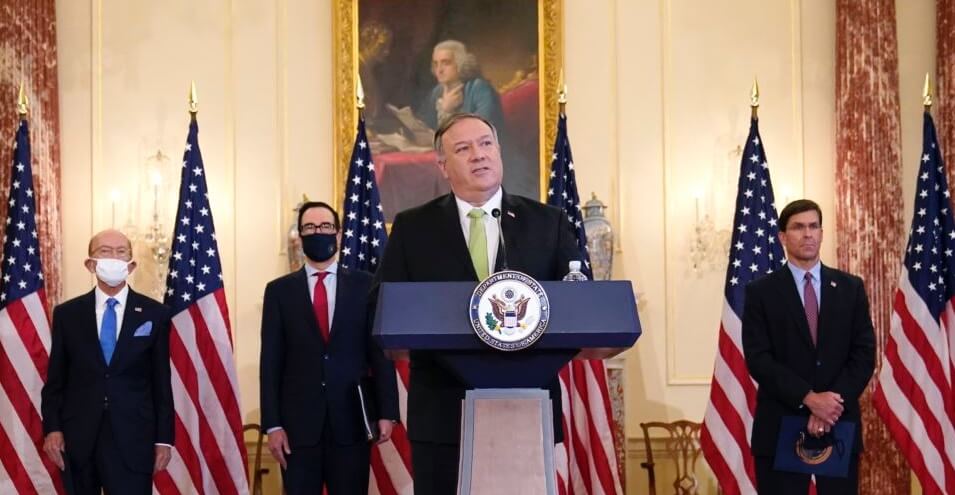
Israel’s Kan network had reported that U.S. Secretary of State Mike Pompeo will travel to Jerusalem in the coming days to take advantage of the ten remaining weeks of the current U.S. administration’s tenure and finalize the last agreements related to Israel’s interests.
Axios and Israel’s Channel 12 television also reported that Mr. Pompeo’s visit is “the Trump administration’s final effort to increase pressure on Iran,” and he will arrive in Israel on a regional tour in the middle of next week.
Elliot Abrams, who will remain in the region until Thursday of this week, will travel to the United Arab Emirates and Saudi Arabia after Israel.
The UAE and Saudi Arabia, U.S. allies, have recently become the open ally of Israel through the normalization of relations with the country.
The head of the Abu Dhabi government and the leaders of Saudi Arabia have congratulated Joe Biden’s election, but according to Axios, the UAE and Saudi Arabia, like Israel, are “very concerned” about the future U.S. administration’s policy toward Iran.
The Joe Biden-Kamala Harris team, which formally announced their victory to their supporters on Saturday evening, has not yet responded to reports about the new sanctions that the current Washington administration apparently intends to impose against Iran.
For Radio Farda, definitive and independent verification of the reports from Axios and Israel’s Channel 12 television is not currently available.
Two months ago, Joe Biden promised in an article on CNN to return to the JCPOA under certain conditions if he won the election.
Said Khatibzadeh, spokesman for Tehran’s Foreign Ministry, said on Sunday that “the list of damages inflicted by America on Iran and matters for which Washington should be accountable to Iran are preserved… and America is not in a position to impose conditions on Iran.”
The spokesman stated that the difference between Joe Biden’s camp and Donald Trump’s camp is clear, but “America must repent and stop its economic war against Iran.”
Said Khatibzadeh also said that “the JCPOA negotiating table stands… although the path is difficult.”
Hassan Rouhani, Iran’s President, also said on Sunday that America’s maximum pressure policy has failed and the new Washington administration should “correct past mistakes and return to the path of adhering to international commitments with respect for global rules.”
Earlier, Mohammad Javad Zarif, Iran’s Foreign Minister, had said that America must take back the JCPOA table. These statements could mean that from the perspective of the Islamic Republic’s leaders, the United States must first lift sanctions and then return to the JCPOA.
Source: Radio Farda