Trump: I Have No Objection to Sending Medical Equipment to Iran
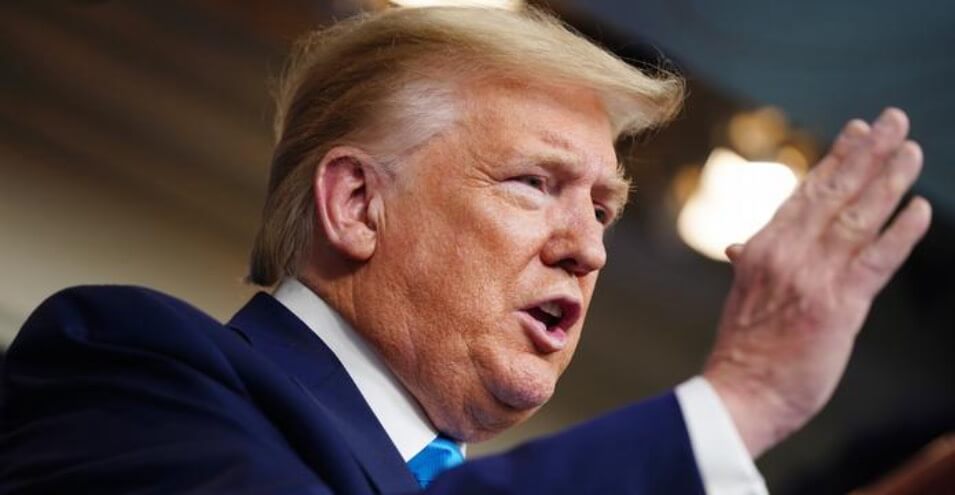
Donald Trump, the President of the United States, has no objection to sending medical equipment from other countries to Iran. Mike Pompeo, the U.S. Secretary of State, also reiterated once again that U.S. sanctions do not prevent the sending of humanitarian aid to Iran.
Donald Trump, the President of the United States, on Wednesday evening, April 8 (Farvardin 20) during a press conference, in response to a journalist’s question that referred to a recent telephone conversation between Rouhani and Macron, the presidents of Iran and France, said, “They [the Europeans] are sending medical equipment to Iran. I have no problem with that.”
Mike Pompeo, the U.S. Secretary of State, also, in parallel with Trump’s remarks, once again emphasized that sanctions imposed by the United States against the Islamic Republic do not prevent the sending of humanitarian aid to Iran.
He clarified to reporters at the White House: “The world should know that there are no sanctions that prevent the sending of humanitarian aid or medical and pharmaceutical supplies to Iran.”
The U.S. Secretary of State, stating that “it has been heard that people [in Iran] are talking about sanctions,” expressed regret that Iran did not accept the United States’ offer of assistance to counter the outbreak of the new coronavirus.
Pompeo added that the United States, in addition to offering assistance to the Islamic Republic, “has facilitated aid to Iran through other countries.” He emphasized that the transfer of money to Iran, however, will not be facilitated.
Request for Loan from the International Monetary Fund
The Islamic Republic, under severe pressure from economic sanctions, including oil export sanctions, has requested a five billion dollar loan from the International Monetary Fund to meet its needs and counter the economic crisis caused by coronavirus.
The International Monetary Fund and the World Bank are set to provide a total of 62 billion dollars in interest-free or very low-interest loans to countries affected by the coronavirus crisis worldwide.
Although the International Monetary Fund approved loan requests from 11 countries in recent days, Iran was not among them. Officials of the Islamic Republic of Iran believe that the International Monetary Fund did not approve Tehran’s request due to American pressure.
The Wall Street Journal also reported on Wednesday (Farvardin 20), citing several senior American officials who declined to be named, that the United States intends to “prevent the approval of Iran’s requested loan from the International Monetary Fund.”
The completion of the first transaction between the European Union and the Islamic Republic through the INSTEX system is one of Iran’s few windows of hope.
The German Foreign Ministry reported earlier (Tuesday, March 31 / Farvardin 12) on the completion of the first successful trade exchange between Europe and Iran through the INSTEX financial mechanism.
This ministry announced in a statement: “France, Germany, and Britain confirm that INSTEX has successfully carried out its first transaction with Iran and has enabled the export of medical goods from Europe to Iran.”
INSTEX (INSTEX) or the Mechanism in Support of Trade Exchanges with Iran was created in January 2019 by France, Germany, and Britain to facilitate non-dollar trade with Tehran.
The Islamic Republic’s banking system’s lack of access to the international fund transfer system among banks has made import and export conditions more difficult and has resulted in goods reaching Iran at higher costs.
Unfreezing of Iranian Assets in Luxembourg
The unfreezing of part of the Islamic Republic’s central bank assets could also help Iran in dealing with the outbreak of the new coronavirus.
Abdolnaser Hemmati, the Governor of the Central Bank of the Islamic Republic, announced on Wednesday, Farvardin 20, that 1.6 billion dollars of the bank’s assets held at the “Clearstream Luxembourg” company have been unfrozen.
According to him, another court in Luxembourg prevented the transfer of the released amount to the United States and its distribution among the survivors of the September 11 incident.
Hemmati’s reference is to a class action lawsuit filed by survivors of the terrorist attack of September 11 in a court in New York. This court ruled in 2012 that the government of the Islamic Republic of Iran must pay 7.5 billion dollars to the survivors of the victims of the September 11 attacks.
Following the ruling of this New York court, the U.S. government asked the Luxembourg judiciary to confiscate 1.6 billion dollars of Iran’s assets in that country and place them at the disposal of the survivors of September 11, but this request was rejected by a court in Luxembourg.
Johns Hopkins University in its latest statistics, which include coronavirus figures through Wednesday evening (Farvardin 20), reported the number of people infected with the new coronavirus in Iran as 64,586 and the number of deaths from COVID-19 as 3,993.