Unemployment Rate Among Iranian University Graduates “Twice That of Illiterates”
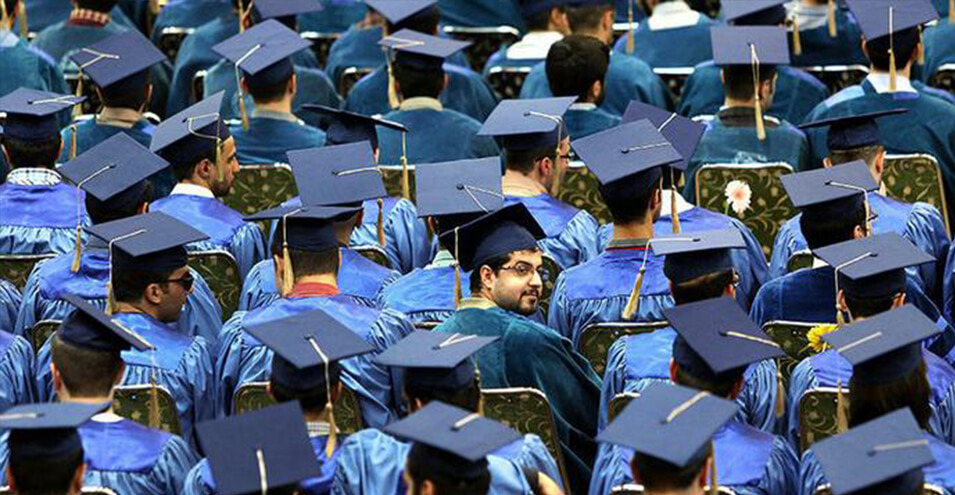
An official from the Ministry of Labor reported a doubled unemployment rate among Iranian university graduates compared to illiterates. According to this responsible official, “at least 70 percent” of existing jobs in Iran’s labor market do not require university education.
AlirezaHatamzadeh, Educational Deputy of Iran’s Technical and Vocational Training Organization, stated that “40 percent” of those referring to this organization, which is affiliated with the Ministry of Cooperation, Labor and Social Affairs, are “unemployed graduates.” He said: “At least 70 percent of existing jobs in the labor market do not require university education.”
The Educational Deputy of Iran’s Technical and Vocational Training Organization said on Monday, the sixth of Aban (October 28), referring to “one million and 340 thousand unemployed graduates in the country,” in a statement to Tasnim news agency: “The unemployment rate among university graduates is twice that of illiterates.”
This official affiliated with Iran’s Ministry of Labor added: “If you take a look at the surrounding jobs one day on your way to work, you will easily notice that a large portion of jobs do not require university education. However, there is a wrong culture in the country that prefers credentials over skills. That is, instead of keeping a person occupied for 4 years in a bachelor’s program and 2 years in a doctorate, we can quickly enter the labor market through skills training.”
According to Tasnim, currently “private car driving, motorcycles and driving in telephone taxi agencies, freelance jobs and brokerage, starting a grocery store and supermarket, working as an assistant under a father and continuing paternal occupation and similar matters are the available options for unemployed graduates” of Iranian universities.
AlirezaHatamzadeh, while criticizing the lack of “career outlook” in university curricula, referred to the shortage of skilled workforce among graduates and said: “We educate people but we are not responsible for employment, however, large organizations come to us, demand from us, and ask us for skilled workforce.”
60 Percent of Homeless People with “Advanced Education”
Meanwhile, even Ali Sadeghi, Deputy of “Social Support of Tehran Municipality’s Organization for Welfare, Services and Social Participation,” reported university education among “some homeless people” who, according to him, “became homeless as a result of family rejection.”
According to ISNA, this Tehran Municipality official said: “About 60 percent of Iran’s homeless people have advanced education or specialized skills, but due to addiction struggles or poverty, they have been driven out of society and left on the streets.”
The Educational Deputy of Iran’s Technical and Vocational Training Organization, in his conversation with Tasnim, mentioned the number of unemployed graduates in the country as “about one million and 340 thousand” people and said that according to statistics from 1397 (2018), about 40 percent of technical and vocational trainees are university graduates, and those referring to this organization affiliated with the Ministry of Labor “have even been at the doctoral level.”
AlirezaHatamzadeh, referring to the fact that “skill deficiency causes 40 percent of university graduates to pursue skills training,” also points out that after completing a training course, only “42 percent of them succeed in entering the labor market.”
Graduates Lacking “Job Skills”
Domestic media report on the phenomenon of “unemployed engineers and doctors” in Iran. According to experts, due to “the gap between higher education and the labor market” and universities’ inability to train “specialized and appropriate” workforce, most Iranian university graduates lack “up-to-date job skills” and the number of unemployed in this category increases every day.
Based on the latest reports from Iran’s Statistics Center and Strategic Information Center of the Ministry of Labor, currently about 1.12 million people are studying as students in 22 university disciplines, of which about 6 million and 400 thousand are men and 5 million and 700 thousand are women.
In the most important academic fields in Iran, the highest unemployment rates belong to computer science groups (with 41.4 percent), environmental protection (with 37.6 percent), arts (28 percent), and physics and natural sciences (27.8 percent), and the lowest unemployment rate belongs to the veterinary medicine group (with 8.7 percent).
Among the official statistics of “one million and 340 thousand” unemployed graduates in Iran, graduates in the engineering field with “over 301 thousand people” account for the highest share of unemployment, and business and administrative fields with “266 thousand” and architecture with “163 thousand” unemployed respectively rank in the following positions.
Of the total population of university graduates or students of Iranian higher education institutions, 52.6 percent are men and 47.4 percent are women. Among the active individuals of this population, 14.14 percent of men and 31.1 percent of women are registered as unemployed. Also, the highest unemployment rate among this population belongs respectively to Kermanshah Province (with 34.9 percent), Kurdistan (with 29.4 percent), and Chaharmahal and Bakhtiari (with 28.7 percent), and the lowest unemployment rate belongs to Central Province (with 12.5 percent).
According to a report from Iran’s Statistics Center, the largest employed population in Iran (five million and 38 thousand people) “hold a diploma and pre-university degree.” In contrast, however, the smallest employed population in Iran (100,704 people) consists of those with a doctoral degree. According to statistics released in Ordibehesht month of 1397 (April-May 2018), the unemployment rate in Iran in 1395 (2016) was 13.1 percent among literate people and 4.6 percent among illiterate people.
However, many experts assess the actual unemployment rate in Iran to be far beyond official statistics, and one of the reasons for this is the definition of employed people in formal institutions. According to them, the definition of “employed population” in Iran has fundamental differences with developed standards. Some analysts believe that unemployment of more than a quarter of youth, which official statistics also confirm, indicates a crisis situation in Iran’s labor market and employment; a market in which unemployment growth is faster than employment growth.
Source: DW