US Formally Initiates ‘Trigger Mechanism’
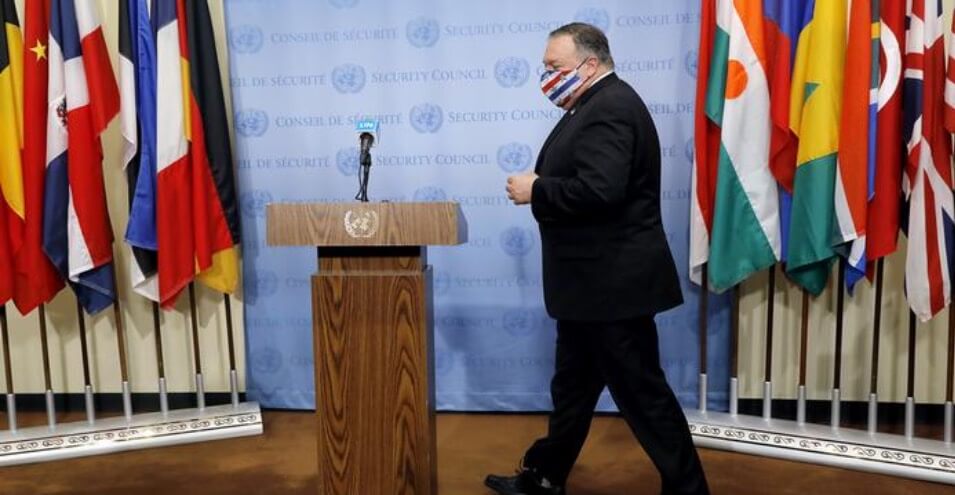
The US Secretary of State presented Washington’s request to the Security Council for the restoration of all international sanctions against Iran. The US claims the Islamic Republic has violated its commitments under the nuclear agreement and JCPOA.
As announced, Mike Pompeo appeared at the UN headquarters Thursday afternoon New York time and presented the US request to activate the trigger mechanism against the Islamic Republic to the rotating chair of the Security Council.
This mechanism was designed to resolve disputes among countries participating in the Joint Comprehensive Plan of Action (JCPOA), and its activation could lead to the automatic restoration of all Security Council sanctions resolutions against Iran.
The German News Agency reported on Friday, August 21, that the disagreement over how to deal with the Islamic Republic has created a vast rift between the United States and its European allies, and the prospects for resolving this dispute are unclear.
The trigger mechanism is a procedure provided for in Security Council Resolution 2231. This resolution was adopted in 2015 following the signing of the nuclear agreement between Iran and six world powers, and the JCPOA is its annex.
Based on this mechanism, countries participating in the JCPOA can request the automatic restoration of international sanctions resolutions against the Islamic Republic if Iran fails to comply with its commitments.
The US ended its participation in the JCPOA by withdrawing from the nuclear agreement in May 2018. For this reason, the five remaining countries in the agreement, including three European countries—France, Britain, and Germany—believe that the United States does not have the ability to activate the trigger mechanism.
Opposition from Three European Countries to US Action
The foreign ministers of three European countries stated in a joint statement that the US action is contrary to their efforts to preserve the nuclear agreement and said they cannot support it for this reason.
According to Reuters, Heiko Maas, Jean-Yves Le Drian, and Dominic Raab, emphasizing their commitment to the JCPOA, called on the Islamic Republic to fully implement its JCPOA commitments.
On the first anniversary of the US withdrawal from the nuclear agreement, Iran reduced the implementation of its JCPOA commitments in five phases. The US has accused the Islamic Republic of violating the JCPOA partly for this reason and has called for the activation of the trigger mechanism.
Mike Pompeo, in response to the opposition of three European countries to the US effort to activate the trigger mechanism, accused these countries of “siding with the ayatollahs.”
Since Donald Trump entered the White House, the dispute between the US and European countries over the nuclear agreement has increased and has now reached one of its peaks.
Trump has repeatedly described the nuclear agreement as the worst deal in history since his 2016 election campaign and believes the agreement will not permanently prevent the Islamic Republic from obtaining nuclear weapons and will not end the country’s destabilizing activities in the region and its controversial missile programs.
The US request to activate the trigger mechanism came after Washington’s proposed resolution to extend Iran’s arms embargo was rejected at the Security Council.
According to Resolution 2231, Iran’s arms embargo expires this September. Some senior officials of the Islamic Republic have threatened that extending the arms embargo would mean the death of the JCPOA forever.
European Countries’ Request from Iran
The three European parties to the nuclear agreement, while opposing the US action, acknowledged that Iran has “systematically” violated its JCPOA commitments but emphasize that this problem must be resolved through dialogue.
France, Britain, and Germany have called on the Islamic Republic to “as soon as possible” halt all measures inconsistent with its JCPOA commitments and return to full implementation of its obligations.
Indonesia holds the rotating presidency of the Security Council, and the US request to activate the trigger mechanism has been presented to the country’s ambassador to the United Nations.
It remains unclear how the Security Council will respond to the US request. Given the abstention of 11 Security Council members on the US resolution last week, some observers assess silence on the US request as one of the possibilities.
Mohammad Javad Zarif, the foreign minister of the Islamic Republic, sent a detailed letter Thursday to the rotating chair of the Security Council, describing the US request to activate the trigger mechanism and restore sanctions resolutions against Iran as “devoid of any validity or legitimacy” and called for rejection of this request.
Source: DW