Warning About ‘Identification of 44 Critical Land Subsidence Areas’ in Iran
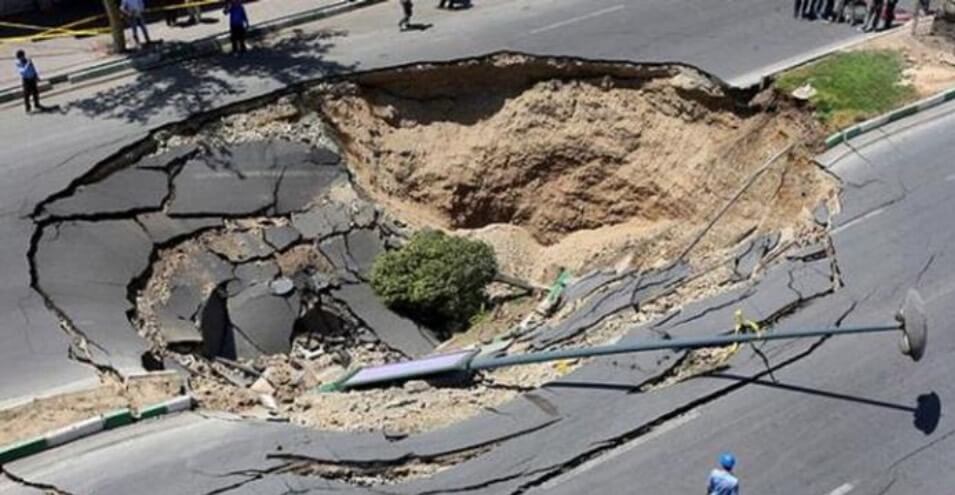
The head of the National Cartographic Organization says dozens of Iranian regions are experiencing land subsidence, with Tehran and Isfahan provinces facing more severe conditions. Masoud Shafiei also reported that the Caspian Sea water level is receding at an average rate of 10 centimeters per year.
For approximately two years, the study and assessment of land subsidence rates in Iran, which have generated concerning reports about its extent, has been assigned to the National Cartographic Organization.
Masoud Shafiei, head of the organization, told ISNA news agency on Monday, the 2nd of Tir month, that during this period, 44 critical areas with significant land subsidence have been identified in Iran based on measurements and data from the past 15 years.
He stated that after identifying subsidence areas, geologists evaluate the level of danger and the probability of sinkhole formation in different regions based on data collected by the organization.
According to Shafiei, the identification of high-risk areas is carried out using four methods: “precise leveling,” “use of permanent geodynmic stations,” “gravimetry,” and “satellite radar data interferometry,” and the geodynmic network stations of the cartographic organization report and record changes in the Earth’s crust every 10 to 30 seconds.
Tehran and Isfahan Provinces Face Most Severe Subsidence
The head of the National Cartographic Organization told ISNA that Tehran and Isfahan provinces are among the most critical areas in the country regarding land subsidence rates, and according to assessments over the past 15 years, this rate in areas such as the southwestern outskirts of the capital reaches approximately 30 centimeters annually.
Shafiei commented on the consequences of land subsidence: “In some cases, unfortunately, this phenomenon has affected vital infrastructure, roads, and airports. Additionally, sinkholes that have formed in the plains of Hamadan province may be related to the subsidence phenomenon.”
To date, land has subsided in many Iranian cities for various reasons, causing considerable damage. Many images and videos of such incidents have been circulated on social media.
“Isfahan Voice” recently published a short video showing the extraction of a bus from a three-meter-deep hole on Mirza Taher Street in the city, reporting that dozens of such incidents have occurred in various cities across the province in recent months.
The head of the National Cartographic Organization mentioned provinces such as Razavi Khorasan and Qom as other high-risk areas regarding land subsidence but did not provide an explanation for the causes of this phenomenon.
Some experts believe that uncontrolled extraction of groundwater and the complete or partial drying of Iran’s most important wetlands and lakes could significantly exacerbate the land subsidence crisis.
Caspian Sea Water Retreat: 10 Centimeters Per Year
In another part of his remarks, Shafiei referred to the National Cartographic Organization’s efforts to monitor water level fluctuations in the northern and southern seas of Iran and stated: “In order to examine water level fluctuations in the Caspian Sea and the Persian Gulf, tide gauge stations have been installed that measure and record changes in water level (water surface elevation) throughout the day.”
The head of the National Cartographic Organization described the rate of water retreat in the Caspian Sea as “significant” and noted that the water level of this sea drops on average by 10 centimeters each year.
ILNA news agency reported on the 6th of Esfand, citing Mohammad Daroush, an environmental expert, that in some parts of Fars province, the land subsidence rate is 140 times higher than the rate that the European Union considers critical conditions.
Yahya Jamoor, technical deputy of the National Cartographic Organization, addressed the results of research and assessments regarding land subsidence in various regions of Iran during a press conference in November of last year.
He emphasized in this meeting that the rate of land subsidence is not uniform everywhere and cited examples such as the Varamin Plain at 26 centimeters per year, Tehran at 18 centimeters, and the Gorgan Plain at approximately six centimeters per year.
According to ISNA, the technical deputy of the National Cartographic Organization had warned that little time remains before land subsidence also affects Tehran’s Azadi Square. The head of this organization had issued a similar warning one month earlier.
Source: DW