Will Iran’s Future Be Shaped as a United Nation or Fragmented?
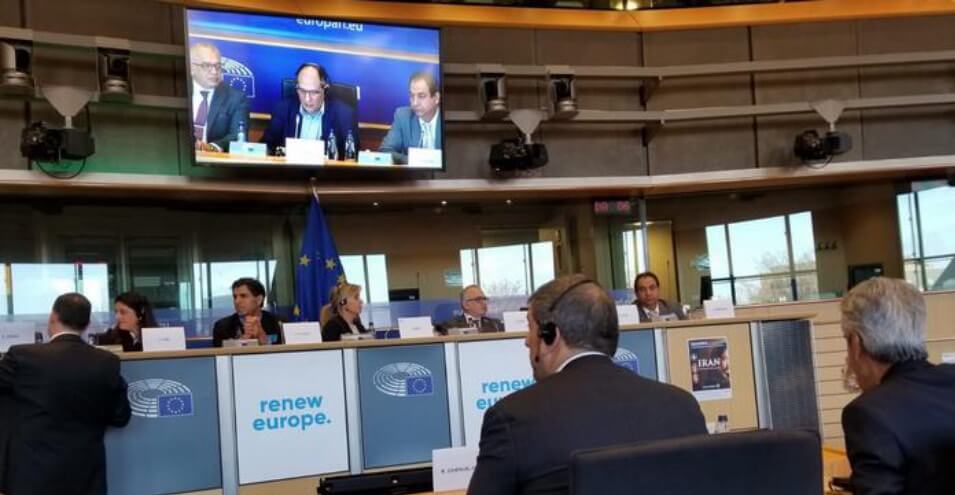
Representatives of Iran’s ethnic minorities, along with Shirin Ebadi, called on Europe not to remain silent in the face of the suppression of the Iranian people. They warned of the dangerous consequences of this process: the growth of radicalism among ethnic groups and the endangerment of Iran’s territorial integrity.
“The Future of Ethnicities in Iran” was the title of a meeting held on December 21 (December 12) at the European Parliament headquarters in Brussels. Representatives from ethnic parties and groups spoke at this meeting. The common thread in the speeches was an emphasis on a “serious danger”: that the continuation of suppression, discrimination, and violence, particularly against ethnic minorities, would eliminate the last possibilities for peaceful coexistence in a united Iran. All speakers referred to the fresh wounds of the latest crackdown on protesters in Iran, which are still open and lie on top of old wounds from the past.
They spoke of discontent turning into deep hatred and deep hatred into a serious threat to Iran’s territorial integrity. However, the demands raised at this meeting and the alternative proposed by the speakers—”democracy and solidarity within a federal system”—have so far not only been marked with a security stamp by the Islamic Republic, but parts of the opposition also consider it a challenge to Iran’s “territorial integrity.”
Which side is Europe on?
The “Future of Ethnicities in Iran” meeting began with a speech by Shirin Ebadi, a lawyer and Nobel Peace Prize winner. After her, Rafael Chenuil Hazan, director general of the “Together Against the Death Penalty” organization, spoke, followed by five representatives of different Iranian ethnicities.
Shirin Ebadi directly asked European governments, “Why do you only value human rights for yourselves,” but when it comes to the Iranian people, you “remain indifferent to their violent suppression by the Islamic Republic?” With a brief reference to what happened in Iran in November of this year, she criticized European governments for claiming to be defenders of human rights, but when their commercial interests are at stake, they “stand with dictators,” and when “defenseless people are killed by bullets and tanks in the streets, no voice is heard from the world.”
“Why in such circumstances are you only thinking of trade with Iran?” This was perhaps a question many have raised these days. Shirin Ebadi told European governments: “You can at least delay trade with Iran and the launch of INSTEX until the suppression stops and prisoners are freed—those whose only wish was bread and work.” She warned European countries that the result of this policy could reach Europe itself and asked them to help the Iranian people.
Mrs. Ebadi, referring to other participants in the meeting and the accusations they face—”separatism”—told Deutsche Welle Farsi that in her view “separatism is a stamp that the Islamic Republic puts on the foreheads of ethnic groups to suppress them.”
“The Face of the Geography of Suppression and Occupation”
Inequality, discrimination, political, economic, and social oppression of different ethnicities in Iran by the central government was the common thread of the subsequent speeches at the meeting. Representatives of Kurdish, Baloch, Arab, Turkmen, and Azeri parties and groups tried to explain to those present in the European Parliament the extent and depth of discrimination against the most basic rights of ethnicities in Iran.
They pointed to the failure to give any value to the development and welfare of ethnic and religious minorities, their mere suppression and deprivation of rights, and a “dangerous” process where this suppression accelerates it forward; the growth of separatist tendencies and radicalism that is constantly escalating, and the more violence is used, the more serious this threat will become.
Mostafa Hajri, executive head of the Democratic Party of Kurdistan of Iran, said in his speech that Iran’s multinational nature not only had “no place in the constitution and the discourse of Iranian nationalism” but was examined as “a sensitive problem and a security issue.” To the point that “the regions inhabited by non-Persian nationalities have taken on the face of a geography of suppression and occupation.”
A “face” that manifests itself with “the absence of any opportunity for free and legal political activity, the plundering of the capital and resources of Kurdistan and their transfer to central regions.” With “executions, imprisonments, and elimination of Kurdish activists and fighters, the diversion of water resources, environmental destruction, and the militarization of cities and villages, the securitization of administrations, educational centers, mosques, and public places.”
Is there a prospect for peaceful change?
The executive head of the Democratic Party of Kurdistan concluded that this set of circumstances has “severely weakened the prospect of peaceful change in a united and integrated Iran and instead strengthened the desire and will for separation among ethnicities. To the point that this has become a discourse “dominant among a significant portion of their public opinion.”
Mostafa Hajri said at the end of his speech that Kurds and other ethnicities in Iran are “seeking sovereignty and self-determination in whatever way is possible and available for them.” I asked him what he meant by this “any way that is possible and available for them” and whether it was a kind of endorsement of “separatist tendencies.?”
He rejects this and says: “The accusations and stigmas thrown at us and others are to create nationalism phobia among Iranians. Unfortunately, some of our compatriots are unknowingly following these propaganda campaigns.” He emphasizes: “Our name is ‘Party of Kurdistan of Iran.’ Our program and charter all emphasize remaining within the framework of Iran, and these labels are unjust. These accusations are to confuse the public mind, and this has caused even a request for the smallest rights from the Kurdish nation and other nationalities to be immediately labeled as separatism and allegiance to enemies. But this method has not helped so far and will not help in the future.”
Mostafa Hajri continues his response: “If the situation continues in this manner, preserving Iran’s territorial integrity will be very difficult. We are saying this so that both Europeans and the Iranian people are aware of this danger. Suppression cannot guarantee territorial integrity. We must do our utmost and reduce, as much as we can, the dangers that lead to the division of Iran.”
“We want a secular, federal, and democratic Iran”
The danger of rising radicalism among Iran’s ethnic minorities was also a key point in the speech of Nasser Bolidaei, spokesman for the People’s Party of Baluchestan. He told Deutsche Welle Farsi:
“In my opinion, the solution is that proper dialogue should take place between opposition groups and the international community. Political groups should unite because none of the opposition groups, whether they consider themselves constitutional monarchists or republicans, or like us who want a federal republic, can impose our views and tastes on others. We must respect, accept, and preserve ethnic plurality in Iran and avoid violence towards each other. We must ignite dialogue in society.”
Nasser Bolidaei rejected the notion that the People’s Party of Baluchestan seeks separation and said: “We do not want the separation of Baluchestan. We want an Iran that is federal, secular, and democratic. A country where all nationalities and religions are equal and democratic. But this is only possible with the overthrow of the Islamic Republic and the creation of a democratic space.”
“Both the Islamic Republic and the Pahlavi regime have even avoided using the word Turkmen Sahra”
Yousof Kar, spokesman for the “Cultural and Political Organization of Turkmen Sahra,” referred in his speech to “ancient” discrimination that does not even tolerate words. He said that not officially recognizing the existence of an ethnic minority called Turkmen, not considering Turkmen Sahra in the country’s administrative divisions, not mentioning Turkmen Sahra in government and state bodies compared to other ethnic minorities, is “an unavoidable feature of a long-standing and ancient tradition.”
Yousof Kar pointed to “the government’s inability to manage in areas such as the use of various resources like water and soil, environmental affairs, economic corruption, and theft,” which have caused countless damages to all of Iran, including Turkmen Sahra. Nasir Kar told the meeting participants that people live in “despair, limbo, and hatred,” are tired of “false promises and threats,” and called on the people and European countries to provide “decisive and effective support” to the Iranian people.
He strongly criticized the European Union for its wavering stance on the violence and cruelty of the Iranian government against protesters in November.
“A sensitive period in a region subject to bitter events”
Jalil Sherha’ni, secretary general of the Democratic Solidarity Party of Ahwaz, was the next speaker at the meeting who put his finger on the sensitivity of the region’s situation. His assessment of the current period was that the outlook for “Iran’s peoples and the entire Middle East region is subject to transformations and bitter events that, if not dealt with rationally and wisely, could darken and obscure the future of this land.”
Jalil Sherha’ni spoke of the suffering of his region’s people who “have to witness the plundering of their underground and surface wealth, the insult and humiliation of their language and culture.” He pointed to “statistics of deprivation, low living standards and welfare, and unemployment rates in the Arab-populated areas of Ahwaz,” which is “the source of most of Iran’s wealth,” and found it shocking.
What was heard in Jalil Sherha’ni’s speech was the repetition of familiar terms for Iran’s ethnic minorities: discrimination and ruthless underdevelopment. He spoke of “school dropouts and lack of cultural and sports facilities,” of “environmental destruction and the drying of rivers and diverting their water to other parts of Iran, the air pollution that people breathe and the suspended particles in it, and water scarcity as ‘another example of injustice done to the Arab nation of Ahwaz.'”
“Brotherhood endures through justice”
The secretary general of the Democratic Solidarity Party of Ahwaz recalled “rational and fair interaction with existing geographical, social, political, and ethnic realities” at the European Parliament meeting as the only solution and warned that “narrow-mindedness, discrimination, and totalitarian and collective ethnic chauvinism from any group and ethnicity will bring catastrophic results for all.”
“Brotherhood endures through justice,” this was a proverb with which Jalil Sherha’ni ended his remarks. But what if that rationality that Mr. Sherha’ni spoke of does not exist?
Hafiz Fadel, a member of the political bureau of the Democratic Solidarity Party of Ahwaz, answered this question and said: “Governments impose the type of struggle on people, not the people. The process of increasing violence that we have witnessed in recent years and especially in recent protests causes people to resort to legitimate defense.”
I asked him what he meant by legitimate defense. He said: “Legitimate defense means that everyone will defend themselves with whatever means they have.” He further emphasizes that “since the Islamic Republic regime is not a reformable regime, at least the central opposition, that is, those who still chant one language one nation one flag and one country, should, taking into account the demands of other nations and forming an alternative and introducing themselves to neighboring and Western countries, take a step to overthrow the system.”
I asked him about accusations such as separatism and receiving financial aid from neighboring countries to advance this agenda. He responds:
“We have a very clear and obvious political program. We believe Iran is a multinational country and should be governed by a completely democratic and federal system. There is no talk of separation or seeking independence in our program. There are other parties that truly seek such things, but we have no relationship with them. We have not received support from any Arab country and will not. All costs are paid monthly by party members. I again emphasize that we have neither asked for help to maintain our independence nor will we accept any help in this regard.”
Hafiz Fadel concludes by saying: “Iran is a land that has been created and preserved by these same people for centuries and has been managed by them until today. Unfortunately, for 85 years, a totalitarian system has been imposed on us. A system that denies a significant part of this history.”
“Linguistic and ethnic diversity is the wealth of a land”
Another speaker at the “Future of Ethnicities in Iran” meeting was Saeid Azizi, spokesman for the Democratic Union of Azerbaijan (Birlik). He started by looking at the glass half full, saying that the existence of linguistic and ethnic diversity for a land “is considered wealth” and with tolerance, acceptance of this plurality and proper dealing with it is that “this diversity will lead to economic, political and certainly cultural development.”
Saeid Azizi also emphasizes that “the absence of freedom, equality, and social justice” will forever lead Iran to “war and conflict and towards further destruction.” He says that it is these extremist forces that will take the greatest advantage of ignoring the demands of ethnicities and fear of a federalist system to govern society.
The Democratic Union of Azerbaijan seeks a federal system “in which the central government and parliament consist of representatives of different nationalities, and local and national governments elected by the people, undertake the management of their region’s affairs. Iran consists of Turkish, Kurdish, Lur, Arab, Baloch, Turkmen, and Persian nationalities, all of which have millions in numbers.”
Birlik’s spokesman says: “In the near future we will witness which of these two paths the centralist forces will choose.”
Source: DW