Yellow Alert; Increase in Pollutants in Tehran, Karaj, and Isfahan
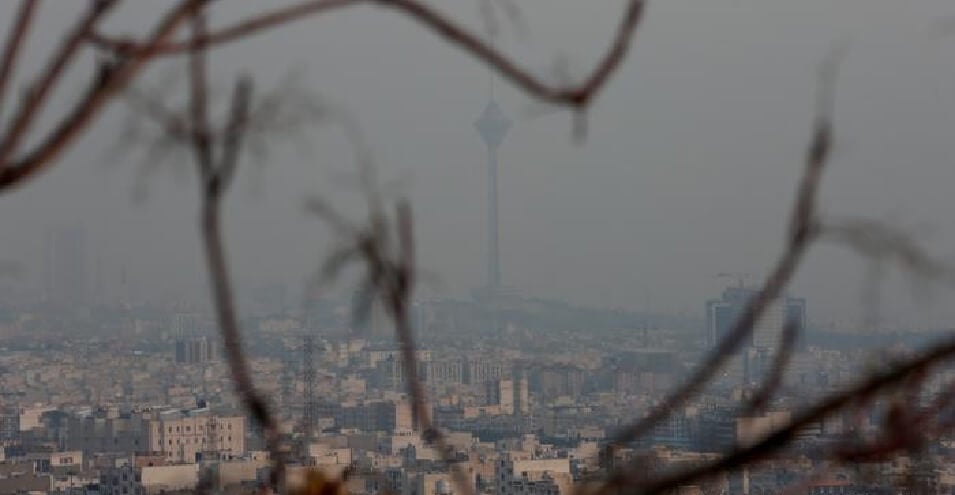
Third day of unhealthy air in Tehran for sensitive groups. Six major Iranian cities are grappling with increased pollutant concentrations, and sulfur dioxide levels in Arak have reached a critical threshold. Schools in Arak and Tehran have returned to remote learning.
Tehran’s Air Quality Control Company announced that the average concentration of suspended particles with a diameter less than 2.5 microns over the 24 hours ending Tuesday, December 14, was 148; an index that is unhealthy for sensitive groups. During the same period, the concentration of suspended particles with a diameter less than 10 microns was 86, ozone was 11, nitrogen dioxide was 106, and carbon monoxide was 39.
Simultaneously, Tehran’s Air Pollution Emergency Committee announced the decision to close kindergartens and preschool centers, and to convert classes in schools across all 22 zones to virtual learning.
This is the second time in the past ten days that the air quality of the capital and several cities in Tehran province has reached this level of pollutant accumulation, necessitating such decisions.
The Meteorological Organization also announced that the lack of wind in Tehran until late Tuesday and increased vehicle traffic will further increase pollutant concentrations. This means the air will be unhealthy for all groups.
Tehran, Arak, Isfahan, Tabriz, Mashhad, and Karaj are at the forefront of cities with smoky skies and polluted air.
Arak’s air has been declared unhealthy and dangerous for all groups, and media outlets are reporting disruptions to people’s lives and students staying home in this city. A city within and around which many industries exist, including power plants and factories that consume fuel oil.
Shazand Thermal Power Plant is considered one of the main factors of air pollution in Arak. Farzad Mokhtassolaeemeh, the governor of Markazi Province, stated that by allocating 5 million cubic meters of gas quota to Shazand Thermal Power Plant, fuel oil consumption will decrease for a period at this power plant. He has promised that with the shutdown of certain units, Shazand’s fuel oil consumption will reach zero, and has also asked people to conserve electricity and gas consumption so that power plants’ gas and fuel oil consumption decreases.
Since the beginning of this year, Tehran has recorded 3 days of clean air, 195 days of acceptable air, 65 days of air unhealthy for sensitive groups, and 6 days of air unhealthy for all groups.
Meanwhile, Iran’s Meteorological Organization, by issuing a yellow alert, has announced that Tehran, Isfahan, and Karaj will face air stagnation hazards (atmospheric calm and increased pollutant concentrations) on Friday, December 17. It is recommended that the elderly, children, and people with a history of illness refrain from any unnecessary movement within the cities.
Domestic consumption or mobile pollutants, namely diesel vehicles, worn-out and scrapped trucks and buses, are usually accused of air pollution in Iran’s major cities, but experts emphasize that the main factor is fuel oil in power plants.
Bijan Namdar Zanganeh, the Oil Minister in the twelfth government, said last winter: “We have no choice but to consume fuel oil.”
Freidoun Abbasi, a member of the Islamic Consultative Assembly and former head of Iran’s Atomic Energy Organization, recently acknowledged the gas shortage and said: “If at a time when we have low gas supplies we do not consume fuel oil, 25 percent of the country will face blackouts.”
Source: DW