Zarif Responds to Khamenei’s Criticism of His Statements in ‘Controversial Interview’
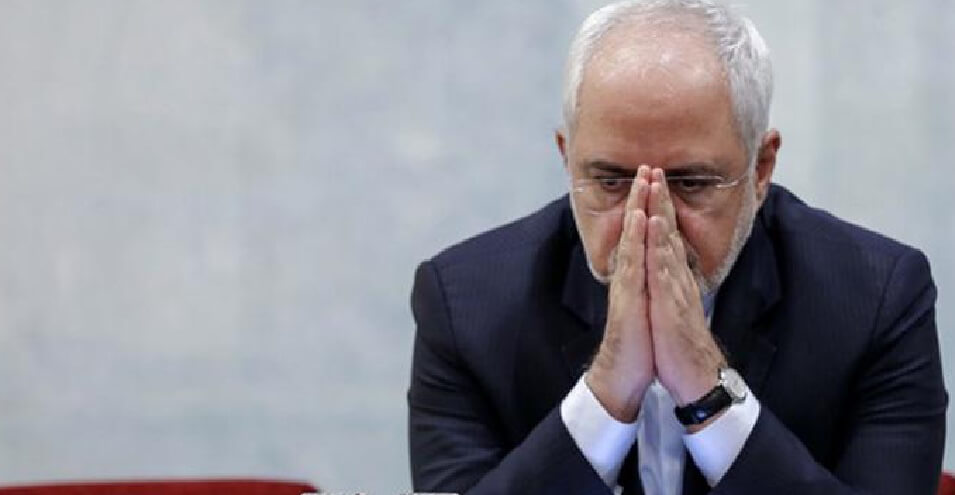
The Foreign Minister expressed regret in a brief message that some of his remarks about Qasem Soleimani had “caused distress” to Khamenei. Khamenei called Zarif’s statements “regrettable” and reminded him that the Foreign Ministry is merely an executor of foreign policy.
The Leader of the Islamic Republic reacted to the disclosure of portions of an interview by Mohammad Javad Zarif that was supposed to be confidential in his first public speech following the leak, calling his remarks “regrettable” without naming him directly.
Ali Khamenei, in this speech delivered on Sunday, Ordibehesht 12, on the occasion of Teacher’s Day and Workers’ Day, specifically addressed that section of the Foreign Minister’s remarks in which he complained about and criticized Qasem Soleimani, the former commander of the Quds Force, the extraterritorial unit of the Islamic Revolutionary Guards Corps.
In an interview recorded as part of the “Beyond Government” project at the Strategic Research Center of the Presidency, Zarif accused Soleimani of interfering in foreign policy, particularly in the region, and of prioritizing the battlefield over diplomacy.
Referencing Zarif’s remarks, Khamenei said: “Some of these statements are repetitions of the hostile statements of enemies and repetitions of American statements. We should not say things that suggest we are repeating the words of enemies; whether about the Quds Force or about martyr Soleimani.”
In a brief message published by ISNA news agency, Zarif wrote: “I am deeply regretful that some personal viewpoints that were expressed solely for the honest conveyance of experiences and without any intention for publication were stolen, leaked, selectively exploited and used as a tool for hostility by ill-wishers of the country, people and revolution, causing distress to the esteemed Supreme Leader.”
Critics and opponents of Hassan Rouhani’s government have used Zarif’s audio file as a pretext to increase attacks against him and his administration, and have added their opposition to the Vienna talks aimed at reviving the JCPOA, which would not have been possible without Khamenei’s approval.
The Leader of the Islamic Republic stated more explicitly and clearly than ever in his speech that foreign policy is not determined at the Foreign Ministry and said these policies are determined by “senior officials beyond the Foreign Ministry.”
“The Foreign Ministry is an Executor”
Khamenei said: “It is not the case that decision-making falls under the Foreign Ministry; the Foreign Ministry is an executor. Foreign policies are determined by all officials in the Supreme National Security Council, and the Foreign Ministry must implement and advance them in its own ways.”
He emphasized that one should not speak in a manner that suggests “we do not believe in and do not accept the country’s policies” because such statements “please the enemy.”
In his interview, Zarif, while complaining about certain actions of the Quds Force under Qasem Soleimani’s command, said he was not even informed of some decisions in regions such as Iraq, Syria, and Yemen.
Thus, it has become clear that the Foreign Ministry, at least in the realm of the Islamic Republic’s regional policies, is not even officially recognized in the role of executor.
Khamenei as Final Decision-Maker and Unaccountable
Nevertheless, the Foreign Minister of the eleventh and twelfth administrations wrote in his message that Khamenei’s “kind remarks” are, as always, the “final word and endpoint for expert discussions” for him and his colleagues.
In another part of his message, Zarif wrote: “As an agent and researcher of foreign relations, I have always believed that for the survival of this divinely blessed land and nation, foreign policy should be a matter of national consensus and unity and should be guided from the highest level of management, and on this basis, adherence to the leadership’s views and decisions is an undeniable necessity for foreign policy.”
These remarks implicitly demonstrate the reality that in the Islamic Republic, even if macro policies in foreign affairs are determined by “senior officials beyond the Foreign Ministry,” Khamenei himself is the ultimate decision-maker and determiner without being accountable to any institution or authority regarding the consequences of these decisions.
Call for Resignation of a Powerless Minister
Hosein Haghverdi, a member of the Education and Research Commission of Parliament, says that given the audio file released from Zarif, “certainly he has lost the capability and qualifications to rely upon the Ministry of Foreign Affairs of the Islamic Republic” and “such a person with such thinking should not hold the position of head of the country’s diplomatic apparatus for even one hour.”
In a note published on Ordibehesht 7 on Parliament’s information portal, he emphasized, stating that diplomacy has achieved nothing, that it would be better if Zarif “resigns wisely,” otherwise “his impeachment and dismissal by Parliament members is inevitable and necessary.”
This parliamentarian did not explain why the Foreign Minister, who was merely an executor of this foreign policy which, according to Khamenei, has its general lines determined beyond the Foreign Ministry, should be accountable for its failures.
Source: DW