Forest fires: Cultural poverty or inefficiency of officials?
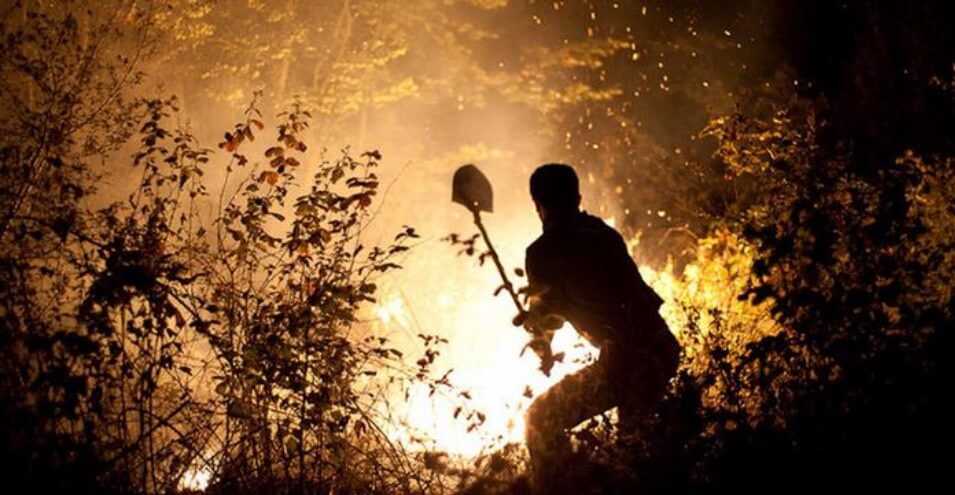
Environmental activists complain about the lack of firefighting facilities in Iran's forests and rangelands. The Environmental Organization says that 90 percent of recent fires were caused by human error and that investing in equipment is not worthwhile.
Colonel Jamshid Mohabat Khani, commander of Iran's Environmental Protection Unit, says that when people enter the natural environment, it is better to avoid lighting fires for cooking and heating, not smoking, and not leaving glass containers in nature because they act like magnifying glasses.
He said in a press conference on Tuesday, June 30: "The cause of 90 percent of recent fires is human error and 10 percent is intentional."
The successive fires in recent weeks in Iran's forests and pastures and the death of four young male environmental activists in the flames due to a lack of firefighting facilities have drawn widespread criticism of the Iranian Environmental Organization.
The commander of the Environmental Protection Unit said in a press conference on Tuesday: "Army and armed forces equipment has been used in the fires. There has been general correspondence regarding the use of armed forces equipment in the process of extinguishing fires in the country, so their facilities are used, but sometimes there are restrictions in this regard. For example, helicopter flights have restrictions, meaning that if the weather is not favorable, it is not possible to fly, but the armed forces did not spare any facilities in the fires."
Fires in Iran's forests and rangelands have tripled compared to last year. In the first quarter of this year, 1,654 hectares of Iran's forests were burned. The Global Forest Watch report, which is based on maps from various NASA satellites, shows that the provinces of Khuzestan, Fars, Bushehr, Ilam and Isfahan have had the most fire incidents. Kohgiluyeh and Boyer Ahmad, Hormozgan, Khorasan Razavi, Tehran and Kermanshah are in the next ranks.
In Kermanshah province, 100 hectares of the Khaiz protected area in the Zagros forests have been destroyed by fire in the space of a week. Three environmental activists who entered the area to help rescue workers did not return alive.
Jalil Bali, Director General of Crisis Management for Kermanshah Governorate, told the "Ibtkar" newspaper that it was not possible to dispatch a helicopter to rescue these environmental activists due to "time and weather conditions."
In response to reports that the cause of death of the three environmental activists was a landmine explosion, he emphasized that a change in wind direction caused them to be caught in the flames. Part of the border province of Kermanshah was mined during the Iran-Iraq war. The words of Fereydoun Yavari, the director general of the environment department of Kermanshah province, have also strengthened the possibility of a landmine explosion setting fire to the Zagros forests.
Yavari told the "Toseh Iran" newspaper on Tuesday, July 10: "The difficulty of crossing and the laying of mines in this border area require that fires be extinguished with the help of airplanes or water-spraying helicopters, but apparently such an issue has no place in protecting our environment."
These statements by the Director General of Environment of Kermanshah Province also contradict the statements of the commander of the Environmental Protection Unit regarding the possibility of sending helicopters of the armed forces to control the fire. Earlier, Mehrdad Sotoudeh, Deputy for Civil Affairs of the Bushehr Governorate, had also complained about the lack of firefighting equipment in difficult-to-reach areas and called the lack of helicopters and water-spraying helicopters “a national issue.”
In response to these criticisms, the head of Iran's Environmental Protection Organization says that investing in this field is not cost-effective and that even developed countries that have sufficient resources are facing fires.
Issa Kalantari told the Ettelaat newspaper on Tuesday, July 10: "It is not cost-effective to spend billions of dollars on firefighting equipment for an annual fire of less than 10,000 hectares. On the other hand, in the mountainous regions of Alborz and Zagros, fires cannot be extinguished with helicopters and airplanes because they have limited operational efficiency, while manpower can be sent to those areas."
In developed countries, firefighting equipment is used for difficult-to-access areas, and the higher the probability of fire, the more investment is made. For example, the massive fires in Australia caused the government to change its environmental policies. In Germany, after the lack of rainfall in the last two years and the increased probability of forest fires, new plans are being considered, including a plan to more effectively use the water of small lakes to control fires.
The Environmental Protection Organization of Iran was established in line with the fulfillment of Article 50 of the Constitution of the Islamic Republic of Iran, and its primary duty is to "protect the country's environment and natural ecosystems and repair past adverse effects on the environment."
The head of this organization told the Etelaat newspaper on Tuesday, July 10: "Our helicopters are very worn out, and I am more concerned about the health of the flight crew when using them to extinguish fires than about forest fires."
Issa Kalantari emphasized that it would be better to spend the hardware costs for extinguishing natural resource fires on training to increase public awareness of forest protection. He said: "We need to teach people how to act when they come to help control the fire, rather than getting emotional and burning themselves."
Source: DW