The figure of 12,000 deaths in Iranian protests: truth or media exaggeration?
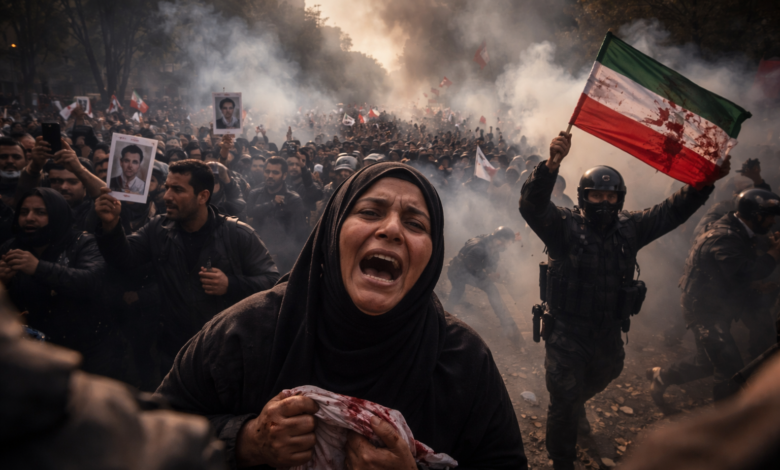
The Iran International report claims that 12,000 civilians were killed, but other independent sources have reported far fewer deaths, a profound discrepancy in narratives that calls into question transparency and access to real information.
While recent protests in Iran have been met with a heavy crackdown by security forces, the publication of conflicting figures on the number of deaths has become a major point of media and political controversy. From reports of a few dozen in the early days to the shocking claim of “12,000 dead” by Iran International, a deep divide has emerged between narratives that has raised serious questions about the accuracy of figures, sources of information, and media objectives.
The beginning of the protests and the first statistics
In the early days of the protests (early January 2026), the only sources available were local human rights groups and a network of activists inside Iran. These sources reported that around 20 to 30 people had been killed in several provinces. Reports were limited, scattered, and accompanied by warnings about communication disruptions and the possibility that the actual toll was higher. At this point, no international body or major media outlet was yet able to independently verify the information.
The arrival of international human rights organizations
Within days, organizations such as Amnesty International and Human Rights Watch published reports confirming the use of deadly force, including live ammunition, by security forces. These organizations generally declined to provide overall statistics or provided limited figures, typically in the tens of thousands, reflecting their policy of reporting only fully documented and verifiable cases. Although these figures were lower than other reports, they were considered to have the highest level of legal and documentary credibility.
Increase in statistics in cumulative human rights reports
Subsequently, groups such as the Human Rights Activists News Agency (HRANA) compiled data from various cities and published more aggregated figures. By around mid-January 2026, these sources reported that the death toll had exceeded 500 and the number of detainees had reached more than 10,000.
These figures were republished by reputable international media outlets such as AP and Reuters and are considered the most realistic independent estimate available to date; although these sources themselves emphasize that due to internet outages and security concerns, the final figures may change.
The official narrative of the Iranian government
During this same period, some Iranian officials sporadically spoke of around “2,000 deaths.” This number was given without providing details, a distinction between civilians and security forces, or verifiable documentation, and included government forces. No independent body has confirmed this figure, and there is no transparency about it.
Claim of 12,000 deaths, the culmination of the media war
In this ambiguous atmosphere, the Iran International media outlet issued a statement announcing that 12,000 Iranian citizens had been killed during the protests. The outlet claimed that this figure was the result of an examination of multiple sources, including medical and security sources, and that the Iranian government was covering up a “mass killing.” This is despite many reports published from inside Iran by Starlink showing that doctors in hospitals and forensic medicine have warned against publishing false statistics about those killed in the protests, calling it the “beginning of a global psychological war.”
However, no reputable international organization, including the United Nations, Amnesty International, or Human Rights Watch, has confirmed this figure. No list of names, geographical breakdown, or verifiable methodology has been published for this number, and the discrepancy with other independent estimates is striking.
For this reason, many observers and analysts consider this claim not to be an established statistic, but rather part of the war of narratives and psychological-political pressure against the Iranian government, because the figure of 12,000 deaths is not unlike a crime against the Iranian people and genocide.
Why are the statistics so different?
Experts attribute several factors to this sharp discrepancy: "widespread internet shutdowns and severe restrictions on the flow of information, the lack of transparent and verifiable official statistics from the government, differences in data collection methods (case-based, aggregated, estimated), and the role of the media in political competition and influencing public opinion." In such circumstances, any number (whether very high or very low) requires critical examination.
Based on available data, the most reliable independent statistics currently place the death toll in the Iranian protests in the range of several hundred people, although there has been no official confirmation of the accuracy of this report. The claim of 12,000 deaths has also not been independently confirmed and cannot be accepted as a final figure.
Given the circumstances of the information package, the actual number may be higher than the current figures, but the gap with the 12,000 figure, based on available evidence, is very large. What is certain is that the transparency crisis and the war of narratives have themselves become part of the Iranian crisis, a crisis that continues.
At FCNN, the global Persian-language news agency, we approach all news with complete care and responsibility. Every piece of news is thoroughly researched and reviewed before publication so that the information published is not only not repetitive, but also accurate and documented. We also strive to publish every piece of news with the highest sense of responsibility and to accurately reflect the truth behind it.
In addition, as Christians, each of our team members believes that the loss of any human being is a heartbreaking loss to God and deeply moving to us. These statistics (whether 500, 5,000, or more) are not just numbers, but represent families who have lost loved ones; children, brothers, sisters, fathers, and mothers, many of whom we know and have shared in their grief.
We have raised their cry for justice with united prayer, confident that God will see and hear the pain and suffering of the oppressed, for He has promised in His Word, Psalm 140:12: “The Lord will judge the oppressed and execute justice for the needy.”
This belief guides us in reporting responsibly and avoiding trivializing the pain and suffering of others. We know that every death toll, every grieving family, and every person who lost their life is not just a number, but thousands of true stories of pain and loss that must not be forgotten.