"Critical conditions continue" in Sistan and Baluchestan; new wave of rain is on the way
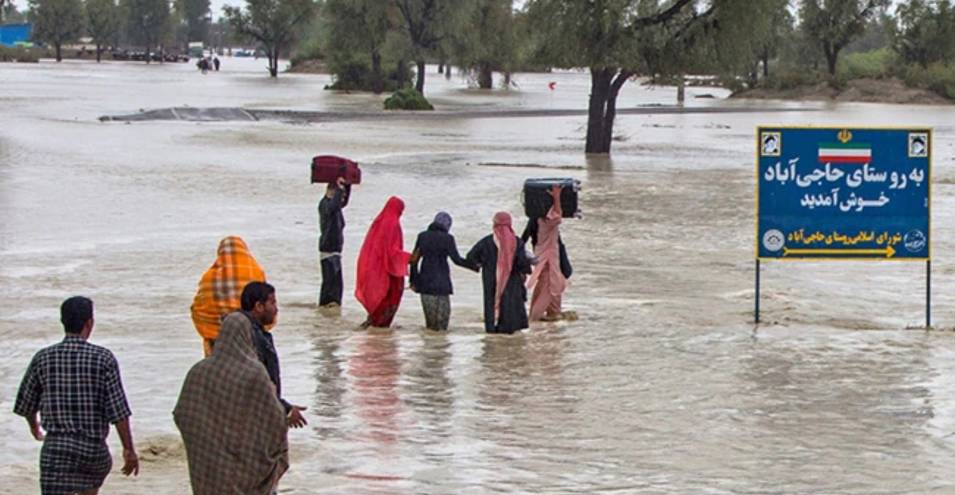
Following the flooding caused by rainfall in Sistan and Baluchestan, which, according to the Minister of Energy, was equivalent to four years of rainfall in the province, the situation in Konark city and the living conditions of the people in this region are still reported to be critical.
At the same time, the Sistan and Baluchestan Meteorology Department has warned that a new wave of snowfall, rain, and strong winds will hit the province starting on the morning of Thursday, January 6.
Due to the recent rainfall in Sistan and Baluchestan, seasonal rivers overflowed, communication routes were blocked, and the homes of many people in several cities and dozens of villages in the cities of Chabahar, Konarak, Sarbaz, Nikshahr, Dashtiari, Fanoj, Qasr-e-Qand, and Delgan in the south of the province were severely flooded.
Abdul Ghafoor Hot, the governor of Konarak, told Mehr News Agency that water has penetrated at least more than two thousand houses in the city and has requested help from all government agencies, as well as the private sector and local benefactors, to collect surface water.
According to Ali Akbar Mehrabian, Minister of Energy, a total of 334 millimeters of rainfall was reported in the recent rainfall in Sistan and Baluchestan province, which is equivalent to four years of rainfall in this region, meaning four years of rainfall in four days.
According to this report, only in the city of Konarak, where the situation is still reported to be critical, "108 millimeters of rainfall occurred in just about half an hour," which is said to be "one of the heaviest rainfalls in recent decades in Iranian history."
Following the flooding of homes and the emergence of critical conditions, the Red Crescent announced on Wednesday, January 5, that 11 emergency shelter camps were being set up and that "a shipment of essential items will arrive in Konarak today."
The reason for this is that at least 70 percent of Konarak's houses have become uninhabitable and 90 percent of people's household appliances have become unusable. This statistic was announced by Rahmdel Bamri, the political deputy governor of Sistan and Baluchestan.
However, the Minister of Energy, who visited the region on behalf of the government, has announced that "the problems caused by the floods in the southeast of the country require national determination."
The reported damage and losses from the destruction of people's homes and belongings are separate from the extensive damage that the recent flood has caused to farmers. In just one case, in Delgan County, the "initial estimate" reported that "heavy damage of at least sixty billion tomans has been caused to 2,400 hectares of cultivated agricultural land."
The recent flooding and inundation was not limited to Sistan and Baluchestan province. According to reports, 14 provinces in Iran were affected by the floods, and as of January 4, it was reported that at least eight people had died as a result of the floods.
Previously, Mehdi Valipour, head of the Red Crescent Society's Relief and Rescue Organization, had announced that the provinces affected by flooding and inundation were West Azerbaijan, Isfahan, Bushehr, Qazvin, Fars, Kerman, Kohgiluyeh and Boyer Ahmad, Chaharmahal and Bakhtiari, Zanjan, Sistan and Baluchestan, Khuzestan, South Khorasan, Hormozgan, and Yazd.
In recent years, due to climate change and disregard for the environment in Iran and neighboring countries, especially in the area of soil erosion, in addition to the dust phenomenon, floods have also affected the lives of people in Iran.
Source: Radio Farda