Efforts by Iran's judicial and intelligence agencies to direct news about cases and defendants
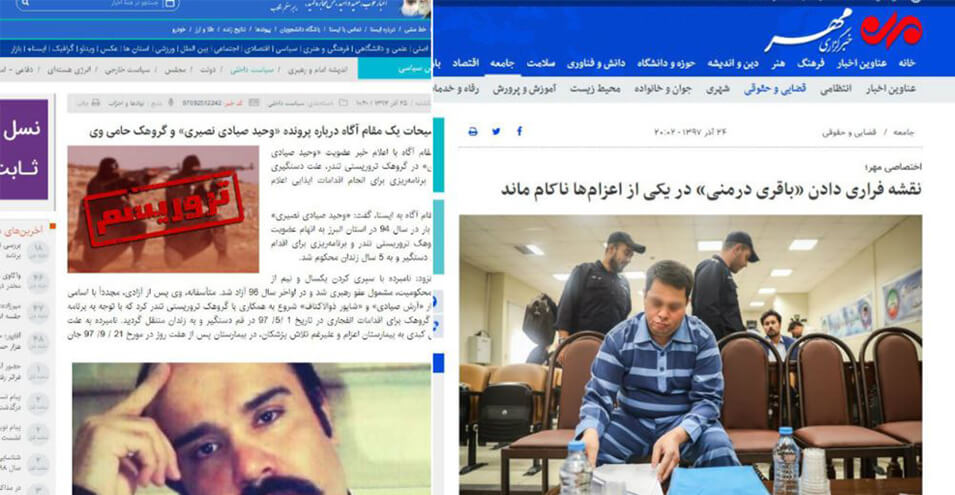
A review of several news stories in Iranian news agencies related to judicial defendants and regional issues in just one day shows that the judicial and security apparatuses continue to attempt to use news agencies as an arm of information dissemination and news direction.
While a political prisoner died this week after a hunger strike, the ISNA news agency reported on Sunday that he had a history of gang activity. Meanwhile, another report in the Mehr news agency quoted “an informed official” as saying that a financial suspect was trying to escape.
Reza Haghighatnejad, a journalist in Turkey, referring to the ISNA news agency and the Mehr news agency report, said that the long-standing practice of the judiciary and security agencies towards the media has not changed.
In a news report by ISNA, published on Sunday, December 15, the news agency quoted an informed source as saying that Vahid Sayadi Nasiri was arrested for planning to “carry out harassing operations.” The source explained that Mr. Sayadi “began cooperating with the terrorist group Thunder, which was arrested due to the group’s planning for explosive actions.”
Referring to the history of attempts by the judicial and security agencies to silence the media, Reza Haghighatnejad referred to the issue of Zahra Kazemi's death in detention, saying that in 2003, the Tehran prosecutor tried to insinuate through the IRNA news agency that Zahra Kazemi was a spy and had a stroke in the hospital after her arrest, but his attempt was unsuccessful.
According to this journalist and analyst of Iranian affairs, the current attempt by the Mizan and ISNA news agencies to cover up the death of Vahid Sayadi Nasiri in prison is similar to the same story, and it seems that the "informed official" who provided information to ISNA news agency has succeeded, at least in the first step, in insinuating that Vahid Sayadi Nasiri is a dangerous figure and that, despite the favors shown him by the regime, he has continued to participate in the activities of a notorious terrorist group.
Comparing these two cases actually shows that over the past 15 years, the judiciary's media approach and its relationship with the media have not undergone any significant change.
The duties of the media from the perspective of security agencies
In addition to the judiciary, the Ministry of Intelligence, the IRGC Intelligence Organization, and in some cases the Secretariat of the Supreme National Security Council have followed this practice over the past decades. Reza Haghighat Nejad believes: “From the perspective of these institutions, the media, as the information arms of the regime, must perform two important tasks: to promote the major components of the regime and to provide good news. The third and unstated aspect of the media’s duty is to wipe away the stains of shame on the regime. What happened in the case of Vahid Sayadi Nasiri’s death is the fulfillment of such a mission.”
The journalist also cited another example, the death in prison of environmental activist Kavos Seyed-Emami, and wrote that IRGC-affiliated media outlets carried out their mission of publishing the news they wanted in a broad and coordinated manner.
He said: "Detailed storytelling about the accused's mission, bizarre claims, rumor-making, and maximum security of the incident is a clear agenda that is always carried out by these media outlets to marginalize the killing of the accused and keep the case out of reach. In the same case of Vahid Sayadi Nasiri, the issue was also linked to terrorism, and just like in the case of Kavus Seyed-Emami, the case was heavily security-related. The ultimate goal of all of these activities is to create a distortion in the provision of information through the media."
Simultaneously with the publication of news quoting informed sources about the defendants in the court, the Fars News Agency, affiliated with the Revolutionary Guard, has also attempted to link the Crown Prince of Saudi Arabia and the Crown Prince of the Emirates to following a tradition in the Jewish religion.
The Fars News Agency news report, referring to the red bracelets worn by the two people, states that the red bracelets are "related to a superstitious belief in the Jewish religion."
This is while the bracelet in question is related to supporting competitions for the mentally disabled.
Mr. Haghighat Nejad believes that media outlets close to the IRGC typically have expertise and a strong track record in carrying out such missions, but state-run and more reputable media outlets also play their own roles, depending on the type of government's relationship with government institutions and the parallel intelligence organization.
Source: Voice of America