Javed Rahman: The Iranian government should not be allowed to get away with crimes against humanity and genocide
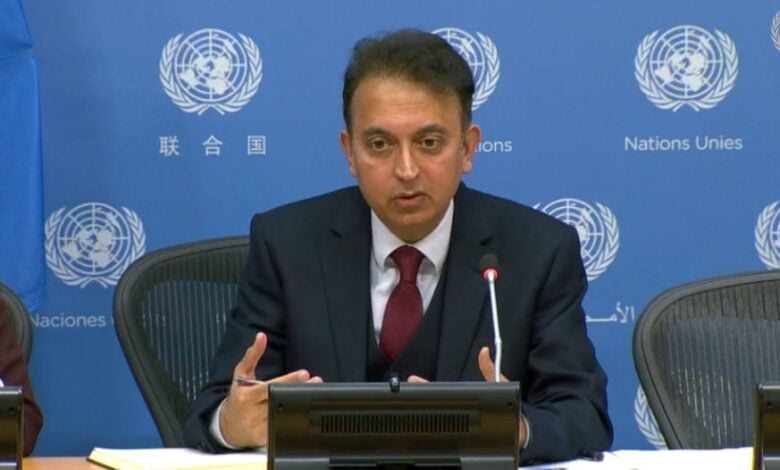
"Javed Rahman" said during a speech on human rights: "The Iranian government should not be allowed to get away with crimes against humanity and genocide."
In his speech this week, Javed Rahman, the UN Special Rapporteur on Human Rights in Iran, while emphasizing the suppression and elimination of Baha'is, the execution of political prisoners, and the arrest and torture of religious and ethnic minorities, referred to the crimes of the Islamic Republic government in the 1960s, especially in the summer of 2018, and said: "Targeting religious, ethnic, linguistic minorities, and political opponents with complete impunity took place in the first decade of the establishment of the Islamic Republic and has continued to this day. Among the executed were women, some of whom, according to published reports, were sexually raped before execution, and many of the executed were children. The Iranian government and its leaders must not be allowed to get away with crimes against humanity and genocide."
Attacks on religious minorities began in the early days of the Islamic Revolution, and regime agents began killing Christians and politicians. The first Christian victim at the hands of Islamists was Aristotle Sayyah, a priest of the Anglican Episcopal Church, who had his throat slit eight days after the Islamic Revolution. In addition, Hossein Soudmand, a Christian citizen and priest of the Jamaat Rabbani Church, was executed in Mashhad on charges of apostasy and buried in a ruin outside Mashhad.
Mehdi Dibaj was also sentenced to apostasy and execution in 1985 for his religious beliefs. A Christian leader and translator, he spent more than 9 years in prison, and the Islamic Republic government was forced to release him under international pressure and the efforts of Bishop Hayek Hospian, but just 5 months after his release, he was kidnapped and murdered by intelligence agents. At least 8 Christian figures have been executed or murdered by the Islamic Republic government.
In addition, by order of Ruhollah Khomeini, thousands of political and ideological prisoners who were serving their sentences in the prisons of the Islamic Republic, and even prisoners whose sentences had ended, were executed and buried in mass graves in the summer of 1988. Ayatollah Montazeri, who was the deputy leader of Iran at the time, opposed Ruhollah Khomeini's decision and called the aforementioned executions the greatest crime in the Islamic Republic.
UN Special Rapporteur Javed Rahman published a report a week before the end of his six-year mission on Iran, writing: "Arbitrary executions and persecution of Kurdish, Turkmen, Arab and Baluch political groups have also continued in the post-revolutionary period under the Islamic Republic government. In addition, immediately after the Islamic Revolution, a campaign against the Baha'is was launched with the aim of exterminating and genocide them, and this crime against them has continued to this day."
In late March 2013, in his sixth report on human rights violations in Iran, Javed Rahman expressed deep concern about the continued persecution, harassment, and arbitrary arrests of religious minorities, including Baha'is, Christians who have converted from Islam to Christianity, and Sufis, including the Gonabadi Dervishes, who are not recognized in Iran.
In his remarks this week, Javed Rehman called for an impartial and transparent investigation under international law, saying: "Hiding the fate of thousands of political opponents and the location of their remains constitutes a crime against humanity, an enforced disappearance."
It should be noted that the government of the Islamic Republic of Iran never allowed Javed Rahman to travel to Iran, and after the end of July, he will be replaced by Japanese lawyer Mai Sato.