Foreign Minister and Khamenei's representative argue over sanctions against the IRGC
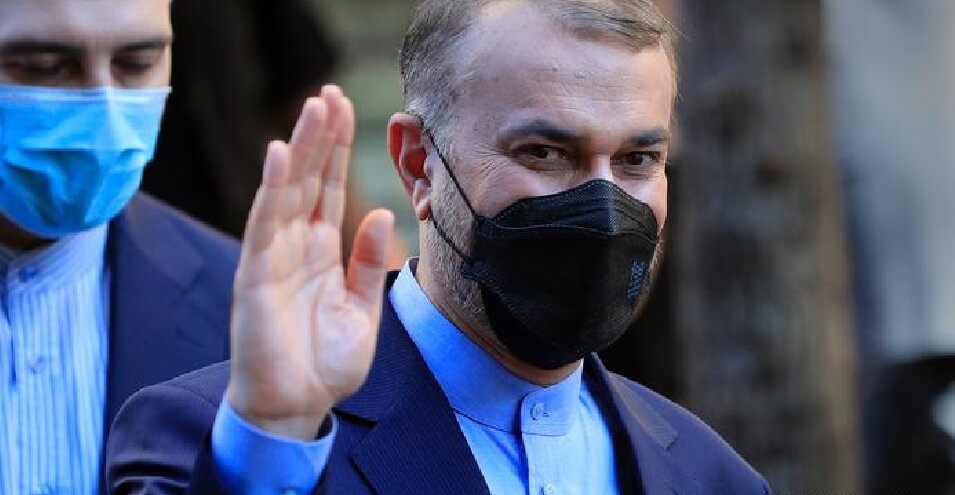
In response to criticism from Khamenei's representative at the Kayhan Institute about his remarks about the IRGC, Amir Abdollahian called his perception "incorrect." The Foreign Minister, quoting senior IRGC commanders, said that "the IRGC issue" should not prevent reaching an agreement in Vienna.
On Sunday, March 27, the Islamic Republic's Foreign Minister called the Islamic Republic Leader's representative at the Kayhan Institute's interpretation of his remarks in a television interview about the Revolutionary Guard Corps "far from the imagination and unlikely," in an Instagram message.
On Saturday, Hossein Amir-Abdollahian said that the senior commanders of the IRGC are ready to "sacrifice" regarding the removal of the IRGC from the list of terrorist organizations and the lifting of sanctions against this institution and its affiliates, which is considered one of the last points of the final agreement in the negotiations to revive the JCPOA.
In an interview with Khabar Network, he quoted high-ranking IRGC commanders as saying: "They say you should do whatever is necessary in the interests of the country, and if you reach a point where the issue of the IRGC is raised, the issue of the IRGC should not be an obstacle for you."
Head of the government's diplomatic apparatus, Ebrahim Raisi, added that in his opinion, the high-ranking officials of the IRGC are actually "showing a kind of selflessness and taking their sacrifice to the highest level," saying that if you really see that the country's interests are being achieved in this agreement, "the issue of the IRGC should not be among your priorities at all."
The controversy over "surrender" or "sacrifice"
In an interview with Fars News Agency, Hossein Shariatmadari accused Amir Abdollahian of making a mistake and mistakenly calling "surrender" "sacrifice" and "worse still, attributing this surrender to the commanders of the IRGC."
Ali Khamenei's representative at the Kayhan Institute says the Foreign Minister's statements could fuel the perception that he does not have "sufficient and necessary knowledge of current issues in his area of responsibility."
In response to these criticisms, Amir Abdollahian wrote in an Instagram note: "What was said is the approach of the Supreme Commanders, which is not to back down even for a moment in securing and protecting the interests of the nation, provided that a good, strong, and sustainable agreement is reached."
He also said in a television interview that despite the "self-sacrifice" of the IRGC's senior commanders, one of the central issues remaining in the messages exchanged with the United States is "the status of the IRGC, the role of the IRGC, and the legal dignity of the IRGC," which is still considered one of the Islamic Republic's red lines for reaching a final agreement.
The 13th government's foreign minister called on Shariatmadari to reread Saturday's interview and, without naming him, wrote: "The far-fetched and unlikely interpretation that some loved ones have made of yesterday's talks is incorrect, and the issue is not at all about crossing or compromising on red lines."
In recent days, there has been much discussion about the "one or two issues" remaining in the negotiations to revive the JCPOA, the most important of which is Iran's request to remove the Revolutionary Guard Corps from the United States' list of foreign terrorist organizations.
Meanwhile, it seems that in the many discussions that have been raised, several issues are confused with each other or have not been given sufficient attention.
Sanctions unrelated to the nuclear deal
The most important issue is that the issue of sanctions against the IRGC and institutions such as the Office of the Supreme Leader of the Islamic Republic do not have a direct or significant connection to the nuclear agreement and the Joint Comprehensive Plan of Action (JCPOA), and this dispute goes beyond the Vienna talks between Iran and the United States.
Enrique Mora, the European Union's deputy foreign policy chief and coordinator of the Joint Commission on the JCPOA, recently said that expert talks on the revival of the JCPOA have ended on March 14.
Hossein Amir-Abdollahian also said in a television interview on Saturday that representatives of the Islamic Republic and the three European countries that are parties to the nuclear deal have reached an agreement on a text in the Vienna talks, and "if the Americans have a realistic approach, an agreement is achievable."
Senior US government officials have previously said they are willing to consider removing the IRGC from the list of terrorist organizations and are prepared to make "tough decisions" in this regard.
Meanwhile, Robert Malley, the US special representative for Iran and chief US negotiator, said in Doha on Sunday that sanctions against the IRGC would not be lifted even if an agreement was reached to revive the JCPOA.
Sanctions on the IRGC and the necessity of post-JCPOA negotiations
AmirAbdollahian claims that a possible agreement to revive the nuclear deal will not go beyond the JCPOA, while saying that removing the Revolutionary Guard from the US sanctions list remains "one of the serious and main issues."
The most significant sanctions against the IRGC were imposed following executive orders issued in 2007, 2010, 2011, and 2012.
All of these sanctions were imposed before the nuclear deal and have not been lifted or suspended since the signing of the nuclear deal. Accordingly, if the Islamic Republic truly wants to lift these sanctions, it must enter into post-JCPOA negotiations with the United States.
In the nuclear agreement between Iran and six world powers (the United States, Russia, China, Britain, France, and Germany), the UN Security Council sanctions resolutions against the Islamic Republic, which had previously been approved with the approval of the five permanent members of the council, were suspended.
Source: DW