Censorship instead of news: BBC's role in concealing the Iranian massacre
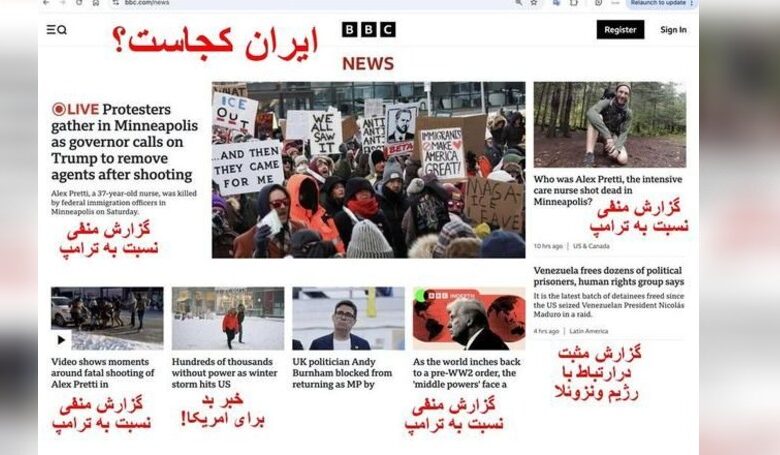
By removing news of the Iranian massacre from its main outlet, the BBC has been accused of censorship rather than reporting, and a wave of criticism has been unleashed about the media's role in concealing the humanitarian disaster.
As shocking reports emerge of tens of thousands of people killed in a bloody crackdown in Iran, the performance of major international media outlets, led by the BBC, has faced a wave of harsh criticism from lawyers, activists and public figures. Critics say that omitting or downplaying this humanitarian catastrophe from media output is not a professional error, but a meaningful decision with moral consequences.
In the latest reactions, Hillel Neuer, an international lawyer and executive director of UN Watch, wrote on the social network X to BBC World Service: "History will record that on the same day that Time magazine reported that 30,000 people died in Iran in a two-day massacre, your homepage did not mention Iran even once."
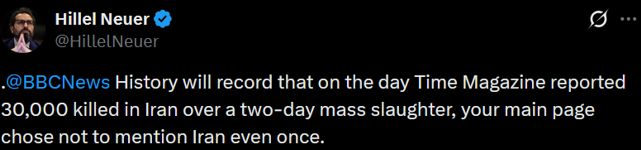
Pointing to the deep gap between the dimensions of the disaster and its media coverage, he described the BBC's silence not as news negligence, but as part of a worrying trend.
At the same time, Omid Jalili, a well-known British-Iranian comedian and figure, also wrote on X: "There is no news of the massacre in Iran on BBC News today; not a single report has been published."
These criticisms come as evidence from the field, independent media reports and human rights investigations show widespread killings of protesters in Iran, reportedly carried out mostly by gunshots to the head at close range. However, the lack of adequate coverage by a media outlet like the BBC, which sees itself as a global news source, raises serious questions about news standards and editorial priorities.
Some observers believe that, if we are to look optimistically, perhaps part of this silence is rooted in the inability of Western public opinion, especially in Britain, to understand the scale of state violence in another country; to accept that what are called "security forces" can kill thousands of their own citizens in a short period of time simply because of peaceful protest.
This situation seems even more paradoxical when compared to the domestic realities of Britain, a country where citizens have repeatedly complained about the poor quality of police services, and in some cases, even simple thefts are subject to delays or non-action. Critics ask how a media outlet that covers the smallest criminal incidents in Europe in detail can be so silent in the face of one of the greatest contemporary human tragedies?
This is not the first time the BBC has come under fire for its coverage of developments in Iran. In recent years, human rights activists have repeatedly accused the media of being overly cautious, using neutral language in the face of repression, and refraining from explicitly naming state violence. They believe that this approach not only fails to bring the truth to light, but also perpetuates impunity for perpetrators of violence.
In a world where information is disseminated at an unprecedented speed, the silence of the mainstream media is no longer a simple vacuum, but a message, one that can be interpreted as indifference, denial, or even complicity. The strong reactions to the BBC’s actions show that a significant part of public opinion and the human rights community are no longer willing to consider this silence as a harmless editorial choice. History (as Hillel Neuer has warned) will remember these days.