Tehran Mayor, Air Pollution, and the Debate on Evacuating the City
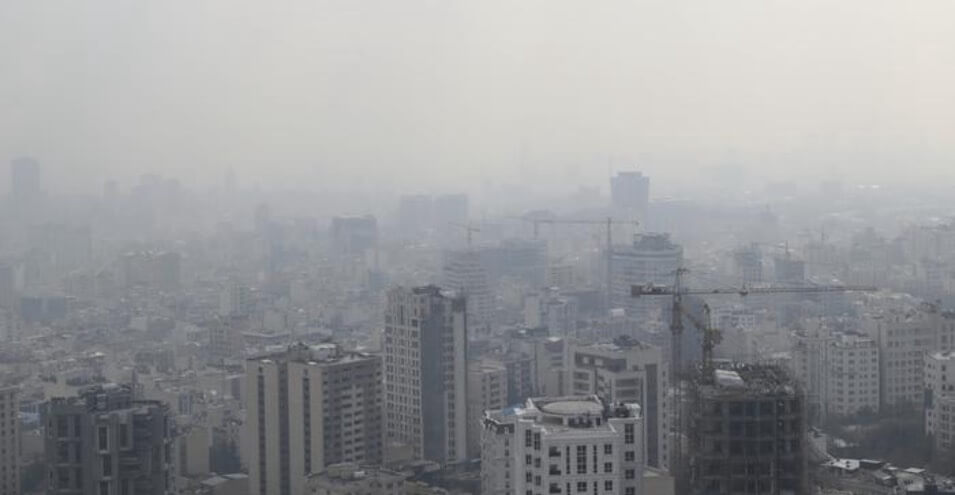
Schools and universities in Tehran are closed due to air pollution. Some news agencies quoted the mayor of Tehran as saying that if the pollution had continued on Monday, the city would have had to be evacuated. IRNA “denied” this news in a report.
Some news agencies in their reports on Tehran's air pollution on Tuesday (December 16) quoted Pirouz Hanachi, the mayor of Tehran, as saying at a meeting of the Tehran Chamber of Commerce that the suspended particles in Tehran's air on Monday night (December 16) had reached a level that "the city had to be evacuated."
A group of news agencies reported that he had said that if it had not rained, the city would have been evacuated. A report in IRNA on the same subject stated that the air quality in the capital on Monday night “was in red status with an increase in the concentration of suspended particles less than 2.5 microns with a momentary index of 167, making it unhealthy for all groups.” However, IRNA “denied” the mayor’s statement that “Tehran should be evacuated,” quoting Pirouz Hanachi himself. In any case, these remarks caused controversy, with Mohsen Hashemi, the head of the Tehran City Council, telling ISNA: “Did Hanachi say this? Did he say closure or evacuation? There is a difference between closure and evacuation!”
Closure is the only measure that will be implemented.
The mayor of Tehran emphasized in the same meeting that in order to control air pollution, attention should be paid to reducing pollutants. Is anything being done in this regard?
The only action that officials take in such cases is to close schools and many of the daily activities of the residents. Anoushirvan Mohseni Bandpei, the governor of Tehran, told IRNA that kindergartens, preschools, and schools in Tehran province at all levels of education except for the two counties of Damavand and Firouzkouh will be closed on Tuesday, December 17. All outdoor sports competitions and activities such as sand and gravel mines and similar industries will also be suspended “until further notice,” according to the governor of Tehran.
ISNA news agency has also reported that all universities in Tehran will be closed on this day. But what is the role of other citizens in such circumstances? Air pollution is now so bad that officials themselves admit that it no longer recognizes the elderly and the young and is dangerous for everyone. Will a one-day closure solve the problem? Past experience gives a negative answer to this question. In the coming weeks and months, Iran's major cities, and in the first stage, the capital, will have to be closed again and again. According to Anushirvan Mohseni, the head of the Air Pollution Emergency Committee, the plan to ban even and odd-numbered drawings from the doors of homes will be implemented.
But what will happen to a country whose capital city repeatedly comes to a standstill? Experts have no answer to this question.
The problem of air pollution in Tehran and other major cities in Iran is a serious threat to the health of citizens, which is caused by various factors: old and substandard vehicles, substandard fuel quality, pollution caused by factories, etc.
Public transportation also has neither the capacity to meet the needs of a city of several million people, nor has there been sufficient investment in their modernization, and they themselves are partly a factor in exacerbating air pollution.
According to experts, no serious and effective action has been taken on any of these issues. Tehran has now become a network of multi-lane highways and streets with millions of polluting cars. The high price of gasoline has not only not reduced this problem, but has also made citizens more desperate for transportation than before.
The metropolitan city of Tehran is facing a population growth rate of two percent, and its surrounding cities are facing a much higher growth rate of about 17 percent. Part of this million-strong population has now turned to public transportation, which does not have sufficient capacity to transport them, as gasoline prices have risen. The mayor of Tehran has said that the metro is facing a shortage of 2,000 cars, blaming this on the “economic conditions of the country.”
"They didn't allocate even a single riyal to transportation development"
The mayor of Tehran said on Tuesday, December 16, at a meeting of the Tehran Chamber of Commerce, “With the increase in gasoline prices, the public transportation load on the metro has increased by more than 12 to 13 percent.” In other words, with the increase in gasoline prices, organizing transportation in Tehran is now facing “newer challenges.”
Mohsen Hashemi, the head of Tehran City Council, also said: “Solving the problem of air pollution is a sovereign and cross-sectoral issue.” He continued: “In many countries, they use electricity as a means of heating, they do not allow the production of inferior cars, and they also support public transportation. All of these issues are sovereign and various agencies are involved in this matter.”
He also pointed to the increase in people's problems after the increase in gasoline prices, saying: "Since the increase in gasoline prices, not a single rial has been spent on transportation development, and we see that air pollution is now in a terrible state."
The closure of schools made headlines not only today but also yesterday (December 15). IRNA news agency quoted Alireza Salimi, a representative of the neighborhoods, as saying that he criticized the continuous closure of educational centers due to air pollution and demanded that the mayor of Tehran implement the Clean Air Law. The law was passed in 2017 and required the Environment Organization to prepare regulations related to this law within three to six months and submit them to the Cabinet for approval.
In December 2018, after some of the “defects” of this law were fixed and “reform proposals from the executive agencies” were added, the Cabinet of Ministers tasked the Environmental Protection Organization with reviewing the necessary reforms in cooperation with other agencies and presenting the results within 6 months. A deadline that has long passed, but there is still no news of the implementation of the Clean Law.
Experts such as Kaveh Madani, who has closely followed the state of the environment and how related laws and regulations are being "implemented" in the Islamic Republic for some time, described the implementation of the Clean Air Law in a tweet as an "empty dream."
Research by the Ministry of Health on seven major Iranian cities shows that 29,500 people die annually in these cities due to pollution. The only thing that has been implemented so far is that metro and bus tickets were halved on Tuesday.
Source: DW