Amnesty International: Iran responsible for more than half of all recorded executions in 2017
On Thursday, April 13, Amnesty International released its annual report on the use of the death penalty in 2017, calling the death penalty a "cruel and inhumane" punishment and identifying Iran as the second country in the world in terms of the highest number of executions.
The report states that 142 countries have abolished the use of this punishment in their laws or stopped it in practice, but last year 23 countries, including Iran, continued to carry out executions.
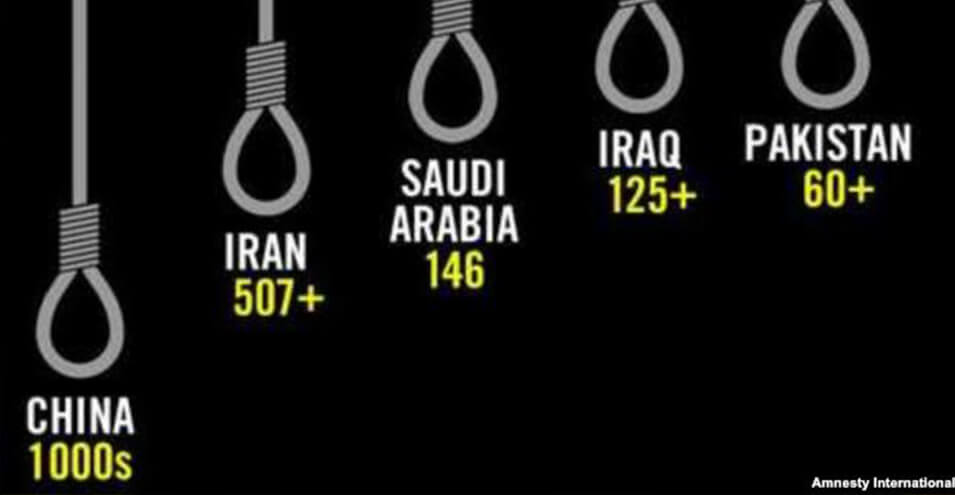
According to Amnesty International, at least 507 people were executed in Iran last year, more than half of all executions recorded worldwide. This is an 11 percent decrease from the number of executions in 2016, but still a high figure compared to other countries.
Of the 507 executions carried out last year, 205 were related to drug crimes and 240 were related to retaliation, making this the first time that executions related to drug crimes have been fewer than executions related to other crimes.
Amnesty International says efforts have been made in Iran to reduce drug-related executions in the past year, citing a new law passed by the Islamic Consultative Assembly in the fall of 2017 that restricts the use of the death penalty for drug-related crimes.
- In 2017, 993 people were executed worldwide, a decrease of about four percent compared to the previous year.
- Most executions have taken place in countries in the Middle East and North Africa.
- Of the 193 UN member states, 170 did not use the death penalty.
- With at least 507 executions, Iran has the highest number of executions in the world after China.
- The death penalty still exists in the laws of 56 countries around the world.
- The death penalty is still used for drug offenders in 15 countries around the world.
- The United States and Japan are the only G8 countries that use the death penalty.
- In 2017, 23 people were executed in the United States and four in Japan.
- After Iran, Saudi Arabia ranks third with 146 executions.
At the same time, Amnesty International has expressed concern about the use of the death penalty in Iran for some other crimes, writing in its report that charges such as warring against God, corruption on earth, and insulting the Prophet are punishable by death in Iran, while these cases are not considered capital crimes under international law and should not be subject to the death penalty.
The report also states that the trial process of many people sentenced to death in Iran is "unfair" and that their confessions are obtained "under torture and ill-treatment," and in some cases these confessions are broadcast on Iranian television.
The public execution of 31 death sentences and the execution of at least four juvenile offenders (people who were under 18 years old at the time of the crime) in Iran are other cases that Amnesty International has criticized.
According to the organization, 80 other juvenile offenders are awaiting execution in Iranian prisons, which violates international law and the Convention on the Rights of the Child.
According to a report by this human rights organization, hundreds of other death sentences were issued in Iran last year, but the organization was unable to confirm the exact figures.
According to Amnesty International, since the number of executions in China is considered confidential government information and there are no accurate statistics, Amnesty International's report and statistics were published without including the number of executions in China, but the number of executions in China is probably higher than in any other country in the world.
Accordingly, Iran, along with three countries - Iraq, Pakistan, and Saudi Arabia - were collectively responsible for 84 percent of all executions carried out in 2017.
After Iran, Saudi Arabia had the highest number of executions in the world in 2017 with 146 executions, and Iraq and Pakistan with 125 and 60 executions, respectively.
Amnesty International stated at the end of its report that the report was prepared using information from various sources, including official statistics, court rulings, individuals sentenced to death or their families and lawyers, reports from civil society organizations, and the media.
The use of the death penalty and the high number of executions in Iran are among the issues that have been criticized in recent years by the United Nations, Western countries, and a number of human rights defenders.
Source: Radio Farda