Travel Ban on Iranian Paralympic Champion Lifted
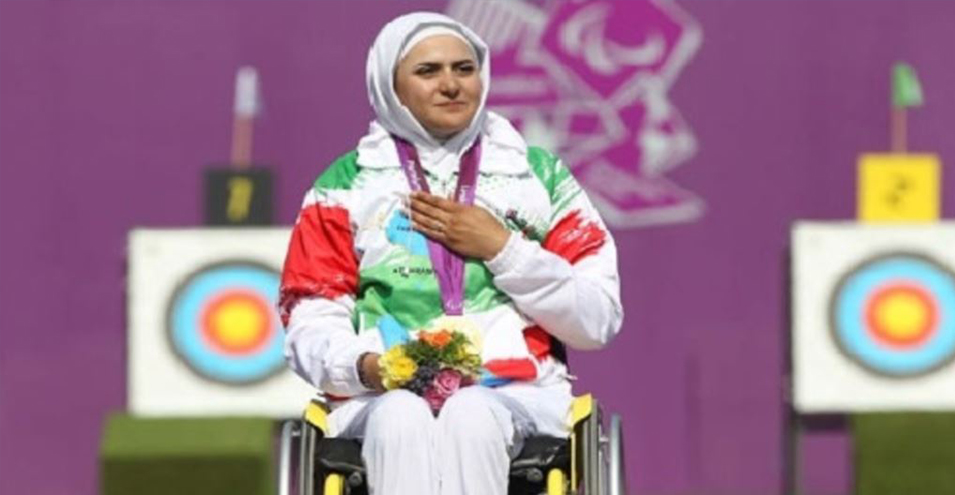
Iranian media reported that the travel ban on Zahra Nemati, an Iranian Paralympic champion, has been lifted. Her husband had imposed the travel ban on her. Zahra Nemati is an archery champion and flag bearer of the Islamic Republic of Iran’s delegation at the Rio Olympics.
The ISNA news agency on Wednesday, May 10, did not release further details and only reported the lifting of the travel ban citing a member of the Cultural Commission of the Islamic Consultative Assembly.
On Monday, May 8, Reham Shahabi Pour, the husband of Zahra Nemati, told ISNA news agency that his wife left home after the Rio Paralympic Games and requested a divorce.
According to Article 18 of Iran’s Passport Law, a married woman can only obtain a passport with her husband’s written consent or with the permission of the prosecutor of the city where the passport application is submitted.
Zahra Nemati, a member of Iran’s national archery team for athletes with disabilities, is among the few athletes in the world who have won gold medals at both Paralympic and Olympic Games. She was the flag bearer of Iran’s delegation at the Rio Olympic Games.
Nemati’s husband is also an athlete on the disabled archery team.
This is not the first time female athletes have been placed under travel bans by their husbands following disputes with them. In September 2015, Niloofar Ardalan, captain of Iran’s women’s futsal team, was unable to participate in the AFC Women’s Futsal Championship due to being placed under a travel ban by her husband.
She wrote on her Instagram page that her husband refused to allow her to leave the country to participate in the AFC Women’s Football Championship because he insisted on attending the first day of school with their child.
Iran is among countries where women cannot travel abroad without their husbands’ permission. This law is among those that has been protested by women’s rights activists and is recognized as discriminatory legislation against women.
Daryá Safaei, a women’s rights activist, said in an interview with the Farsi service of Voice of America: “In the laws of the Islamic Republic, women are recognized as beings who need a guardian and supervisor; this guardian is the father before marriage and the husband after marriage.”
The United States has repeatedly criticized the discriminatory laws and policies of the Islamic Republic against women.
Two years ago, Samantha Power, the U.S. representative to the United Nations, criticized Iran’s membership on the board of the UN entity for gender equality. She cited the lack of legal permission to appoint women to certain government positions, the absence of laws against domestic violence, and the existence of stoning as punishment in Iranian law as reasons that make it completely inappropriate for Iran to assume a leadership role in the field of women’s welfare and rights at the United Nations.
Meanwhile, Shirin Ebadi, a lawyer and Nobel Peace Prize winner, told the Farsi service of Voice of America that what the U.S. representative at the United Nations enumerated regarding gender inequality in Iran is only a small part of these inequalities and the disregard for women’s rights.
Source: Voice of America