Reactions to Mohsen Rezaei's recent tweet: Was the death of thousands of Iranian soldiers just a "hoax"?
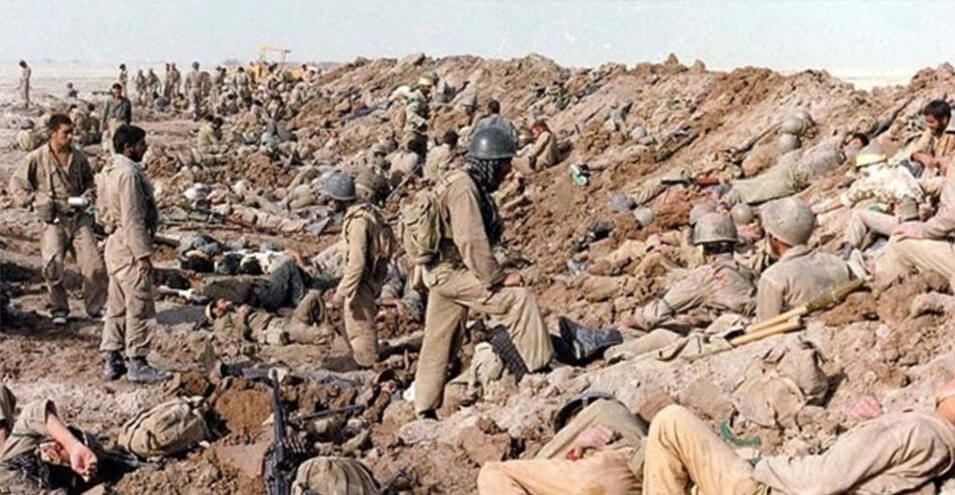
A recent tweet by Mohsen Rezaei, the then commander of the IRGC during the eight-year Iran-Iraq war, about Operation Karbala IV, has drawn widespread backlash from Twitter users. While he claimed the operation was to “deceive the enemy,” users and even some family members of those killed in the operation say sacrificing thousands of Iranian soldiers for what he called deception is a “crime,” and Mohsen Rezaei and senior officials should be brought to justice.
In a tweet, Mohsen Rezaei described the Karbala IV operation as an operation to deceive the enemy and wrote: "If a historical analyst is deceived in understanding it, then woe to his writings." Apparently, he wrote this tweet in a verbal dispute with a senior government official.
He wrote in another tweet about the details of this operation: "With Operation Karbala IV, we pretended to the enemy that this was our only annual operation. Ten days later, at the same spot and when the Baathist army forces had gone on leave, we carried out Operation Karbala V."
The Karbala Four was carried out in January 1986, resulting in thousands of Iranian forces being killed and missing. Although the exact number of dead and missing in this operation has not been clearly announced to this day, Hashemi Rafsanjani, the commander at the time of the war, quoted Ali Shamkhani, the deputy commander of the IRGC, as saying in his memoirs of January 1, that the Iranian forces suffered “one thousand martyrs, 3,900 missing, and 11,000 wounded.” Some sources have estimated the number of Iranian forces killed to be much higher, as high as 12,000. Iraqi television broadcast images of a large number of Iranian casualties, indicating a very high number of Iranian forces casualties. The New York Times reported at that time that more than ten thousand were killed.
Last year, with the discovery of 175 bodies of divers from Operation Karbala IV, the story of the bloodiest operation for Iranian forces in the Iran-Iraq war made headlines, and earlier, the "leakage" of this operation was cited as the reason for its failure.
But the former IRGC commander's recent tweets about Operation Karbala IV have raised a new issue. This time, Mohsen Rezaei called Operation Karbala IV a way to deceive the Iraqis and a prelude to Operation Karbala V.
Most users criticized the fact that Operation Karbala IV, which had the highest casualty rate for Iranian forces in the Iran-Iraq War, was only intended to deceive the Iraqis.
Mir Hossein was unaware of the executions of the 1960s!
Rafsanjani was unaware of #KarbalaChahar !
Khatami was unaware of the situation in the university dormitory!
Rouhani was unaware of the increase in the exchange rate!
And most importantly, the leader was unaware of all these events!— Luther King (@M_Lotherking) December 30, 2018
Political activist Mohammad Mozaffari posted a photo of the remains of a diver with his hands tied, writing: "The picture below belongs to one of the martyred divers in the Karbala IV operation, who was tortured and died tied up so that the enemy would be deceived! When the time comes, they will kill us all so that the enemy would be deceived."
#Mohsen_Rezaei : Operation #Karbala_Chahar was carried out to deceive the enemy.
The image below belongs to one of the martyred divers in Operation Karbala IV, who was tortured and died handcuffed so that the enemy could be deceived!
When the time comes, they will kill us all so that the enemy will be deceived. pic.twitter.com/OoauVqLRB6
— Mohammad Mozafari (@mohmd_mozafari) December 28, 2018
Also, Hesameddin Ashena, an advisor to Iranian President Hassan Rouhani, wrote on his Telegram channel to Mohsen Rezaei: "There is a world of difference between a deception operation and a leaked operation. Retrospective analyses do not solve a problem. We may forgive the wrongdoers, but never the narcissists."
Iranian writer and satirist Pouria Alemi also tweeted to Mohsen Rezaei: "Why, Mr. Rezaei, do you every now and then pour salt on the wounds of the loss of so many young people and martyrs, so many grieving families?"
The commanders jokingly pretended to have a plan.
The soldiers were seriously pretending to be captured, shot, and killed.🙁
Why, Mr. Rezaei, do you keep rubbing salt into the wounds of the loss of so many young men and martyrs, and so many grieving families? https://t.co/tvfyhYeQut— Pouria Alami (@pouriaalami) December 28, 2018
Some users also tweeted videos of the farewell moments of the divers of Operation Karbala Four and scenes of the words of martyr Hassan Bagheri.
Although Mohsen Rezaei this time called the Karbala IV operation a "deception operation," published documents and interviews with commanders of this war, contrary to Mohsen Rezaei's claim, the issue of the operation's "deception" seems closer to the reality of the operation.
Previously, Mirza Mohammad Salgi, one of the commanders of that operation, had stated in this regard that "a fundamental problem threatened us, and that was the lack of compliance with security principles and the enemy's knowledge of the presence of nearly 100,000 Iranian forces in Aqaba, this region, who were training in various camps and garrisons in the south until the operation. In addition to the common and general issues of all divisions, two characteristics of our division's conditions distinguished it from the others."
Even Mohsen Rezaei himself said in his memoirs that "until a week before the operation, and based on the commanders' assessment, the surprise rate was about 80 percent, and by the night of the operation it had reached about 50 percent." Nevertheless, the operation was carried out.
Source: Voice of America