Pompeo: US may target more Iranian leaders if Iran retaliates
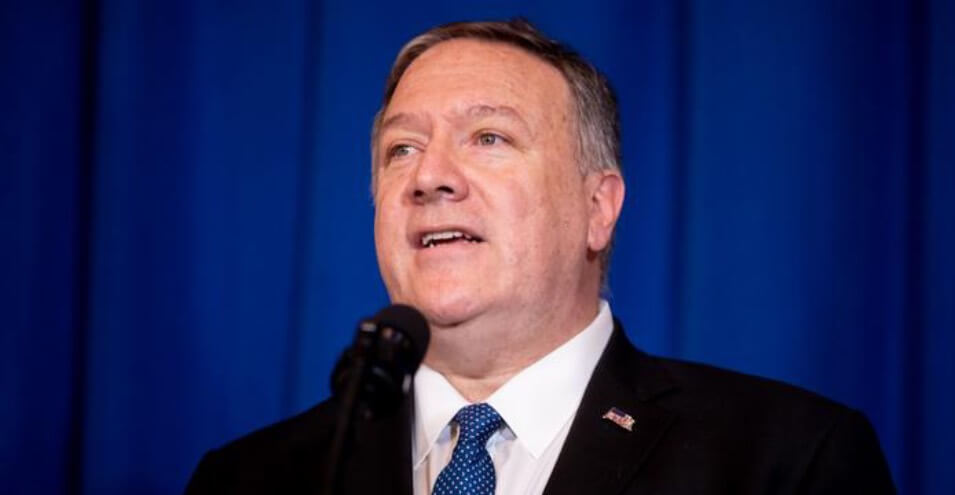
Reactions to the killing of Qassem Soleimani in the US strike in Baghdad continue: Pompeo threatened that the US could attack more Iranian leaders if Iran retaliates. Germany, France and Britain called on Iran to exercise restraint.
[00:13] Pompeo: US may target more Iranian leaders
The US Secretary of State warned that if Iran tries to attack Americans or their interests in revenge for the killing of Qassem Soleimani, the US military may target more of the country's leaders.
According to the Associated Press, Mike Pompeo, during his television interviews, attempted to clarify the US strategy in targeting Soleimani in Baghdad.
Iran and Shiite groups it supports have threatened retaliation. In the latest developments, Iraqi police reported that three rockets were fired near the US embassy in Baghdad.
[00:06] Leader of Asaib Ahl al-Haq: If American forces do not leave Iraq, they will be considered occupiers
Qais Khazali, leader of the Asaib Ahl al-Haq group, an Iranian-backed Shiite group, warned against the continued presence of American forces in Iraq.
He said that if American forces do not leave Iraq, they will be considered "occupiers."
The Iraqi parliament voted on Sunday to withdraw foreign troops, including American units, from Iraq.
[23:49] NATO holds extraordinary meeting to review regional developments
NATO Secretary General announced the convening of an extraordinary meeting regarding the rising tension between Iran and the United States in Iraq.
Reuters writes that Jens Stoltenberg announced that the meeting will be held on Monday, January 6th.
This meeting will review developments in the region after the killing of Qassem Soleimani in Baghdad.
[23:42] Merkel, Macron, Johnson call on Iran to exercise restraint
Germany, France and Britain have called on Iran “in particular” to exercise restraint in light of the escalating tensions between Iran and the United States. A German government spokesman said Sunday evening that German Chancellor Angela Merkel, French President Emmanuel Macron and British Prime Minister Boris Johnson had spoken by phone and were in agreement.
All three politicians believe in trying to reduce tensions between Iran and the United States. In addition, they believe that Iraq's national sovereignty and security must be preserved. They are "trying with all their might to reduce tensions in the region."
[23:32] Pompeo's reaction to the decision to withdraw US troops from IraqAfter the Iraqi parliament approved the withdrawal of foreign forces, the US Secretary of State implicitly spoke of America's desire for a military presence in Iraq, noting that this presence was "in Iraq's interest."
In an interview with CBS, Mike Pompeo said that Washington is committed to continuing its presence in Iraq and fighting terrorism, and considers it to be in the interest of both countries.
He also recalled that Iraqi Prime Minister Adel al-Mahdi, who has called in parliament for the immediate withdrawal of American forces from the country, "has resigned due to numerous Iranian interference in his government."
[23:30] “Several rockets hit near the US embassy in Baghdad”
International news agencies are reporting that at least two to three missiles hit near the US embassy in Baghdad's Green Zone.
The news quoted Iraqi police as saying that the US embassy's emergency sirens had sounded.
[23:15] Johnson: Soleimani was involved in actions that led to the deaths of thousands of innocent people
The British Prime Minister called Qassem Soleimani's actions a "destabilizing" factor in the region, saying he was "responsible for a pattern of destructive and destabilizing behavior in the region that gave him a leading role in actions that led to the deaths of thousands of innocent civilians and Western personnel."
Boris Johnson, while stating that he did not regret the killing of Soleimani, referred to Iran's threat of retaliation and added that calls for revenge and retaliation "will only lead to more violence in the region."
He said he had spoken with US President Donald Trump, German Chancellor Angela Merkel, and French President Emmanuel Macron about the rising tension in the region and was trying to defuse it.
Johnson added that Britain has taken steps to increase the security of its personnel and interests in the region.
[22:30] Erdogan's warning: Don't make Iraq a scene of conflict between Iran and America
The Turkish president warned of the possibility of a loss of stability in the region, given the rising tensions between Iran and Iraq after the killing of Qassem Soleimani.
Recep Tayyip Erdogan said that turning Iraq into a conflict zone between Iran and the United States will increase tensions in the region and disrupt its stability.
[21:57] Pompeo: I spoke with Qatari Foreign Minister about Iran's continued threats
The US Secretary of State announced in a tweet that he had a telephone conversation with his Qatari counterpart and discussed "Iran's continued threats and provocative actions."
In a conversation with Mohammed bin Abdulrahman Al Thani, Mike Pompeo thanked him for Qatar's efforts to de-escalate tensions in the region.
[21:54] The Islamic Republic of Iran lifted all restrictions of the JCPOA.
On Sunday, January 5, the government of the Islamic Republic of Iran issued a statement announcing the fifth and final step in lifting the restrictions of the nuclear agreement, the Joint Comprehensive Plan of Action (JCPOA).
According to the government information website: “In the fifth step of reducing its commitments, the Islamic Republic of Iran will remove the last key item of its operational restrictions in the JCPOA, namely the “limitation on the number of centrifuges.” Thus, the Islamic Republic of Iran’s nuclear program no longer faces any restrictions in the operational area (including enrichment capacity, enrichment percentage, amount of enriched material, and research and development), and from now on, Iran’s nuclear program will proceed solely based on its technical needs.”
The statement states that “Iran’s cooperation with the International Atomic Energy Agency will continue as before” and “if sanctions are lifted and Iran is deprived of the benefits of the JCPOA, the Islamic Republic of Iran is ready to return to its JCPOA commitments.”
[21:35] The German government made the continuation of the military presence in Iraq conditional on the approval of the country's government.The German government announced that it would be willing to continue the German military mission in the country if the Iraqi government approves.
A spokesman for the German Ministry of Defense, noting that the German government is closely monitoring the situation in Iraq, told RND that what is certain is that German soldiers can remain in Iraq as long as the country's government announces its desire for their presence.
The Iraqi parliament voted on Sunday to withdraw 5,000 American troops from the country.
[21:00] Mohsen Rezaei's warning to America: We will raze Tel Aviv and Haifa to the ground
Mohsen Rezaei, former commander of the Revolutionary Guards, threatened to attack Israel, referring to Trump's threat to attack Iran.
Speaking at the funeral of Qassem Soleimani in Iran, he emphasized: "If America takes action after Iran's military response, we will raze Tel Aviv and Haifa to the ground."
[20:42] Iran summons German embassy chargé d'affaires
Iran's Foreign Ministry announced that it has summoned the German chargé d'affaires in Tehran to protest Germany's "unilateral positions" in the absence of the German ambassador.
According to Mehr, the Iranian Foreign Ministry announced that the summons was made "following unrealistic, ill-considered, and destructive statements by some German officials in support" of the US attack on the vehicle carrying Qassem Soleimani.
Mehr writes that the German embassy's chargé d'affaires announced that he would immediately report the matter to his country.
Reuters wrote in this regard that a German government spokesman on Friday called the attack that killed Soleimani "a response to Iranian military provocations."
[20:40] Arab League Secretary-General expresses concern over developments in Iraq
The Secretary-General of the Arab League expressed his growing concern over the ongoing developments in Iraq in a statement.
According to Reuters, Ahmed Abu al-Gheit said in the statement that the region is currently in dire need of peace, not worsening, flaming, and perpetuating conflicts.
Abu al-Gheit's message comes as tensions escalate between Iran and its backed militias on the one hand and the United States on the other.
[20:00]
Pompeo: Trump did not say he would attack Iranian cultural sites
In response to a question about Donald Trump's threat to attack 52 sites in Iran, some of which are culturally important, the US Secretary of State said that Trump did not say he was "attacking Iranian cultural sites."
In an interview with ABC, he said, with an implicit reference to Iran, that in response to proxy groups in Iraq, the US strategy is to target "real decision-makers."
Attacks on cultural sites are considered war crimes under international law.
[19:52] Ayatollah Sistani expressed condolences over the killing of Soleimani in a message.
Ayatollah Ali Sistani, one of the Shiite religious leaders, expressed his condolences over the killing of Qassem Soleimani in a message to Ayatollah Khamenei, the leader of the Islamic Republic.
According to Fars, in this message, Sistani called the news "a cause for great regret and sorrow" and considered Soleimani's "role" in the "fight against ISIS elements in Iraq" "unforgettable."
[19:48] Muqtada Sadr calls for the formation of “international resistance regiments”
In a message to the country's parliament, influential Iraqi Shiite cleric Muqtada al-Sadr called for the formation of "international resistance regiments."
In this message, he invited resistance groups inside and outside Iraq to an urgent meeting to form these regiments.
Sadr thanked the Iraqi parliament for approving the withdrawal of foreign forces from the country after the killing of Qassem Soleimani.
[19:26] Hassan Nasrallah: Americans will leave the region in disgrace
Hassan Nasrallah, the leader of Lebanon's Hezbollah, said in a televised message that the US would pay the price for the attack on Qassem Soleimani's car with "just retribution" in attacks on "every soldier, base and ship" of theirs.
He added that the same suicide forces that had previously driven the United States out of the region are still present on the scene and have increased in number.
[19:24] Soleimani's funeral ceremony in Tehran's Mosalla canceled
The IRGC Public Relations Department announced the cancellation of the funeral ceremony for Qassem Soleimani in Tehran's Mosalla, which was scheduled to be held at 7 p.m. on Sunday, January 5.
According to Khabar Online, the ceremony has been postponed to Monday morning, January 6, at Tehran University due to the "delayed arrival of Soleimani's body."
[19:20] Senate Democratic leader warns Trump about entering a "major war"
Senate Democratic Leader Chuck Schumer warned President Donald Trump about leading the country into a "major war."
According to Reuters, Schumer said in an interview with ABC News that America does not need this president who is dragging the American people into such a war with his "unwise words."
He added that he does not believe Trump would have the authority to enter such a war without congressional approval.
[18:20] Iraqi parliament votes to withdraw all foreign troops
The Iraqi parliament voted to withdraw foreign troops from the country. The mission of the US-led international coalition against ISIS must also end. The decision means that the Iraqi government has withdrawn its previous request for international cooperation in the fight against ISIS.
This resolution prohibits foreign forces from using Iraqi land, air, and sea space for any reason.
Although the resolution was passed by the Iraqi parliament, it is not binding on the Iraqi government to implement it. However, Iraqi Prime Minister Adel Abdul-Mahdi had previously said that he was seeking to end the military presence of foreign forces in the country.
[17:50]
Pompeo responds to Trump's threat to attack Iranian cultural centers
The US Secretary of State says that possible US military action against Iran would be in line with international law.
"We will act legally. We will act within the rules," Mike Pompeo said in an interview with ABC News, according to AFP.
[17:40] Iran sends letter of protest to UNESCO over Trump's threat
The Secretary-General of the UNESCO National Commission in Iran announced the decision to send a letter protesting the US President's threat to attack 52 centers, including cultural centers in Iran.
According to Mehr, Hojatollah Ayubi considered the US withdrawal from the world organization UNESCO as proof that "Americans do not attach any importance to human heritage." He even called the statement a "crime."
Donald Trump had threatened on his Twitter account on Saturday evening that 52 locations in Iran would be targeted “very hard” if the Islamic Republic jeopardized American interests. This number symbolizes the 52 Americans who were taken hostage after the occupation of the US embassy in Tehran in 2015.
[17:30] Coalition forces announce cessation of fighting against ISIS in Iraq
The US-led coalition forces announced that they are suspending their mission to fight the Islamic State (ISIS) group in the country due to recent missile attacks.
Given that American forces tasked with training local forces in Iraq have been facing missile attacks for some time, the coalition announced that these attacks have limited the ability of their training missions and that they will therefore review this mission.
[17:20] Iraqi parliament session begins on decision to expel US troops
A special session of the Iraqi parliament to review the plan to withdraw American forces began with the presence of Prime Minister Adel al-Mahdi.
According to Reuters, Iraqi lawmakers said they had called the meeting to approve a resolution calling on the government to withdraw US troops from Iraq.
[17:10] Pompeo: I have no doubt that Iran has received Trump's message
The US Secretary of State said it was "absolutely clear" that the world has become safer with the killing of Qassem Soleimani, the former commander of the IRGC's Quds Force.
In an interview with ABC, Mike Pompeo also warned that if the Islamic Republic plans to attack US targets, it will face a response from the US.
Pompeo added that there is no doubt that the leadership of the Islamic Republic has received the "message" from US President Donald Trump.
[17:00] British Foreign Secretary Stresses Need to Exit “Dangerous Crisis”
In a telephone conversation with Iraqi Prime Minister Adel al-Mahdi, the British Foreign Secretary called for a reduction in tensions after the killing of Qassem Soleimani, referring to the dangerous consequences of the war.
According to Reuters, in this conversation, Dominic Raab emphasized the importance of keeping the region and the world away from the dangers of war and its consequences, and reminded the Iraqi Prime Minister of the importance of moving towards reducing tensions so that a shift towards dialogue and a way out of this "dangerous crisis" can take place.
[16:50] Iraq summons US ambassador to Baghdad
Following the reactions to the killing of Qassem Soleimani in a US drone strike, the Iraqi Foreign Ministry summoned the US ambassador to Baghdad.
The Iraqi Foreign Ministry announced that the US ambassador was told during the summons that the country's territory should not be used to attack neighboring countries.
Meanwhile, the Iraqi parliament began its emergency session, attended by the country's outgoing Prime Minister Adel al-Mahdi, who is temporarily acting as acting prime minister. The session is expected to discuss the withdrawal of US forces from Iraq.
[16:40] Sardar Dehghan: Iran's response to US action will definitely be military
Iran's defense chief's advisor announced that the country's response to the US government's assassination of Qassem Soleimani will definitely be military.
In an interview with CNN, Brigadier General Hossein Dehghan said that Iran is not looking for war and that "it was America that started the war, so it must accept appropriate responses to the actions it has taken."
Dehghan added: "The only thing that can end this round of war is that the Americans must receive a blow equivalent to the blow they have dealt. After that, they should not look for a new round."
[16:20] Zolnour responds to Trump's threat: We will strike US regions as many times as there are verses in the Quran
The head of the National Security Commission of the Islamic Consultative Assembly, in response to Trump's recent threat, said: "If they want to hit 52 points in Iran, we will hit their areas as many as the verses of the Quran."
Mujtaba Zolnoor added: "We have a target of them as many as the verses of the Quran, and we will strike and target 124,000 of them as many as the prophets. Today, the majority of their forces in the region are under our target and fire."
US President Donald Trump threatened the Islamic Republic in a series of Twitter messages on Sunday morning that 52 Iranian sites would be targeted "very hard and very fast" if they attacked American citizens or interests.
[16:20] Pope Francis calls on Iran and America to exercise restraintFollowing the increase in tensions between Iran and the United States after the killing of Qassem Soleimani, Pope Francis, the leader of the world's Catholics, called on the conflicting parties to exercise restraint.
"War brings only death and destruction," Pope Francis said today at the Vatican.
[16:10] Israeli security cabinet meeting postponed until Monday
According to media reports, the Israeli security cabinet meeting, which was scheduled to be held to discuss the possible consequences of the killing of Qassem Soleimani, has been postponed until Monday.
The topic of the meeting, which was scheduled for this Sunday, was to discuss and consult on the possibility of an Iranian missile attack on Israeli targets and prepare for it.
Meanwhile, Benjamin Netanyahu today once again praised the US action in killing the former commander of the Quds Force, saying: "Qassem Soleimani was responsible for the deaths of a large number of American citizens and many other innocent people in the past and present decades."
The Israeli Prime Minister also added: "Soleimani has directed, planned and executed numerous terrorist attacks throughout the Middle East and elsewhere."
[15:50] British Foreign Secretary: Recent US action under current circumstances means self-defenseBritish Foreign Secretary Dominic Raab announced that the US action to attack the convoy of Qassem Soleimani, commander of the Quds Force of the Islamic Revolutionary Guard Corps, was in self-defense.
In an interview with the BBC on Sunday, January 5, when asked if there was such a thing as “legal” killing, Raab emphasized: “There is a right to self-defense.”
The British Foreign Secretary added that, in accordance with the duties that General Soleimani had, he was busy working with proxy groups and militias that were attacking Western countries. The right here and under these circumstances clearly means the right to defend oneself.
[15:30] The European Union invited Zarif to Brussels.According to the European Union's announcement, the EU's foreign policy chief, Joseph Borrell, in a phone call with the Iranian Foreign Minister, emphasized the need to de-escalate tensions and invited Mohammad Javad Zarif to Brussels.
The statement said that in a conversation with Zarif, Borrell described "the only way to take a step forward" as "a regional political solution" and said that the European Union is ready to support such a solution.
The European Union's foreign policy chief also expressed concern about the rise in tensions in Iraq, calling for Iran to exercise restraint and to reflect and exercise caution regarding any reaction to prevent the spread of tension.
[15:20] Mousavi: America's message was a rude letter from PompeoRegarding the US message to the Islamic Republic after the killing of Qassem Soleimani, the Iranian Foreign Ministry spokesman said that the message was a "rude" and "outside diplomatic procedure" letter from Mike Pompeo.
Abbas Mousavi said about this message, which was conveyed to Iranian officials through the Swiss embassy: "This message was a letter from the US Secretary of State that was outside diplomatic procedures, diplomatic formalities, and rude. We also reviewed this letter and responded with a response that was worthy of the American officials, at a level lower than they imagined."
Mousavi also denied that a delegation from Oman had traveled to Iran for mediation, saying: "The Islamic Republic of Iran and the Foreign Ministry do not accept negotiations under the shadow of threats, as we have been proceeding with this policy and strategy during this period."
According to ISNA, the Iranian Foreign Ministry spokesman also announced that "an important meeting will be held tonight on reducing JCPOA commitments and withdrawing from the fifth step, and final decisions will be made on this issue."
[14:20] Iran summons US interests representative for third timeThe Islamic Republic's Foreign Ministry summoned the Swiss ambassador in Tehran, who represents US interests in Iran, in protest at Trump's recent statements. This is the third time in recent days that the Islamic Republic has summoned the US interests representative in Iran.
According to Iranian media reports, during this summons, the Islamic Republic's "strong protest" against "threatening statements that violate fundamental international laws and norms" was conveyed to the Swiss ambassador in Tehran.
Abbas Araqchi, Iran's deputy foreign minister for political affairs, said at the summons: "The hostile, threatening, and abnormal statements of the US president are completely unacceptable and are in complete violation of international law."
Araqchi also referred to the "US President's threat to attack cultural centers," calling such a threat "clear evidence of a war crime."
Referring to the killing of the former commander of the Quds Force by American forces, the Iranian Deputy Foreign Minister emphasized: "In addition to all political and legal measures, the Islamic Republic reserves its indisputable right to respond to the assassination of martyred General Qassem Soleimani at a time and place it deems appropriate."
US President Donald Trump threatened the Islamic Republic in a series of tweets on Sunday morning that 52 Iranian sites would be targeted “very hard and very fast” if they attacked American citizens or interests. Trump had said that some of the targets were high-level and very important “to Iran and Iranian culture.”
[14:00] Iranian government delegation: Tehran will be closed on MondayThe Iranian government delegation has declared Monday a holiday in Tehran to prepare for people's participation in the funeral of Qassem Soleimani.
Ali Rabiei, spokesman for the Iranian government, while announcing this news, also announced the government's decision to close Kerman province on Tuesday (January 7).
Offices, schools, and universities across Khuzestan province were also closed today in Ahvaz due to the funeral of the former commander of the IRGC's Quds Force, the deputy head of the Popular Mobilization Forces, and their entourage. A similar ceremony was held in Mashhad today and is scheduled to be held tomorrow in Tehran and on Tuesday in Qassem Soleimani's hometown of Kerman.
[13:50] Azari Jahromi's harsh attack on Instagram's action in deleting posts related to Qassem Soleimani
Iran's Minister of Communications Mohammad Javad Azari Jahromi strongly attacked Instagram for removing posts related to Qassem Soleimani, saying: "We will definitely stand against this move."
While Iran's communications minister called Instagram's move to remove posts related to Qassem Soleimani "censorship of the voice of the Iranian nation and the world" by the United States, Facebook officials, as the company that owns Instagram, have said that the move was taken in compliance with US sanctions laws against the Islamic Republic. The US has placed the Revolutionary Guard Corps and its commanders on its terrorist list.
After the killing of the former commander of the Quds Force in a US drone strike, the social network Instagram has deleted posts by some Iranian users regarding the killing of Qassem Soleimani and blocked the pages of a number of individuals and Iranian state media outlets.
In addition to deleting some posts related to Qassem Soleimani, Instagram has also blocked the account of Ahmad Alam-ul-Huda, the Friday prayer imam of Mashhad, and the pages of the Tasnim news agency affiliated with the Revolutionary Guards and the Young Journalists Club affiliated with the state-run Iranian Radio and Television.
[13:40] Transfer of the bodies of Qassem Soleimani and Abu Mahdi al-Muhandis to MashhadThe Iranian Broadcasting Agency tweeted a photo of the bodies of Qassem Soleimani and Abu Mahdi al-Muhandis being transported to Mashhad on a passenger plane. The bodies of the dead are then scheduled to be transported to Tehran.
[13:30] Former Quds Force Commander: Israel was at the Center of the ConspiracyAhmad Vahidi, former commander of the IRGC Quds Force and former Iranian Minister of Defense, pointed the finger of blame at Israel regarding the killing of Qassem Soleimani, claiming that the country had "people on its assassination list" and that Qassem Soleimani was on that list.
Mr. Vahidi, speaking on Iranian state television on Saturday evening, January 4, accused Israel of being “at the center of this conspiracy” to kill Qassem Soleimani, and according to him, “perhaps the Americans were deceived by the Israelis.”
According to Tasnim News Agency, the former commander of the Quds Force threatened the Islamic Republic of Iran with the "response" to the United States, saying: "From now on, they will have to live in a constant nightmare, and this is not something that will end anytime soon. The response may be in the form of a series of events, and this will happen over time. Iran will act in a thoughtful, complex, and painful way in its own design."
Ahmad Vahidi continued his speech by stating that the Americans “crossed the lines for which they must receive a response,” and also threatened Israel, saying: “The Israelis must also wait for a response. Anyone else who supports this terror must also wait for our response. Harsh revenge may be a series of events that will take their breath away and make them throw themselves at Iran’s feet, begging us to stop them.”
On Friday, January 3, Iran's Supreme National Security Council held an emergency meeting with the presence of Ali Khamenei, the Leader of the Islamic Republic, regarding the killing of Qassem Soleimani by the United States, and announced that it would take revenge on the United States for this action "at the appropriate time and place."
[12:30] Ali Larijani rejects US claim about Qassem Soleimani's "imminent operation"Ali Larijani, the speaker of the Islamic Consultative Assembly, called the claim that Qassem Soleimani was planning “operations in Syria, Lebanon and Iraq against American forces” a “lie.”
In his speech before the order in the Islamic Consultative Assembly today, Sunday, Mr. Larijani called the killing of the former commander of the IRGC's Quds Force in a US drone strike a "great crime" and said to US President Donald Trump: "Your name will be recorded in world history alongside the crimes of the August 18 coup and the US crimes in shooting down the Iranian passenger plane."
The Speaker of the Islamic Consultative Assembly also rejected Washington's claim about Qassem Soleimani's intention to carry out "imminent operations" against American forces, saying: "American officials have said that General Soleimani wanted to take action against American forces in Syria, Lebanon, and Iraq. This claim is nothing more than a lie. The American people and the House of Representatives of this country should know that the US President's claim is a lie to cover up a war and terrorist crime, and they intend to deceive. If they have any documents, they should make them public."
Ali Larijani also stated that the recent action of the United States in Iraq "is not consistent with any international rules," adding: "The barbaric action of the American president is considered a terrorist operation of war, which contains the utmost disrespect for the Iraqi people, who carried out this action at night and stealthily, without any authorization."
The president and other US officials have described the killing of Qassem Soleimani as a “defensive action,” saying that the former commander of the IRGC’s Quds Force had traveled to Iraq to plan an “imminent attack” on US targets in the country, and that their goal in eliminating him was to prevent that attack. Trump had said that the move was not to start, but to “prevent war.”
[12:00] Statement by the Afghan Taliban regarding the killing of Qassem SoleimaniThe Afghan Taliban responded to the killing of Qassem Soleimani, the former commander of the IRGC's Quds Force, by issuing a statement.
In this statement, dated yesterday, Saturday, January 4th (January 4th), the killing of Qassem Soleimani by American forces was called "a great adventure" and warned of its consequences.
This extremist Islamist group, while offering condolences to the family of Qassem Soleimani and calling American forces "barbarians," emphasized in its statement that "the jihad against American barbarism and occupation continues in Afghanistan."
The Taliban have also stated: "The US response after the killing of General Soleimani and Trump's fear of taking responsibility for this murder shows that America is more powerless than ever."
This comes while Afghan President Ashraf Ghani, in a statement on Friday, January 4, in response to the killing of Qassem Soleimani, expressed concern about the "possibility of increased violence in the region."
In his statement, the Afghan president referred to Iran as his country's "great neighbor" and the United States as his country's "strategic and fundamental partner," and called on the parties involved to prevent an escalation of tensions. At the same time, Ashraf Ghani assured that no country would be allowed to use Afghan soil for regional conflicts.
[11:45] Iranian Army Commander's Reaction to Trump's Statement on Hitting 52 Targets
Major General Abdolrahim Mousavi said on Sunday, in response to a question about the US President's recent statements: "In a possible conflict in the future, which I doubt they will have the courage to carry out, it will become clear where these numbers 5 and 2 will belong."
Donald Trump had threatened on his Twitter account on Saturday evening that 52 locations in Iran would be targeted “very hard” if the Islamic Republic jeopardized American interests. This number symbolizes the 52 Americans who were taken hostage after the occupation of the US embassy in Tehran in 2015.
[11:30] Oman calls for dialogue between Iran and the US
Oman's state news agency announced that the country has called on the United States and the Islamic Republic to engage in dialogue to resolve the tension.
This is while Al-Mayadeen News Network reported this Sunday morning, citing "informed sources," that a delegation from Oman traveled to Tehran to mediate, but returned without any achievements.
According to this news network close to Lebanon's Hezbollah, the Islamic Republic has told the Omani delegation that it will not accept any mediation. According to the report, the members of the Omani delegation have left the country without meeting with Iranian officials.
Meanwhile, Mohammad Javad Zarif and Yousef bin Alawi, the foreign ministers of Iran and Oman, discussed regional developments in a phone call last evening.
[11:00] Abu Mahdi al-Muhandis' body transferred to Iran for DNA testingThe Popular Mobilization Forces announced in a statement that the body of Abu Mahdi al-Muhandis has been transferred to Iran for DNA testing and, after the testing, will be returned to Iraq for burial in the Wadi al-Salam cemetery in Najaf.
Abu Mahdi al-Muhandis, deputy commander of the Popular Mobilization Forces, was killed in a US drone strike near Baghdad airport in the early hours of Friday morning, January 4, along with Qassem Soleimani, commander of the IRGC's Quds Force. Several other IRGC officials and members of the Popular Mobilization Forces were also killed in the attack.
The funeral ceremony for the former commander of the IRGC Quds Force, deputy commander of the Popular Mobilization Forces, and his entourage began at 7:00 AM in Ahvaz today, Sunday, January 5. Offices, schools, and universities across Khuzestan province are closed.
The bodies of Qassem Soleimani and Abu Mahdi al-Muhandis were airlifted to Ahvaz this morning. The funerals for the two were held in Iraq the previous day.
Source: DW