Iranian asylum seekers in Sweden go on hunger strike due to dire conditions
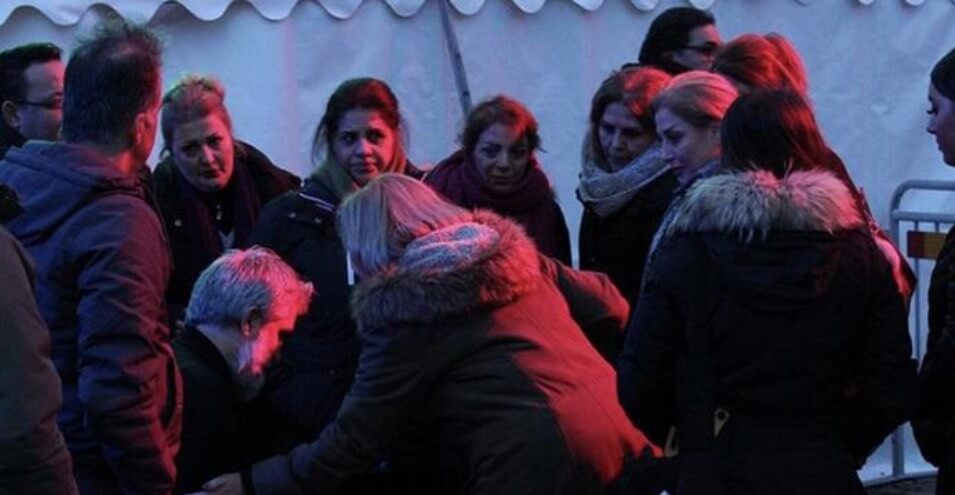
A group of Iranian refugees in the Swedish city of Gothenburg have staged a sit-in and hunger strike to protest the dire situation of refugees in the country. They are also calling on the Swedish government to abandon its “double policy” towards the Islamic Republic.
"Many of us, even those with children, have to share a room with two or three other people to make ends meet. The financial aid from the Swedish Migration Agency is not enough to cover the costs here. We have to work illegally. I feel really sorry for ourselves that we are exploited even when we work for our fellow countrymen. They make us work for very little pay. I have to work illegally and the employer, despite knowing my circumstances, charges me 40 to 60 kronor per hour (60 Swedish kronor is about five and a half euros)."
Narges Jalali tells DW Persian. An Iranian asylum seeker living in Gothenburg, Sweden, has been waiting for more than four and a half years for a court decision to clarify her asylum status. She has been denied once, has appealed, and now a year and a half has passed, but it is not even clear when the next court hearing will be held.
The employer sometimes asks her to work 12 or 13 hours a day. "Well, for a woman who has a child and leaves her child with her boyfriend, it's very difficult," she says. "It's no better for men. When they see after a long day of work that they are paid 40 kronor an hour, they have to pay at least 5,000 or 6,000 kronor a month for a room."
The West's dual policy towards the Islamic Republic
Narges, along with a group of nearly 80 refugees living in Gothenburg, have been protesting since February 15. 63 people have staged a sit-in. 14 of them are on a hunger strike. She is among the strikers. She says that with this movement they want to protest many things, “the policy of the whole world towards refugees,” the Swedish government’s appeasement of the Islamic Republic, and the “behind-the-scenes collusion” between the Swedish government and European governments with the Iranian government, all the while “the situation of refugees in the heart of Europe, in a place like Sweden, is dire, let alone in countries like Türkiye and Greece.”
Narges Jalali says that our protest is against the dual policies of Western countries that "claim that they are with the protesters and the Iranian people, but behind the scenes they are cooperating with the Iranian government. We want the Swedish government to stop colluding with the Islamic Republic."
Deportation, a threat that hangs over many asylum seekers in Sweden
The refugees are also calling on the Swedish government to address the poor conditions for asylum seekers in the country. Among them are people who left Iran for political activism or religious beliefs and are now at risk of deportation. "We want our asylum cases to be processed quickly and fairly," says Narges Jalali.
He also criticizes Iranian associations in Sweden: "Syrian refugees have the support of their fellow countrymen, but this is not true for us Iranians. It's not just us. All Persian-speaking people, Afghans, have the same problem. Some of our Iranian compatriots have lived here for 40 years, have an association, receive government assistance, and can support refugees, but they prefer to work only for themselves."
However, they are not alone in their protest movement. There are Iranians and Swedes who have come to the aid of the protesting refugees in organizing and financing this movement. Reza Talebi, a political activist and supporter of the protest movement, tells DW Persian:
"We are a group that each of us personally decided to support this movement. A rally has also been held by the people of Stockholm and other cities in Sweden to support this movement to cover the costs of this protest movement. Including the cost of the tent, transportation, electricity or lawyers who want to advance the work of the protesters."
The main goal of this group is to prevent the Swedish Migration Agency from deporting Iranian asylum seekers. He says: "We want to make it clear to the Swedish Migration Agency that we will not allow them to implement their decision to deport them. Because the problem with these people is not that they came here looking for a so-called luxurious life, but that they left their lives and homes for political, religious or social reasons and applied for asylum here."
“Hear our voice”
Reza Talebi talks about the history of a group that has been pursuing the demands of refugees and has now embarked on a sit-in and hunger strike: "Refugees here formed a group called "Hear Our Voice" a long time ago. This group tried to make their voice heard by the Swedish government through various means. As someone who has lived here for years and has worked in these fields and has experience, I decided to help them organize this protest movement, and now we are moving this movement forward together."
The 14 people who have gone on hunger strike have decided to “walk to the end.” They hope that such a move will draw public attention to the plight of refugees and the government’s behavior in Sweden. “This issue cannot be covered up in Sweden, which is a democratic society,” says Reza Talebi.
Sweden is one of the countries that has accepted the largest number of refugees in the world relative to its population and has given them a chance to live. However, with the start of the Syrian war and the wave of migrants coming to European countries, the Swedish government's approach to migrants also changed. Not only Sweden, but many European countries closed their doors to people who had fled the horrors of war and extremism.
Reza Talebi says: "Unfortunately, some countries did not fulfill their responsibilities, and the burden of humanitarian aid was shared only by a few countries, including Germany, Sweden, Belgium, and to some extent the Netherlands. The rest of the European Union countries almost did not accept refugees. This caused Sweden's human resources to accept refugees to decrease. On the other hand, right-wing forces have gained power in Sweden. For this reason, not only did financial resources and housing and other facilities such as education and housing decrease, but also a political climate was created that was not in favor of immigrants."
He is also critical of the Swedish government's policy towards the Islamic Republic and what is reflected in the country's media regarding Iran, saying: "The image that the European and especially Swedish media portray of the situation in Iran is in fact consistent with what the Islamic Republic presents of Iran. An image that has nothing to do with reality."
This, according to the political activist, is one of the things that has made it harder than ever for Iranians to accept asylum. Some of the asylum seekers who participated in this protest have been waiting for more than five years for their status in Sweden to be clarified. “It is clear that anyone who is willing to live in these difficult conditions for this long is facing a situation in Iran where they cannot return,” says Reza Talebi.
Source: DW