Ardeshir Babakan's palace was not spared from the flood either.
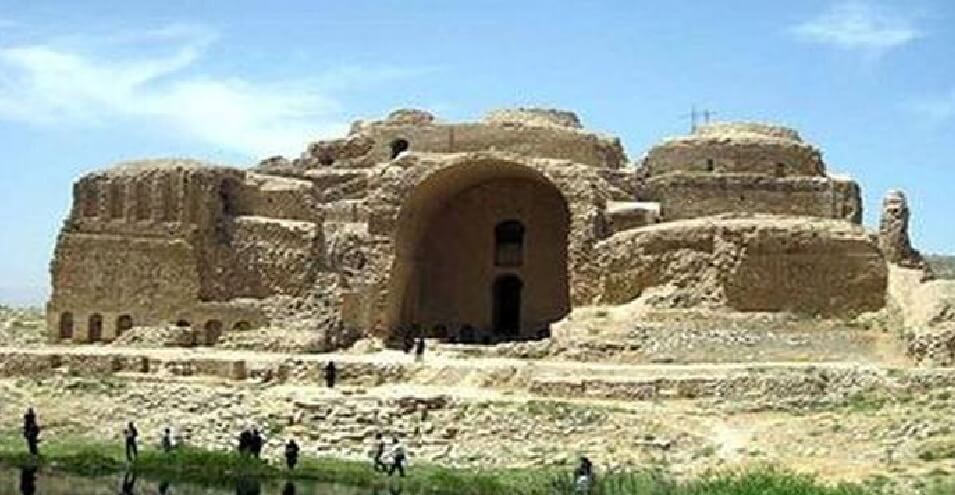
As the rains continue in Iran's southern provinces and flooding continues, the historic Arshir Babakan Palace in Firuzabad County, Fars Province, is in danger of flooding. So far, 9 people have lost their lives due to the flooding.
Recent rainfall in Iran's southern provinces has caused flooding and inundation of homes and roads. According to a spokesman for Iran's Emergency Management Organization, six people have died in Hormozgan province, two in Bushehr province, and one in Gilan province.
Of course, the general crisis management in Gilan province said that there was no flooding in the province, and that the water level in the rivers had only risen due to heavy rainfall. Despite warnings not to approach the river, a car fell into the river and its driver drowned.
According to him, "This accident occurred due to the driver's carelessness and placing the car on a slope towards a flooded river."
The head of the Iranian Red Crescent Society's relief and rescue organization said that 19 provinces were "affected by weather disasters," including: East and West Azerbaijan, Isfahan, Bushehr, Tehran, South Khorasan, Zanjan, Sistan and Baluchestan, Fars, Qazvin, Qom, Kerman, Golestan, Hormozgan, Gilan, Mazandaran, Markazi, Hamadan, and Yazd.
Damage to antiquities
Baharnews website reported that part of the fences surrounding Ardeshir Babakan's palace in Firuzabad, Fars Province, have been destroyed due to flooding.
According to this report, citing videos published by some domestic news agencies of the destruction of the castle's fence, "the possibility of mismanagement in timely cleaning and disregard for the natural path of water disposal in this complex" has been strengthened.
The Palace of Ardashir Babakan was built by the founder of the Sasanian dynasty himself in the 3rd century AD.
Last year, rainfall and flooding caused damage to the "Naqsh-e Rostam".
ISNA news agency also reported, citing the village headman of Firouzabad village in Abarkuh county, Yazd province, that 70 percent of the residential castle of Firouzabad had been destroyed. The castle was one of the tourist attractions of Firouzabad village and 23 families lived in it.
This historical castle dates back to the Qajar period and is located northwest of Abarkooh.
Who is to blame?
Every time a flood occurs and causes significant financial and human losses, the relevant agencies scramble to shift the blame from themselves and onto another entity.
This time, the Deputy Minister of Energy and CEO of the Water Resources Management Company, in an interview with ISNA, defended the policy of "indiscriminate dam construction" that has been repeatedly criticized by environmentalists, and considered the existence of these dams as a barrier against floods, saying: "If the Karkheh, Dez, Karun, and Seymareh dams did not exist, it is not clear what would have happened, but fortunately these dams played their role very well in flood management."
Qasem Taghizadeh Khamsi considered the main problem of cities in Khuzestan province to be their sewage networks and said: "The issue of surface water and sewage must be seen separately. The implementation of the sewage network is the responsibility of the Ministry of Energy, and the collection of surface water is the responsibility of the municipalities. In cities where there is no surface water collection plan, the sewage network also loses its efficiency with a single rainfall and water entering the sewage pipes."
According to the deputy minister of energy, the main problem in southern cities like Ahvaz and Abadan is surface water, and this problem must be solved first. He said: "Given that the streets in Ahvaz are not sloped and there is no surface water collection system, water accumulates in the sewage system, causing sewage pipes to break and water and sewage to accumulate in the streets."
The problem of the sewage system in Ahvaz and other cities in Khuzestan Province has been a subject of debate for years, and the matter has recently reached the General Inspection Organization.
The head of this organization said in a meeting with the Friday prayer leader of Ahvaz on Tuesday, December 8: "The state of the province's sewage network is very deplorable, and this issue was mentioned in today's meeting with provincial officials. According to the report of provincial officials, the Ahvaz and Karun sewage reform project has been underway since 2006, but unfortunately, we have only made 40 percent progress to date."
Hassan Darvishian also spoke of the need to review this plan due to climate change that has occurred over the past 15 years.
Source: DW