Trump's 45-minute conversation with BB focused on the Islamic Republic of Iran
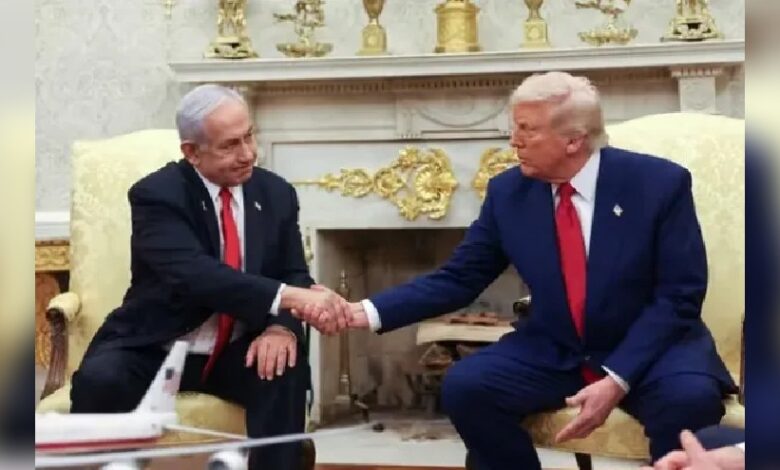
The Israel Hume magazine reported on Trump's 45-minute conversation with BB, focusing on the Islamic Republic and other security issues.
The Israel Hume magazine reported hours ago, on Monday, June 9, that Trump had a 45-minute conversation with BB, which took place hours after the remarks of Ismail Baghai, spokesman for the Islamic Republic's Ministry of Foreign Affairs, regarding the rejection of the US proposal and the submission of a new proposal by the Islamic Republic regime.
According to the Israel Hume report, the phone conversation between Donald Trump and Benjamin Netanyahu regarding Iran's nuclear talks with the United States has ended, and Israeli Prime Minister Netanyahu will hold a security cabinet meeting after the phone call, although the call has not yet been officially confirmed. Israel had previously announced that it would refrain from military action against Iran's nuclear program until the talks between Tehran and Washington fail.
Benjamin Netanyahu emphasized that he will hold a security meeting with a number of senior Israeli officials, including the Minister of Finance, the Chief of Staff of the Army, the Director of Mossad, the Director of Shin Bet, the Minister of Internal Security, the Minister of Defense, the Minister of Foreign Affairs, and the Minister of Strategic Affairs.
Rafael Grossi, Director General of the International Atomic Energy Agency, announced today that the organization cannot wait for negotiations between the Islamic Republic and the United States, because in the absence of a clear and convincing answer about the discovery of uranium particles in undeclared locations, it cannot confirm that other aspects of Iran's nuclear program have been peaceful.
He said in a press conference today: "There is definite evidence that confidential Agency documents have fallen into the hands of Iran. Unfortunately, this issue goes back several years. We were able to clearly identify that documents that belonged to the Agency have been in the hands of Iranian authorities, and this is a very worrying issue. Normally in such cases, the Agency allows the Member State to respond, but what happened is an indisputable fact, not an interpretation."
"This Iranian action in collecting confidential documents from this institution could undermine mutual trust between this country and the Agency and could also negatively affect the Agency's inspections in Iran."
The Telegraph newspaper also wrote about the nuclear negotiations: "While Donald Trump is trying to reach a nuclear deal with Iran, the Islamic Republic has accelerated the process of enriching uranium and expanding its military capabilities."
Ismail Baghaei's remarks about rejecting the US proposal came at a time when Majid Takht-Ravanchi, the Deputy Foreign Minister for Political Affairs, stated in a speech today: "We are preparing a response that has not yet been finalized. Good work has been done on it and we think the response we will provide will be reasonable. We hope that this will be finalized within the next few days and will be made available to the Omani Foreign Minister so that it can be conveyed to the Americans through him."
Regarding the details of Iran's response to the US proposal, he added: "Our plan is definitely not a single sentence or a single paragraph. This text shows our seriousness, has a framework, and is based on clear principles. Any plan must have internal logic, its components must not contradict each other, and must have a logical beginning and end. If there is political will on the other side, we think this text can be the basis for negotiations. It is natural that an agreement will be reached more quickly on some parts, and more time will be needed on other parts."
Ravanchi stated that Tehran's goal in presenting the response text was to achieve an initial framework for understanding, not to draft a comprehensive and time-consuming agreement, and continued: "If this framework is agreed upon, more detailed negotiations on the details can be initiated. Our feeling is that a final agreement can be extracted from this framework. The text proposed by Tehran can keep the window of diplomacy open and pave the way for continuing the current process towards reaching a final agreement."