Heavy Attack on IRGC Air Hub in Tehran; IRGC Transport Fleet Destroyed at Mehrabad Airport
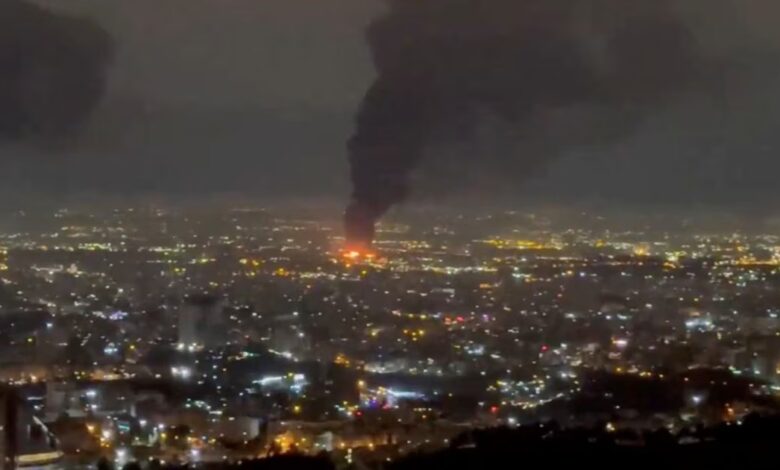
In a heavy attack on the IRGC air hub in Tehran, reports indicate the destruction of a large portion of the IRGC transport fleet at Mehrabad Airport and an escalation of military tensions between Iran, the United States, and its allies.
Following an escalation of military clashes in the Middle East, reports indicate extensive aerial attacks on military and logistical facilities of the Islamic Republic in Tehran, attacks that reportedly destroyed a significant portion of the Revolutionary Guards’ air transport capability at Mehrabad Airport.
According to released reports, on the evening of Sunday, Esfand 24, corresponding to March 15, a new wave of aerial attacks targeted Tehran’s Mehrabad Airport; an airport that, in addition to domestic flights, serves as an important logistical and military base for the Revolutionary Guards. Multiple sources have announced that during this operation, several transport and logistical aircraft belonging to the Revolutionary Guards were destroyed.
Some reports also indicate that among the destroyed targets was a ceremonial aircraft used by high-ranking officials of the Islamic Republic, including Ayatollah Khamenei; an aircraft that was used for transporting senior officials and special missions.
Analytical reports based on satellite imagery show that several large military aircraft, including cargo and tanker planes, were lost in these attacks. Based on these assessments, at least several Boeing 747 cargo aircraft, IL-76 transport aircraft, and other logistical planes at Mehrabad Airport were destroyed. These aircraft played an important role in transporting military equipment and forces.
Some reports also state that a total of up to 16 aircraft related to the Quds Force of the Revolutionary Guards were targeted in this operation. According to military sources, these aircraft were used to transport weapons and financial resources to groups allied with the Islamic Republic in the region.
Military experts believe that the destruction of such a fleet could deal a significant blow to the logistical capability of the Revolutionary Guards; since these aircraft formed the backbone of military equipment transfer operations outside Iran’s borders.
Meanwhile, military officials of the Islamic Republic have reacted sharply to recent developments. The spokesperson of the Khatam al-Anbiya headquarters announced in a statement that Iran considers the presence of the American aircraft carrier “Gerald Ford” in the Red Sea as a threat to itself.
The statement said that logistical centers and service facilities for the aforementioned naval group in the Red Sea are considered targets of Iranian armed forces.
The aircraft carrier “Gerald Ford” is considered the largest warship in the world with a length of over 300 meters. The U.S. Central Command (CENTCOM) had previously announced that a small fire occurred in one of the service sections of this ship but the incident was contained and no damage was caused to the ship’s main systems.
Mehrabad Airport, one of Tehran’s oldest airports, serves not only a civilian role but is also recognized as an important center for military activities. Parts of Iran’s air force infrastructure and equipment related to the Revolutionary Guards are stationed at this airport.
For this reason, in recent years this airport has been recognized as one of the sensitive military points and has repeatedly been mentioned in security analyses as a key hub for transferring the Islamic Republic’s military equipment.
The recent attacks occur as military tensions between the Islamic Republic and its regional opponents have increased in recent weeks. Analysts say the attack on the Revolutionary Guards’ key infrastructure shows that the clashes have entered a new phase and there is a possibility of its expansion in the region.
Some observers also believe that strikes against the Islamic Republic’s military infrastructure could have a direct impact on this government’s network of proxy forces in the Middle East; a network that has been organized and supported by the Revolutionary Guards for years.
At the same time, many critics of the Iranian government emphasize that the Islamic Republic’s regional policies and extensive investment in military activities outside its borders have exposed the country to such crises and conflicts; crises whose ultimate cost is paid by the Iranian people.