Maryam Rajavi’s Controversial Claims About Students; Rewriting History in the Shadow of Blood and Betrayal
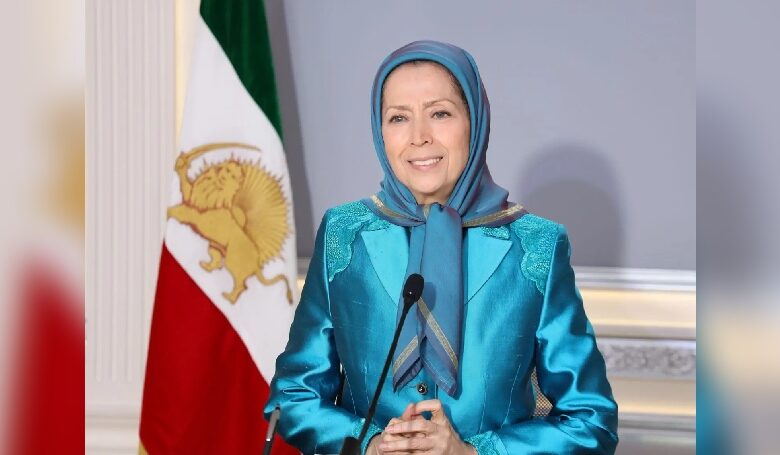
Maryam Rajavi’s claims about students, suggesting they want the Mujahedin-e Khalq, come at a time when the record of the Mujahedin-e Khalq is bound up in blood and collaboration with the enemy.
While recent student protests have once again turned Iran’s universities into centers of political discontent, Maryam Rajavi, leader of the Mujahedin-e Khalq organization, attempted to appropriate these movements for her affiliated organization by posting a message on her personal social media account—an organization whose name for many Iranians is not associated with freedom, but rather with collaboration with foreign enemies during the war and bloody internal violence.
In a message posted on social networks, she wrote: “Greetings to the risen students in Iran’s universities, from Ferdowsi University in Mashhad and University of Tehran to Sharif University of Technology, Amirkabir, Iran University of Science and Technology, Khajeh Nasir al-Din al-Tusi University, and others, who on the second consecutive day marking the fortieth day of mourning for the martyred companions in the December uprising, with the chants ‘By the blood of our companions, we stand until the end,’ ‘Death to Khamenei,’ ‘Death to the oppressor whether king or leader,’ and ‘Neither monarchy nor leadership, democracy and equality,’ emphasized the continuation of the uprising. The tactics of Basiji mercenaries using deviant slogans and attacking activist students faced decisive responses from the students.”
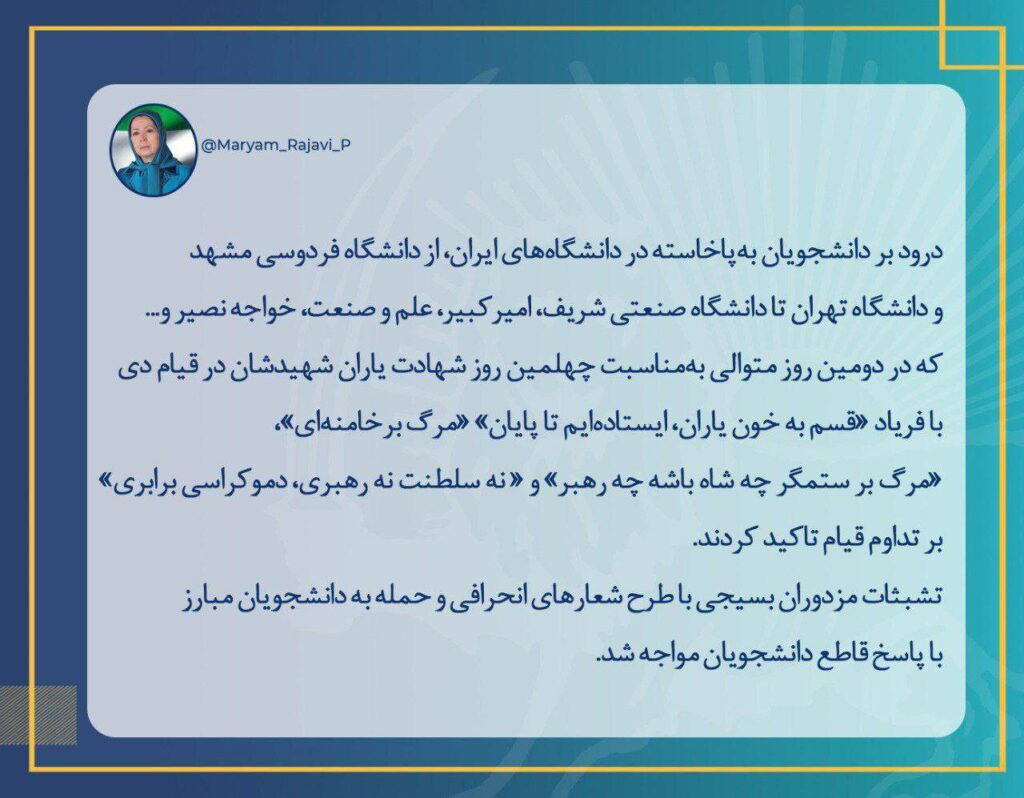
These statements come at a time when no independent or reliable reports have been published of chanting in favor of the organization called the “Mujahedin-e Khalq” in Iran’s universities. On the contrary, in many protests over the years, and particularly in the last two months, slogans in support of Reza Pahlavi and the chant “Long Live the Shah” have been heard—a slogan indicative of some protesters’ inclination toward revisiting the pre-Islamic Republic era, not an aspiration toward a group with a highly controversial record in contemporary Iranian history.
The “Mujahedin-e Khalq” organization, which entered into armed conflict with the Islamic Republic following the 1979 revolution, carries in its record during the 1980s the responsibility or accusation of involvement in a series of armed operations and bombings—actions that resulted in the deaths of citizens and government officials and plunged Iran into a cycle of violence.
However, the most controversial chapter in this organization’s activities was its overt collaboration with Saddam Hussein’s regime during the Iran-Iraq War—a war that left hundreds of thousands of casualties among the Iranian people. The presence of this organization’s forces on Iraqi soil and their participation in operations such as “Operation Eternal Light” in 1988 (carried out from Iraqi territory against Iran) was perceived by many Iranians not as a form of political opposition but as standing alongside an army that was raining missiles on Iranian cities.
In the collective memory of a large section of Iranian society, this action was not a “political strategy,” but rather siding with the military that was bombarding Iranian cities. This very history is why the organization’s current claims about representing the Iranian people are met with skepticism and even anger.
The recent protest developments (from nationwide demonstrations to student gatherings) have primarily stemmed from economic, social, and political grievances within the country. The main body of these protests is composed of the younger generation, students, and dissatisfied segments whose slogans reflect a diverse spectrum of demands.
Nevertheless, attempts by certain groups outside the country to claim credit for these movements are questionable. Critics argue that while the Mujahedin-e Khalq attempts to present itself as an alternative, it neither has a clear social base within the country nor has its record been able to gain public trust.
Critics also point to the internal structure of this organization, which has been repeatedly described by former members as a closed structure based on lifetime leadership—a structure that is inconsistent with slogans of “democracy” and “equality.”
Iran’s universities in recent days have become a battleground of narratives; on one hand, the government trying to control the space through security pressure, and on the other, various political currents outside the country, each attempting to claim the protests under their own name.
But the fundamental question is this: Do people who pay the price of protest with imprisonment, expulsion, bullets, and even the noose need a political guardian and master? Or are they, as has been heard in many gatherings, already in the process of choosing their own path and symbols?
The historical record of the Mujahedin-e Khalq (particularly during the Iran-Iraq War) continues to cast a heavy shadow over the organization’s current claims. For a generation seeking freedom and a different future, awareness of this past is essential; lest groups that once stood alongside the invading enemy attempt once again to gain legitimacy through deceptive slogans amid public crisis and anger.
In a period when Iran is experiencing one of the most sensitive phases in its contemporary history, society’s vigilance regarding the past of political actors is part of that very awakening that can prevent the repetition of historical mistakes.