Trump’s 45-Minute Call with Netanyahu Focused on Islamic Republic of Iran
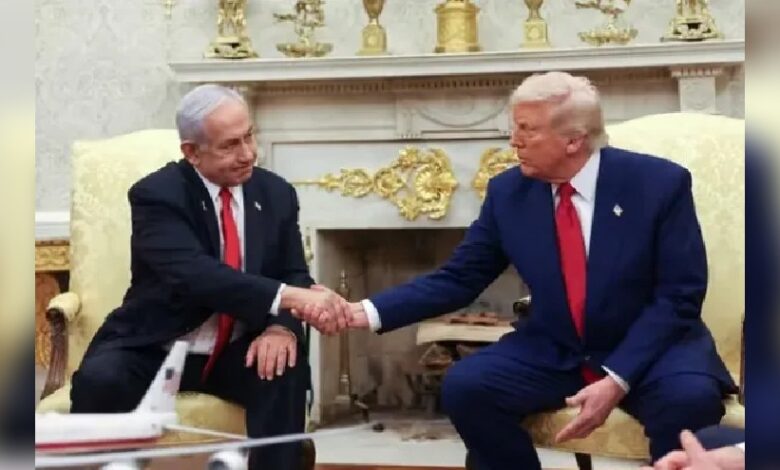
The “Israel Hayom” newspaper reported on a 45-minute conversation between Trump and Netanyahu centered on the Islamic Republic of Iran and other security issues.
The Israel Hayom newspaper reported hours ago on Monday, June 9 (corresponding to Khordad 19) about a 45-minute conversation between Trump and Netanyahu, which took place hours after remarks by Ismail Baghaei, spokesperson for the Islamic Republic’s Foreign Ministry, regarding the rejection of the American proposal and the presentation of a new proposal by the Islamic Republic regime.
According to the “Israel Hayom” report, the telephone conversation between Donald Trump and Benjamin Netanyahu regarding Iran’s nuclear negotiations with the United States has ended, and Netanyahu, Israel’s Prime Minister, will hold a security cabinet meeting after the conclusion of this phone call, although this call has not yet been formally confirmed. Israel had previously announced that it would refrain from military action against Iran’s nuclear program until the failure of Tehran-Washington negotiations.
Benjamin Netanyahu emphasized that he will hold a security meeting with a number of senior Israeli officials, including the Finance Minister, Chief of Staff, Mossad Chief, Shin Bet Chief, Minister of Internal Security, Defense Minister, Foreign Minister, and Minister of Strategic Affairs.
“Rafael Grossi,” Director General of the International Atomic Energy Agency, announced today that this agency cannot wait for negotiations between the Islamic Republic and America, as without clear and convincing answers about the discovery of uranium particles in undeclared locations, it cannot confirm that other aspects of Iran’s atomic program were peaceful.
He said at today’s press conference: “There is conclusive evidence that classified IAEA documents have fallen into Iran’s hands. Unfortunately, this matter goes back several years. We were able to clearly determine that documents belonging to the Agency were in the possession of Iranian officials, and this is very concerning. Usually in such cases, the Agency allows the member state to provide answers, but what happened is an established fact, not an interpretation.
This Iranian action in collecting classified documents of this agency could weaken mutual trust between this country and the Agency and also have a negative impact on the Agency’s inspections in Iran.”
The Telegraph newspaper also wrote about nuclear negotiations: “While Donald Trump is trying to reach a nuclear agreement with Iran, the Islamic Republic has accelerated uranium enrichment and expanded its military capabilities.”
Ismail Baghaei’s remarks about rejecting the American proposal came while “Majid Takht-Ravanchi,” Deputy Foreign Minister for Political Affairs, said today: “We are in the process of preparing a response that is not yet finalized. Good work has been done on it and we believe the response we will provide will be reasonable. We hope that within the next few days this will be finalized and placed at the disposal of Oman’s Foreign Minister so that it can be transmitted to the Americans through him.”
He added regarding the details of Iran’s response to the American proposal: “Our draft is certainly not a single sentence or a paragraph. This text demonstrates our seriousness, it has a framework and is based on specific principles. Any proposal should have internal logic, its components should not contradict each other, and it should have a logical beginning and end. If there is political will on the other side, we believe this text can serve as a basis for negotiation. It is natural that agreement on some sections would be reached more quickly and other sections would require more time.”
Ravanchi described Tehran’s goal in presenting the response text as achieving an initial framework for understanding rather than drafting a comprehensive and time-consuming agreement, and continued: “If this framework is agreed upon, more detailed negotiations about the details can begin. Our feeling is that a final agreement can be extracted from the heart of this framework. The text proposed by Tehran can keep the window of diplomacy open and provide the ground for continuing the current process toward achieving a final agreement.”