Iran’s Ambassador in London Summoned as Nazanin Zaghari and Narges Mohammadi Begin Hunger Strike
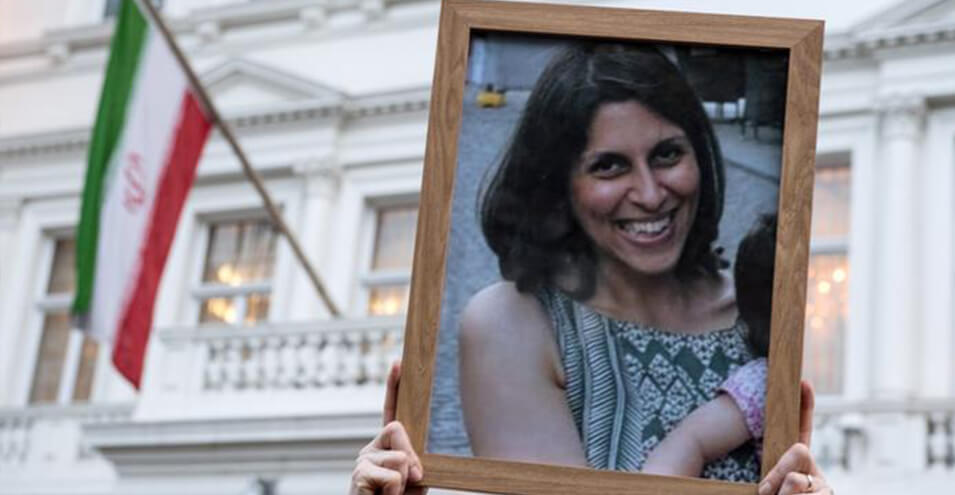
A press conference was held today in London with the presence of Shirin Ebadi, Richard Ratcliffe, husband of Nazanin Zaghari, and Monique Villa, director of the Thomson Reuters Institute. Meanwhile, Iran’s ambassador in London was summoned to the British Foreign Office.
Narges Mohammadi and Nazanin Zaghari, two political prisoners in Iran, have announced that starting Monday, December 24 (January 14), they will embark on a three-day hunger strike in protest of their situation.
For this occasion and on the same day, a press conference was held in London with the presence of Shirin Ebadi, a human rights lawyer and head of the Center for Human Rights Defenders, Richard Ratcliffe, husband of Nazanin Zaghari, and Monique Villa, director of the Thomson Reuters Institute where Nazanin Zaghari worked.
Ms. Ebadi at this conference described Iran’s move to link Nazanin Zaghari’s case to Britain’s previous debt to Iran as actions similar to “pirates.” The British government believes that Iran has taken Nazanin Zaghari hostage to force Britain to pay its previous debt to Iran. However, Iran’s Foreign Ministry has denied any connection between these two issues.
Both Narges Mohammadi and Nazanin Zaghari are ill and require special medical examinations. According to Shirin Ebadi, “although the prison doctor has issued a certificate for treatment and transfer of these two to medical centers outside the prison, the prosecutor, following orders from security officials, refuses to send them.”
Narges Mohammadi, vice president of the Center for Human Rights Defenders, suffers from periodic paralysis and pulmonary embolism. Ms. Ebadi told Deutsche Welle that Narges Mohammadi, due to her pulmonary embolism, takes blood-thinning medications and therefore should have her blood concentration tested every two months, but this has not been done for months now.
According to Ms. Ebadi, Nazanin Zaghari also has a lump in her breast that should be examined to determine whether it is malignant or benign.
Given the physical condition of these two, a hunger strike could be life-threatening for these prisoners. Nevertheless, according to Shirin Ebadi, “the hunger strike is the last thing they can do to draw the attention of Iranian authorities to their severe physical condition.”
Ms. Ebadi states: “The condition of Iranian prisons is such that it seems the Iranian government has arranged for the silent and gradual death of political and ideological prisoners.”
According to the Prison Organization’s executive regulations, if prisoners require specialized medical treatment, after approval by the prison doctor, they should be transferred to hospitals or medical centers outside the prison.
In a statement issued by the Center for Human Rights Defenders for this occasion, the names of prisoners who are ill but have been denied treatment were announced as follows: Narges Mohammadi, Nazanin Zaghari, Saeed Malekpour, Ahmadreza Jalali, Arash Sadeghi, Mostafa Daneshjou, Mohammad Banazadeh, Hassan Shahrooza, Hassan Momtaz Saroastani, Saeed Shirzad, Shokofeh Yadollahi, Shima Entesari, Ali Karimi, and Ahmad Barakehi.
Iran’s Ambassador in London Summoned
According to Reuters, Jeremy Hunt, British Foreign Secretary, summoned Iran’s ambassador in London on Monday regarding Nazanin Zaghari’s situation. This action took place simultaneously with the holding of the press conference in London.
Nazanin Zaghari-Ratcliffe, who holds dual Iranian and British citizenship, was detained at Imam Khomeini Airport in June 2016 while leaving Iran with her young daughter and was imprisoned. The Islamic Revolutionary Guard Corps Intelligence Organization accused her of spying for Britain, and the Revolutionary Court, confirming this charge, sentenced Nazanin Zaghari-Ratcliffe to five years in prison.
Hamid Baeidinejad, Iran’s ambassador in London, said hours later about the news of his summons by the British Foreign Secretary: “Today the British Foreign Secretary, by summoning me to the Foreign Office, specifically expressed concern about Ms. Zaghari’s situation and the start of her hunger strike.”
Despite reports circulating about Zaghari’s health condition, Baeidinejad, in an interview with IRNA news agency, described his response to the British Foreign Secretary as follows: “Dual nationals are all considered Iranian nationals and enjoy civil rights. Ms. Zaghari, as an Iranian national, while preserving her rights in prison, has been and will be provided with necessary medical facilities and services.”
Source: DW