Ali Khamenei: “Reza Khan the Bully Destroyed Our National Identity and Changed Our National Clothing”
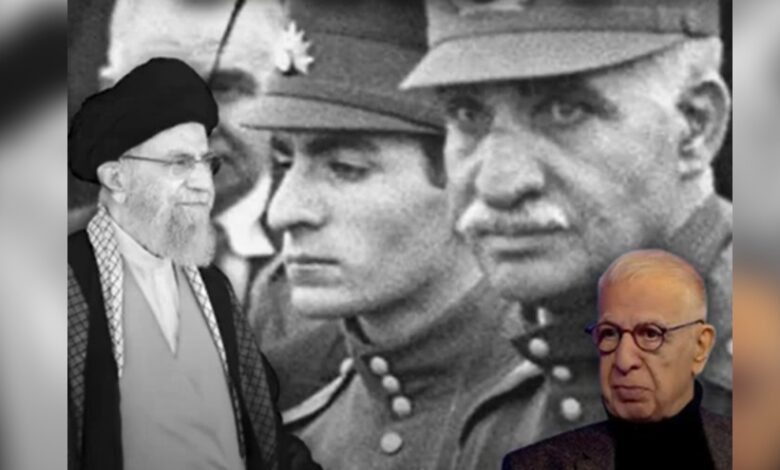
Ali Khamenei on the birthday of “Reza Shah the Great” held him responsible for the destruction of national identity and the alteration of national clothing.
March 16 is the birthday of Reza Shah the Great, the king of Iran. He was born on this day in 1877 in the village of Alasht, a district of Soudkuh, into a military family. His father “Abbas Ali Dadash-beg Soudkuhi” served in the seventh regiment as an officer. Reza Shah was the youngest child of the family whose father died a few months after his birth.
Reza Shah was Minister of War from 1921 to 1925 and also served as Prime Minister of Iran from 1923 to 1925 during the Qajar period. He ultimately ascended to the throne in 1925 with the end of the Qajar era. He had joined the military at age 12 and was able to achieve high ranks during his years of service.
During his reign, Reza Shah established a new order in Iran and laid the foundation for modern institutions for better life in Iran, which can be cited as “the new military,” “the new judicial system,” “Tehran University,” and “the national railroad” as the most important institutions.
To ensure his power, he violated the constitution and dissolved independent parties, and subsequently stripped parliamentary immunity from members of the National Consultative Assembly. He wanted an Iran free from the influence of religious clergy, foreign conspiracies, and ethnic conflicts, and on the other hand, he wanted Iran to have educational institutions in the European style, modern employed women, a new economic structure with state factories, communication networks, investment banks, and chain stores. To achieve his goal of rebuilding Iran, he implemented secularization, dismantled tribalism, promoted nationalism, advanced education, and state capitalism.
In 1941, he was forced to resign due to a British ultimatum and leave Iran, transferring the throne to his son Mohammad Reza Pahlavi, and three years later died at age 66 in Johannesburg. His supporters considered him the “father of modern Iran,” and in 1949, with the approval of the National Consultative Assembly, he was given the title “Reza Shah the Great.”
Every year on the birthday of this deceased king, Ali Khamenei has attempted in various ways to portray him in the public mind as a despotic and dictatorial figure—labels that he and his agents have used to rule over the Iranian people for nearly half a century. He spoke about him in the new year with different expressions.
On the birthday of this deceased figure, Ali Khamenei said: “Reza Khan the bully was captivated by the West. He destroyed our national identity and even changed our national clothing.” His use of the term “national identity” and “national clothing” instead of “Islamic identity,” which he frequently referred to in the past, means that he is trying, by relying on this word (national), to move along with the wave of nationalism that is becoming stronger every day.
His remarks about “the change of national clothing by Reza Shah” were made while he believes that the clothing chosen by Shiite clergy is the same as Iranians’ national clothing, whereas history tells something different. In fact, the clothing that Ali Khamenei and his agents refer to as national clothing is called “dishdasha” in Arabic, which belongs to the Arabs and was never the national clothing of Iranians.
Iranians’ national clothing since ancient times has been trousers and a type of waistcoat or coat for men, and mid-length garments and loose trousers with bright colors for women. After centuries, the chador, chaqchur, piche, niqab, burqa, and other forms of hijab were gradually imposed on some urban women, but it never took on a “national” character.
Ali Khamenei has repeatedly referred to the “Pahlavi hat” in his statements. In fact, the Pahlavi hat existed because believers could not press their foreheads to a seal during prayer. However, they were able to remove it during prayer or with a twist, move its veil to the back of the head.
During his remarks on the birthday, Ali Khamenei did not clarify which part of Iran’s national identity was destroyed by him, because during his reign, Reza Shah revived Persian literature, which had been in decline since the 18th century, so that with compulsory education, millions of people became interested in it, and Persian was introduced as the national language. Other Iranian languages that were in decline also had their decline stopped or slowed.
The first Kurdish-Persian dictionary was prepared and published during his reign, and researchers published their scientific reports and grammars from the languages and dialects of the Iranian people, which was very reliable. The late “Saeed Nafisi” also said about this: “We remembered where and when we were.” When we read various books and articles about the history of Iran, the statement of the late Nafisi, which shows a reminder of deep love for the homeland, becomes apparent.
Ali Khamenei uses the word “bully” for Reza Shah while he was not seeking state control over religion, and with the reforms he introduced, he removed large portions of the political, social, and judicial structures of the Iranian people from the dominance of the Shiite clergy network and transferred their responsibilities to the state, including endowments, the judiciary, education, theology university, and even religious sciences.
By building a modern nation-state and extending the power and legal authority throughout the country, Reza Shah was able to rebuild Iran’s national identity, which for nearly 150 years had been threatened by imperialist powers including Britain and Russia with the help of internal agents, in a context of national understanding.
He also reclaimed parts of Iranian territory that had been separated during the Qajar period and reminded the whole world that Iran would continue to be called Iran, and introducing it with terms such as “Persia” or “Pars” was unacceptable. He even declared the word “religion,” which means a way of living, as part of the whole. This was an issue that Ruhollah Khomeini and Ali Khamenei attempted to impose on the Iranian people, meaning they replaced Iran, which is the whole, with religion and faith, which is a part.
Reza Shah, whom Ali Khamenei calls a bully, received a poor and half-starving Iran but delivered a developing Iran. He tried to keep Iran from war, but with the invasion of the Russians and the British and the British ultimatum, he preferred to bear the pain of exile and sacrifice himself to prevent the destruction of Iran—an issue that with the coming to power of the clergy and the founders of the Islamic Republic, Iran was dragged into war, and the result was millions of dead and disabled remaining, a war that continues to this day.
Ali Khamenei’s attack on the Pahlavi family, history, culture, and Iranian national identity has led Iranian compatriots to reach this statement of the late Nafisi: to compare “where we were and who we were” with the current situation of where we have reached and who we are.
Ali Khamenei’s recent remarks on the eve of Nowruz and Reza Shah the Great’s birthday caused widespread reactions by the Iranian people, as many Iranians expressed their protest against Ali Khamenei’s remarks by posting images of Reza Shah and writing texts on social networks.
A user, in response to this speech, posted a picture of Reza Shah and wrote a message on social media: “In fact, during these 46 dark years of history, the Iranian nation paid the price of ingratitude and ungratefulness for the countless services of Reza Shah Pahlavi and his successor Mohammad Reza Shah Pahlavi in the most heinous ways possible.
This ungratefulness and ingratitude is not limited to that ten percent who brought about the madness of 1979, but that ninety percent who remained silent against the ungratefulness and ingratitude of that ten percent and allowed Iran, which was taking fundamental steps toward progress and development at great speed, to suddenly reverse course at the same speed toward backwardness and decline in all economic, cultural, and scientific fields, are complicit in this ingratitude and ungratefulness.
That Reza Shah the Great, to achieve his goal of a prosperous, free, and developed Iran, used coercive power, which they called “dictatorship,” proclaimed it from the rooftops, and ungraciously ignored all his services and did not even once ask themselves that a hundred years ago, to save a people who not only lacked literacy due to Qajar incompetence, but half of whom had perished from disease and the other half suffered from syphilis and were struggling in poverty and misery, there was no way but coercion and force, and basically among the people of that time, there was nothing called democracy that had any practical application, and in fact, a hundred years ago, the Iranian people could not understand what democracy meant or what concept it had.
Now, after nearly a century of Reza Shah’s reign and nearly half a century of the blessed rule of Mohammad Reza Shah Pahlavi, we are facing, as the essence of the existence of those two selfless servants, Prince Reza Pahlavi, in whose every cell democracy and popular sovereignty are crystallized. With the intelligent ideas he has, he can continue the services of his grandfather and father and in the shortest possible time, save Iran from the brink of destruction, and his coming to power in Iran could be the greatest blessing for a nation that, out of ingratitude and ungracefulness in the frenzied uprising of 1979, caused the interruption of Iran’s progress.
Unofficial statistics show that more than 90 percent of current Iranian society despise the destructive clerical system and more than 80 percent of the people support the ideas of Prince Reza Pahlavi. My question is! Will the Iranian people, to compensate for those ingratitudes and ungratefulness, come together to the field at the 90th minute to save themselves and their country, or will the gray section again choke back what they have in their hearts?”