A Forgotten Clergyman Who Predicted the Existence of Black Holes 250 Years Ago
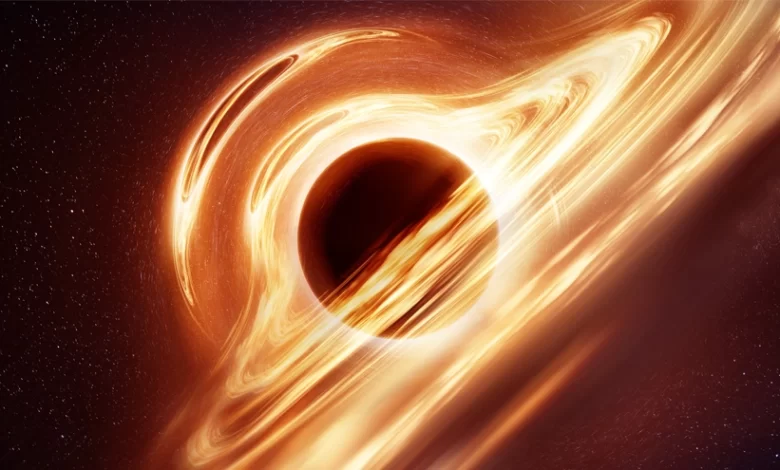
Nearly two centuries before scientists discovered the existence of black holes, a British clergyman named “John Michell” published a remarkable prediction about celestial bodies. Belief in the existence of black holes is a bewildering notion. Prominent twentieth-century physicists did not believe for decades that these giant cosmic objects could be real and ignored what mathematicians predicted.
Even Albert Einstein did not believe in their existence, although his theory of general relativity made the existence of black holes possible. However, long before Einstein’s birth, there was someone who demonstrated remarkable insight into black holes and predicted their existence using only Newtonian laws.
John Michell was born in 1724 in the village of “Eking” in England, in a family that followed the Christian tradition of preferring reason over extreme teachings. He attended Cambridge University and for more than 20 years studied and taught in various fields including Hebrew, Greek, mathematics, theology, and geology.
He was both a theorist and an experimental scientist. John Michell became the first person to be credited with explaining the cause of earthquakes by proposing the hypothesis that “earthquakes and the energy waves resulting from them are caused by the movement of rock layers located kilometers beneath the earth.” For this reason, he is considered one of the founding fathers of seismology.
John Michell Public Domain
John Michell also demonstrated a way to estimate the epicenter of the catastrophic Lisbon earthquake in 1755 and examined the idea that earthquakes under the sea could cause tsunamis.
He remarkably calculated the density of the Earth using scientific methods. The number he obtained differs by only one percent from the number known today as Earth’s density. Alongside his work in the church, Michell corresponded with other natural philosophers and intellectuals of his time, including Benjamin Franklin, one of the most prominent scientists in the world and one of the founding fathers of the United States.
From a twenty-first century perspective, it may seem surprising that a servant of the Christian church would be at the center of scientific life; but he, like many seventeenth-century intellectuals, did not make a distinction between religion and science. For John Michell, scientific laws of nature were still considered the laws of God.
Alongside his local duties, Michell gradually focused his attention on cosmology and especially the nature of gravity. He built his own 3-meter reflecting telescope and in 1767 became the first to apply new statistical methods to study visible stars, demonstrating that clusters like “Pleiades” in the constellation Taurus could not be explained by random distribution.
Foresight into the Existence of Black Holes
Michell published a paper containing a hypothesis that, although it had less scientific longevity, was perhaps his most brilliant contribution to understanding the cosmos. In this paper, using Newtonian principles, he explained how to determine the density of stars by observing how their gravity affects other nearby bodies.
This eighteenth-century scientist argued that although light tends to escape from the surface of a star, if the hypothetical star is large enough, its gravity would be sufficient to bring the light back. He said it is possible that the enormous gravity of the largest cosmic bodies would overcome their light rays. He went even further and pointed to a reality that in the 21st century most scientists believe in: that although the light of such a star cannot reach us and perhaps we cannot see it, we might be able to detect it through the gravity of the invisible star and the chaos it creates in the orbit of other celestial bodies near it.
In his paper, he writes that these speculations were “somewhat aside from my current purpose,” but they perhaps presented the closest concept to the idea of possible black holes in Newtonian physics.
His hypothesis was presented at a time when Newton’s theory of light was the prevailing belief of his era. The idea of invisible stars was a relatively common idea among scientists of that time. However, some time later, new experiments convinced scientists that light was composed of waves rather than particles. As a result, the hypothesis that light could be deformed or trapped by gravity fell out of fashion.
Michell’s astronomical work fell into obscurity and it was only in the second half of the twentieth century that it was rediscovered. Russell McCormmach, a historian, says: “It was John Michell’s scientific passion and power of imagination that led to this discovery. As Albert Einstein said in 1929, imagination encompasses the world.”
It is worth noting that the above-mentioned article was from the website Porpasokh and has been published through the cooperation of this website with the website fcnn.