Islamic Republic’s Infiltration Inside Britain
The influential think tank “Policy Exchange” has reported on the Islamic Republic’s infiltration within Britain in a comprehensive report.
Dr. Paul Stott, head of the security and extremism division at the Policy Exchange think tank in London, released a detailed 87-page report titled “Iran on the Line – Iran’s Threat to Britain,” detailing the Islamic Republic’s infiltration in Britain. The report demonstrates what threats the regime’s activities, carried out under the guise of religious freedom and tolerance over the past two decades, have posed to British security.
The report details the methods of infiltration and operations of the Islamic Republic within Britain, and if the 14-point proposals in this report are adopted and implemented, they could prove effective in countering the Islamic Republic’s infiltration.
The Islamic Republic has sought to exert social and cultural influence and increase its political interference in England through the establishment of various institutions. According to the Policy Exchange report, this infiltration has dangerously expanded due to negligence by British security forces.
The Policy Exchange think tank, while criticizing the failures of British security forces and the Home Office, has raised a question that remains unanswered. The substance of this question is as follows: “It is clear that protecting Britain from Iran’s terrorist state is the responsibility of the police and security services. But whose responsibility is it to counter the Islamic Republic’s expanding soft power infiltration in Britain? A process through which the Islamic Republic seeks to influence political, religious, educational, and cultural organizations in this country.”
The first section of this report, comprising 16 pages, concerns the Islamic Centre of England in the Maida Vale district of London, which is referred to as the Islamic Republic’s main artery in Britain. The directors of the Islamic Centre of England from its inception to the present have been Ayatollah Mohsen Araki, Hujjat al-Islam Abdolhossein Moezi, Sheikh Mohammad Ali Shomali, and Seyyed Hashem Mousavi, all of whom were directly appointed by Ali Khamenei to manage this institution.
The Charity Commission began its legal investigation into the Islamic Centre in 2020, and with the appointment of British lawyer Emma Moody as the interim director of the centre and the removal of Seyyed Hashem Mousavi, the centre’s political activities faced some obstacles. However, after 2 years of investigation and inquiry, the final report on this centre has still not been published.
In the second chapter of the aforementioned report, another institution related to the Islamic Republic’s infiltration network in Britain is mentioned, which are as follows: “Islamic Human Rights Commission, Islamic Mission of Ahlul Bayt Society, Dar al-Islam Charity, Bayt Taha, Willesden Islamic Seminary, Islamic College, Al-Mahdi Foundation, Muslim Students Association of Britain, Lebanese Youth Foundation, Islamic Republic School”
According to published reports, the Islamic Republic’s infiltration in Scotland is much deeper than previously thought. Another criticism raised in the report concerns the practice of various British governments in issuing visas carelessly to government clergy. Since 2005, approximately 100 visas have been issued for entry to England for officials of the Islamic Republic, and among these visas, 8 Iranian clergy have received permanent residence permits in England.
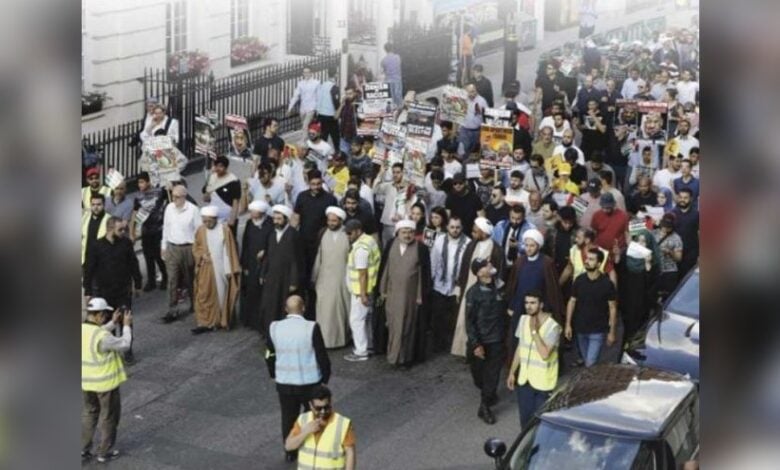
The Policy Exchange report believes that the Islamic Republic played a significant role in organizing pro-Palestine demonstrations in England, and Israel’s war against Hamas since October 7 has provided a good opportunity for the Islamic Republic to advance its agenda in Britain by utilizing its infiltration network, which it has worked on for over 20 years.
The Policy Exchange think tank has proposed 14 measures to counter the increasing infiltration of the Islamic Republic’s government in Britain, which are as follows:
- Refrain from issuing religious visas for employment in the Islamic Republic’s institutions in Britain
- Review visa issuance for all officials of the Islamic Republic of Iran
- Increase scrutiny by the Charity Commission to properly perform its duties
- Place the Islamic Revolutionary Guards Corps on the terrorist list
- Investigate the Islamic Republic’s role in promoting laws against insults to sacred values
- Investigation by the British Home Office regarding the activities of Hashd al-Shaabi organizations in this country
- Greater focus by the British Home Office and security services on the activities of the Islamic Republic
- Consider Britain’s security and values when reviewing asylum cases
- Request by the Home Office from security services to prepare an annual report on extremist threats
- Proactive counter-measures against the Islamic Republic’s cyber attacks
- Employ more Persian speakers in security services
- Implementation of the new national security law that received royal assent in July of last year (2023)
- Better understanding of how “Peace and Unity” conferences in Scotland were formed and the reason for British officials’ participation in them
- Collection of more statistics on followers of different Islamic sects in Britain for better analysis
The think tank’s idea that the Islamic Republic may seek to influence British Muslims and expand its infiltration through them, and that preventing this is the responsibility of whom, is unfortunately not reflected in the job descriptions of British security services.
It should be noted that to date, since the preparation and publication of this report, there has been no reflection by the Islamic Republic’s opposition outside the country or Persian-language media.