Change in Iran Could Change the Middle East
The following article is a translation and summary of an article published in The Economist magazine, London edition, dated October 3.
The subject of change in Iran, which could transform the Middle East, could weaken militia groups across the region or trigger conflict and a wave of refugees.
In 1985, a young Lebanese group called Hezbollah presented its manifesto. “Party of God,” as its name means in Arabic, promised to fight Israel and the West and called on its countrymen to establish an Islamic state.
Many Lebanese thought this would be a passing fad. Nearly 40 years later, it has become the country’s most powerful militia, even better equipped than the army itself. It is a key player in Lebanese politics.
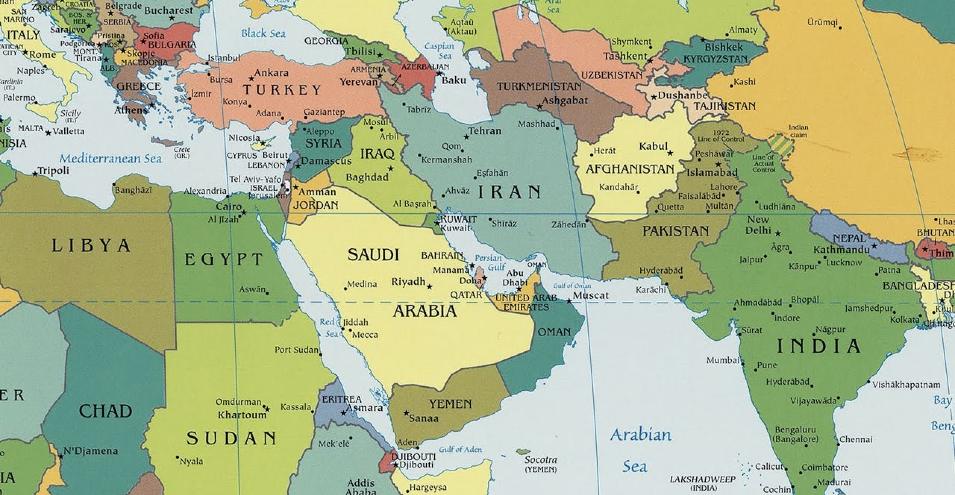
Hezbollah has been the most successful example of Iranian influence across the Middle East. Since 1979, the region has been shaped by a rivalry with Saudi Arabia. Iran saw multiple reasons for befriending regimes and nurturing proxy militias. It hoped to expand its own Islamic revolution and act as the protector of fellow Shiite Muslims. It also sought a form of strategic depth.
Some of its leaders felt a degree of Persian chauvinism toward Arabs, particularly those in the Persian Gulf.
Gulf rim states, in turn, sought to push back. In the 1980s they supported Saddam Hussein’s war against Iran (he thanked them shortly after by invading Kuwait.) They tried to strengthen their allies in places like Lebanon, often without great success. Saudi King Abdullah, now deceased, called the Iranian regime a “regional plague.” Gulf states certainly hope for regime change to reshape the region’s geopolitical landscape.
Saudi-backed news channels have covered the protests with vim: even small demonstrations in provincial cities are deemed worthy of breathless coverage. Meanwhile, Iran’s allies are nervous. Hassan Nasrallah, leader of Hezbollah, has mocked recent protests in Iran as a foreign conspiracy. Yet predicting how Iran might be different is hard. The first question in Gulf circles is what kind of government would replace clerical rule. If a military regime, likely led by the Islamic Revolutionary Guards Corps, would probably maintain its support for regional proxy forces; if not for ideological reasons, then for strategic ones. A democratic government, by contrast, could dampen Iran’s ambitions. Some Iranian protesters have chanted slogans like “No to Gaza, No to Lebanon,” expressing hostility to the futile expense of billions of dollars abroad, supporting dictators and brutal militias. But if the ruling ayatollahs fell, their regional proxies would not disappear. Hezbollah, even if cut off from Iranian patrons, would still be Lebanon’s strongest force. Wealthy backers and illicit businesses would still fund it. Many Lebanese Shiites, who see it as a bulwark against Israel and a voice for a repressed sect, would still support it.
The Houthis, a Shiite rebel group that controls much of Yemen, have grown closer to Iran during an eight-year-long war against a Saudi-led coalition. But they are not merely Iranian puppets: they emerged in the 1990s as a local insurgency; weakened but persistent. In Iraq, Iran-backed factions often compete with other Shiite groups; not over ideology, but over access to the state’s oil wealth. They could end up fighting each other, regardless of the nature of the regime in Tehran.
The biggest change might occur in Syria. Bashar al-Assad relied on Iranian support to survive a long civil war; but he shares no ideological affinity with the ayatollahs. He has tried to balance between Iran and Russia.
The invasion of Ukraine has made this harder: Russia has withdrawn some of its forces from Syria, as they are needed elsewhere.
If Assad could not count on Russian or Iranian support, he would need to seek new friends. He is trying to restore relations with Gulf rim states, which eagerly backed rebels seeking to overthrow him. Earlier this year he visited the United Arab Emirates, his first trip to an Arab country in over a decade. If he lost his Iranian patron, he would be all the more eager for Arab friendship.
Before the fall of Iran’s shah in 1979, Gulf rim states had territorial and political disputes with the shah; but they found accommodation with one of the oil-exporting monarchs. A more normal regime in Tehran could enable widespread trade and investment across the Persian Gulf and could force Arab kings to cut their hefty military spending. But this depends on Iran curtailing its support for groups like the Houthis and militias in Iraq. The same is true of Israel, which had friendly relations with the shah’s Iran. It could have them again, but only if Iran limits its nuclear programme and stops backing groups like Islamic Jihad in Gaza.
Some Iranians fear their uprising will not end in democracy or even a stable military regime, but something resembling Syria. A failed state collapsing from within. If that happened, Iran’s role could be reversed. Instead of directing proxy forces across the region, it could find itself a playground for foreign powers.
Turkey occupies parts of Syria, to keep Kurdish fighters away from its border and periodically strikes Kurdish targets there and in Iraq. It might do the same in an unstable Iran. Meanwhile, Gulf rim states could fund and arm Arab separatists in Iran’s southwest. For now, the Gulf enjoys Iran’s regime difficulties. A state that has sown much chaos across the region now faces turmoil at home. But instability in Iran could have unpleasant consequences elsewhere. The Gulf rim states might look like easy pickings to fleeing Iranians, and the clerical regime could still ask its proxy forces to attack: bring us down and we bring down our neighbours.