Joint Chiefs of Staff Issues Written Warning to Host Countries of US Military
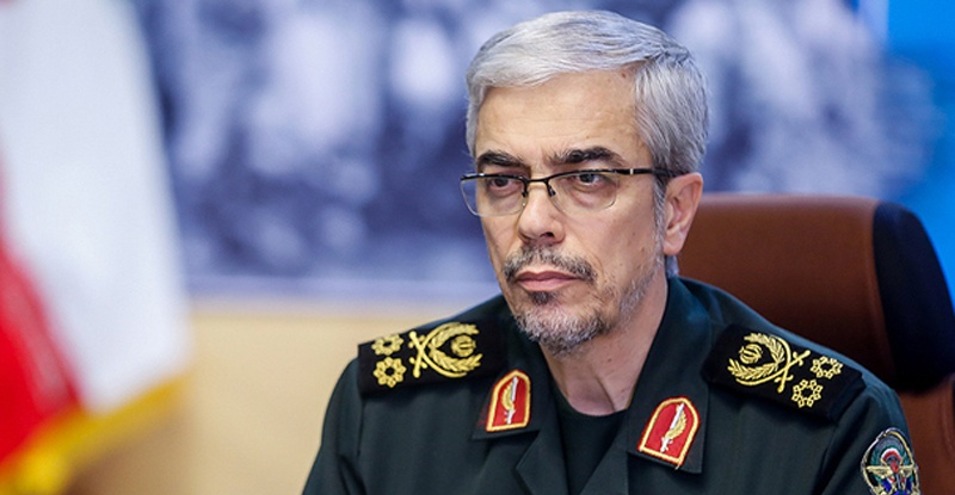
Following recent confrontations between the US Navy and the Islamic Revolutionary Guard Corps, the commander of Iran’s Joint Chiefs of Staff announced on Wednesday, September 7, that a “written warning” had been issued to countries hosting the US military.
Mohammad Bagheri, referring to this written warning, stated: “From our perspective, America’s espionage (and even operational) capabilities and those of its allies” will also be placed at Israel’s disposal, and this will increase the threat to the Islamic Republic.
He did not provide further details on this matter, but the Wall Street Journal had previously published some details about cooperation between the US Navy, Israel, Saudi Arabia, and several other Middle Eastern countries to create a network of unmanned vessels to counter the Islamic Republic’s activities.
The US Navy stated that by next summer, it is expected that one hundred small unmanned reconnaissance vessels from various countries will participate in this plan and cover a vast area from the Suez Canal in Egypt to Iran’s shores.
According to this report, information collected in this plan will be sent to US Central Command, based in Bahrain at the headquarters of the Fifth Fleet.
The commander of Iran’s Joint Chiefs of Staff said today that in addition to issuing written warnings and transferring messages through the Ministry of Foreign Affairs to host countries of the US military, “by expanding presence and intensifying air and naval patrols, deepening intelligence oversight, and conducting various naval, missile, and drone exercises, we have announced and continue to announce our readiness and warning.”
Earlier this week, for the second time in several days, Iran seized one of the American unmanned vessels and then released it.
Previously, on Tuesday of last week, the US military had announced that an Iranian naval vessel in the Persian Gulf seized one of these unmanned vessels, and after intervention by a destroyer and helicopter from the Fifth Fleet, it was released.
After that, an American official told the Washington Post that the cameras on the American reconnaissance vessels that had been seized by Iran’s military were missing.
The American official also added that the cameras, radar, and equipment on these vessels are not classified technology and can be purchased from the market, but examining these cameras could lead to greater awareness by the Islamic Republic about the capabilities of their systems.
The unmanned vessel network plan, which is six months old, is part of America’s efforts to expand cooperation between Israel and Arab countries in the Persian Gulf region, which was facilitated following the Abraham Accords.
This plan could be a symbol of another American-led effort to unite Israel and regional Arab countries to create a regional air defense network.
In this regard, the commander of Khatam al-Anbiya headquarters also said: “All mercenary elements and governments that cooperate with the Zionist regime to threaten Iran’s national security will pay the price of their actions.”
According to Tasnim News Agency, Gholamali Rashid added that from the perspective of the headquarters under his command, Israel is “placed at the top priority as a threat to Iran’s national security.”
He stated in a gathering of commanders of the Army Ground Force: From the perspective of Khatam al-Anbiya headquarters, “any threatening actions” by Israel “against Iran’s interests and national security, based on information, coordination, and support from America, will be evaluated, and the armed forces’ response to them will be definite and proportionate.”
The commander of US Central Command, CENTCOM, said last year that from the perspective of the United States and its armed forces in the Middle East, “Iran is the most important threat or, in other words, the most important bad actor at the regional level,” and America’s focus is countering Iran’s threats.
The Iranian government provides financial and military support to quasi-military groups that are primarily active in Lebanon, Iraq, Syria, and Yemen, and some regional countries have described these groups as Iran’s most important tool for increasing security threats in the region.
Source: Radio Farda