Arrest of 14 People Including Former Mayor in Connection with Metropol Building Collapse in Abadan
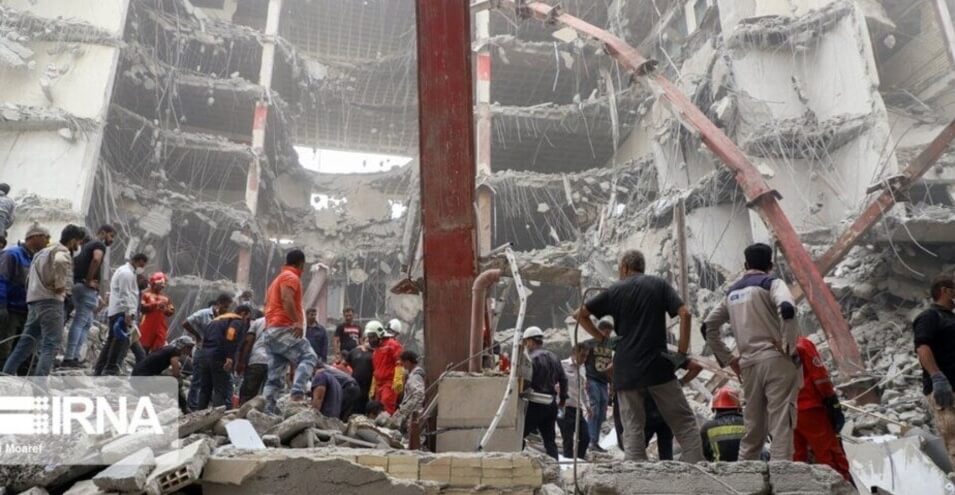
Iran’s Judiciary announced the arrest of 14 people in connection with the collapse of the Metropol building in Abadan.
Masoud Setayeshi, spokesman for Iran’s Judiciary, said on Tuesday, June 7 that four of these individuals are former mayors and the other detainees are people responsible for the engineering system domain in Abadan.
The Judiciary spokesman, without naming the detainees, announced the positions of some of them as follows: former mayor, head of the engineering system, project supervising engineer, mayor of district one, acting head of district one municipality, acting head of technical and civil affairs, deputy for infrastructure and transportation affairs, and technical deputy of the municipality.
According to Mohammad Javad Rezavi, head of the investigation, supervision and inspection commission of Ahvaz city council, one of the detainees is the head of the investment and participation organization of Ahvaz municipality.
News agencies in Iran also reported that Gholamreza Shariati, former governor of Khuzestan, whose departure from the country was announced on Saturday, has returned to Iran.
Following the publication of these reports, Mizan news agency, affiliated with the Judiciary, announced: “To date, no report of suspected or definite negligence by the former governor of Khuzestan regarding the Metropol has been sent to the judiciary of this province.”
The 11-story Metropol building collapsed on the second day of Khordad and at least 43 deaths have been confirmed so far.
Ehsan Abbaspour, special governor of Abadan, announced the latest death toll from this incident on Tuesday, June 7, telling the government news agency IRNA that debris removal to find possible bodies and preparation of the area for demolition of the Metropol building continues.
Following this incident, residents of Abadan and people from several other Iranian cities held consecutive nightly protest gatherings and chanted anti-government slogans.
Following the collapse of the Metropol in Abadan, a number of Islamic Republic officials warned about the unsafe condition of similar buildings in other cities.
Mehdi Chamran, head of Tehran City Council, on Tuesday, May 31, referring to an existing list of 129 dangerous buildings in Tehran, said that some authorities oppose making this list public, without specifying who these authorities are or what institutions they represent.
Ibrahim Ghanbari, head of Ahvaz Fire Department, announced on Monday, June 6 that 409 unsafe buildings have been identified in Ahvaz, saying: “Mahziar City Center and several hospitals in Ahvaz are in a much more critical condition than the Metropol.”
He continued: “The current condition of Mahziar City Center in Ahvaz is catastrophic, and if the parking lot of Mahziar City Center collapses, we will have two thousand deaths.”
Mojtaba Abdollahi, governor of Alborz province, also called for the formation of a task force to identify unsafe structures in the province.
Abbas Jafari, CEO of Qom Fire Department Organization, announced on June 3 that there is no shortage of “Metropol-like” buildings in Qom and there are many buildings such as commercial and medical structures that lack necessary safety measures, especially regarding fire safety.
At the same time, Masoud Aghaziarti, CEO of Arak Fire Department Organization, announced that the organization has issued more than 500 warnings for unsafe structures over the past three years.
According to Ali Salehi, General and Revolutionary Prosecutor of Tehran, fire department managers over the past two years have issued approximately 930 safety warnings and directives to the Tehran Department of Education, for which no appropriate action has been taken by that department.
In recent days, government officials in Isfahan, Shiraz, Tabriz, Mashhad, Arak, and Qazvin have also expressed similar concerns about the existence of unsafe and dangerous buildings in these cities.
Critics of the Iranian government view governmental corruption in the structure of the Islamic Republic as the main cause of such incidents.
Source: Voice of America