Seventy-Ninth Session of Hamid Nouri’s Trial; Witness: When Nouri was arrested, I said the tailor fell in the pitcher…
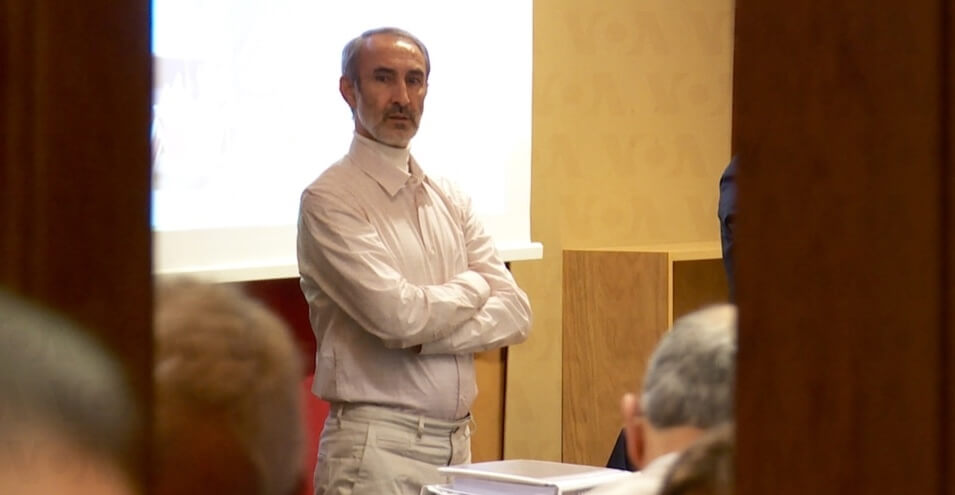
The seventy-ninth session of the trial of Hamid Nouri, accused of participating in the execution of political prisoners in the summer of 1988 at Gohardasht Prison, was held on Tuesday, April 29, 2022 (9th of Farvardin 1401) with testimony from Mahmoud Khalili in Stockholm, Sweden.
Mahmoud Khalili, known as “Uncle” among Qarchak prisoners, was arrested on November 25, 1981 on charges of sending poems and articles to the “Kar” publication and supporting the Organization of Fadai Guerrillas of the People. He was later sentenced to twelve years in prison.
After his arrest, he was forced to write a will and experience what is known as “artificial execution.”
In this court session, Mahmoud Khalili testified as a witness that in 1986 he was transferred from Qarchak Prison to Gohardasht Prison and was held in multiple wards and solitary cells. After the division of prisoners based on the type of sentence and religious beliefs in 1987, he was transferred to Ward Six of Gohardasht Prison and was held with approximately sixty left-wing political prisoners and thirty-eight Bahai prisoners.
Referring specifically to Wednesday, July 26, when the television was removed from Ward Six and visiting hours were cut off, he said this measure led to food and visitation boycotts by prisoners, but unlike previous occasions, this action by prisoners was not accompanied by a reaction from the guards and beatings by them.
Mahmoud Khalili testified that almost all the guards of Ward Six had been changed in July and August 1988. He said that in mid-July he witnessed the entry of fifty or sixty prisoners from the main entrance of the prison into the courtyard. All these prisoners were wearing clean clothes and flip-flops. The witness stated that “the next day I personally saw a pile of flip-flops behind the locked iron door of the prison courtyard.”
Mahmoud Khalili told the court that on August 26, 1988, he was taken to the corridor of death and encountered prisoners including Jahanbakhsh Sarkhosh, Majid Vali, Mohammad Ali Behkish, Mohsen Rajab Zadeh, and Keyvan Mostafavi. Mahmoud Khalili testified that during his first presence in the corridor of death, he heard the sound of trucks and news of their arrival at the prison grounds from a guard.
Mahmoud Khalili explained to the court how people were taken in groups from the corridor of death for execution. In describing the execution of Keyvan Mostafavi, he said that Keyvan, by jumping to the end of a line heading toward the amphitheater, unknowingly and mistakenly joined the execution group and was executed. The witness told the court that later he personally collected Keyvan’s belongings, put them in Keyvan’s bag, and wrote [Keyvan’s information] on it.
Mahmoud Khalili, confirming the execution of another prisoner named Jahanbakhsh Sarkhosh, said he is in contact with Behrang Sarkhosh, the son of this executed prisoner. He said that Behrang, who now lives in Europe, was twelve or thirteen years old at the time of his father’s execution. Behrang told the witness that “after a call from the prison and when we visited the prison, we were informed that Jahanbakhsh Sarkhosh was executed on August 26, but no body would be given to the family and the family has no right to hold any ceremony for the executed.”
Mahmoud Khalili testified that he personally collected the belongings of some executed political prisoners and put them in their bags. He claimed that his handwriting could probably still be seen on some of these bags. By presenting photographs of seventy families of those executed to the court, he said he had taken pictures of the families of executed prisoners as a memento while collecting their belongings. The witness said, “I have brought seventy pieces of these photographs with me to today’s court session.”
Mahmoud Khalili also testified that he was brought before the death tribunal at Gohardasht Prison twice. The first time was on August 26, 1987, after he was transferred from Ward Six to the corridor of death. The witness said he stood before the death tribunal in the death room, including Niri and Eshragi, and by emphasizing his non-belief and not praying, and his father’s non-belief, he resisted pressure to accept forced prayer reading. Mahmoud Khalili testified that after leaving the death tribunal room, he personally heard from Naserian who said to Abbasi: “Take this to the ‘ward of the praying ones’ and emphasized that you don’t make a mistake! Don’t let it become the story of thirty-seven people that you mistakenly took!”
According to Mahmoud Khalili’s testimony, the person being addressed by this warning was “Guard Abbasi,” who, based on Naserian’s statement and claim, had mistakenly executed thirty-seven people during the execution days at Gohardasht Prison.
Mahmoud Khalili, explaining events after meeting with the death tribunal, said that the same night his mustache was shaved and along with several other saved prisoners, they were whipped for refusing to pray. He said, “Through Morse contact we realized that Ward Seven was empty and through the ventilation opening we heard a guard tell other prisoners to write their wills and pour their watches, glasses, and everything they have into these [plastic bags].”
The witness said it was the same night he saw two trucks. One of them was parked under an electric light and several meters beyond the amphitheater, at the site of executions. He testified that the same night he personally saw the bodies of those executed with his own eyes.
Mahmoud Khalili said he was taken to “trial” again on September 2. This time only Niri was present. The witness said, “Along with Siavash, another prisoner, we hid a pencil sharpener blade in our bodies so that in the worst case we could commit suicide.”
Mahmoud Khalili says that it was there that he learned of his second verdict, namely the verdict of “execution.” This sentence was apparently issued by Ayatollah Bidmeshki in 1983. Niri told the witness, “You should have been executed in 1983 and you were lucky.”
Mahmoud Khalili, stating that Niri, after a brief phone conversation, angrily told the witness, “You were lucky!” Niri then told Guard Laskari to “take him away and if he leaves here and says anything about the executions, bring him back and beat him right here at the door.”
Mahmoud Khalili testified in Tuesday’s session that until late December 1986 he had dealt with “Guard Abbasi” many times in Gohardasht Prison as the ward leader appointed by the prisoners and knew him well. The witness said that for him, Abbasi is “a guard.”
Mahmoud Khalili testified that Abbasi personally beat him on Yalda night. The witness’s other personal experience with Abbasi goes back to a day when he was informed of his mother’s death.
Mahmoud Khalili says that on that day, because of his resistance to signing a repudiation statement, he was beaten by Abbasi. Naserian had told him that instead of a leave request form, he should sign a repudiation statement toward his own organization, loyalty to the Islamic Republic, and be interviewed in order to participate in his mother’s funeral ceremony. The witness said that Abbasi, in response to his resistance while he was being beaten, told him, “Even if you had signed it, we would not have given you [leave].”
It should be noted that the witness’s mother, only one day after visiting Gohardasht Prison and having her request to visit her son, Mahmoud Khalili, denied, suffered a stroke and died.
Mahmoud Khalili was transferred to Evin Prison in late February 1988 after the executions and was released ten days to two weeks later.
The witness, in explaining his reaction after Abbasi’s arrest in Sweden and seeing his photographs, said that (to myself) “I said the tailor fell in the pitcher…”
In today’s session, Mahmoud Khalili also testified that Naserian was the prosecutor of the prison until 1987. After Mortazavi, the head of Gohardasht Prison, was transferred to Evin Prison, Naserian for some time held both the position of prison head and prosecutor. In the meantime, Laskari was the head of the strike force and Abbasi played the role of prosecutor.
It is worth noting that Mahmoud Khalili also showed the court a commemorative blindfold from his imprisonment in the 1980s during his testimony in the session. He said, “These blindfolds are not standard and I am willing to go anywhere the court says with it.”
Kent Louise, legal advisor for some of the plaintiffs in this case, asked the court to include this blindfold as an attachment to the case file and as evidence to be added to the indictment. Thomas Sander, the court judge, asked Kent Louise to keep the blindfold with him before review and final decision on this matter.
Nouri reacted to this claim and said: “Give it to me so I can see, no one will understand, I have worked ten years in prison. A prison where you cannot provide a blindfold should be destroyed. Judge, keep this blindfold, it is important…”
The next session of the court will be held on Thursday, April 30, 2022 (11th of Farvardin 1401) with testimony from Alireza Akbari Sepehr in Stockholm.
Source: Voice of America