Revolutionary Guards Launch ‘Second Military Satellite’ into Orbit
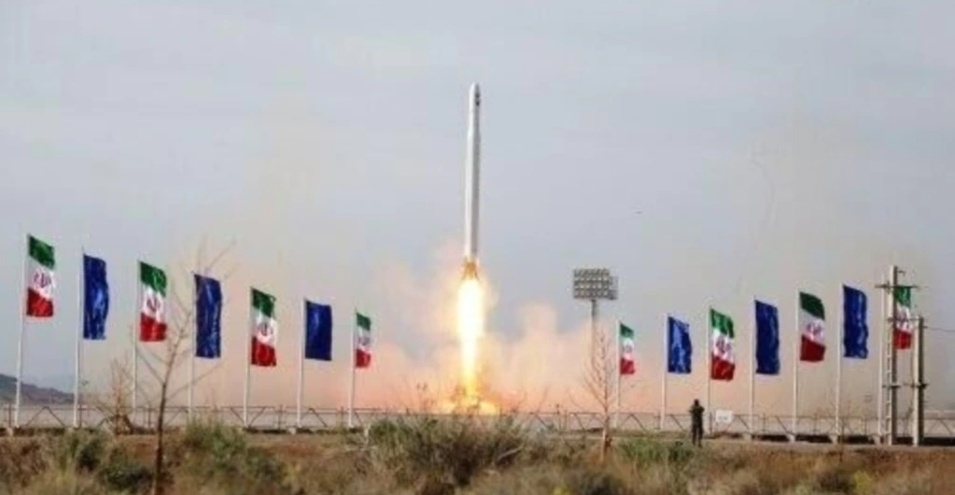
As speculation intensifies over the fate and outcome of nuclear deal revival negotiations, Iran’s state news agency IRNA reported that the Aerospace Force of the Islamic Revolutionary Guard Corps has launched “Iran’s second military satellite, named Noor-2,” into space.
The satellite launch comes just three days after Iran unveiled two new underground “missile and drone” bases, and the commander of the Revolutionary Guard’s Aerospace Force claimed that Tehran is “capable of simultaneously firing 60 drones,” emphasizing the “increase” in the Islamic Republic’s missile capability.
According to Tasnim news agency’s report on Tuesday, this is Iran’s second military satellite and “was launched into space by a three-stage satellite launcher with composite fuel from the Revolutionary Guard’s Aerospace Force and successfully injected into a 500-kilometer orbit around Earth.”
On the third day of Ordibehesht in 1399 (Iranian calendar), the Revolutionary Guard’s media outlets also reported that the organization had launched what it called “Iran’s first military satellite” named “Noor.”
Days later, the United States Space Command announced that what Iran presented as its first military satellite in space is actually a suspended webcam and poses no threat.
The launch of this “military satellite” coincides with intensifying speculation about the fate of nuclear deal revival negotiations, which is significant because Western officials have consistently considered Iran’s military satellite launches as violations of UN Security Council Resolution 2231.
Following Iran’s agreement with six world powers on the nuclear deal in June 2015, the UN Security Council approved Resolution 2231 in endorsement of the agreement.
According to one of the resolution’s annexes, the international community “calls upon Iran” not to undertake activities that produce or expand ballistic missiles capable of carrying nuclear warheads.
Iranian government officials, while rejecting these criticisms, say their missile and space programs are defensive and peaceful in nature.
The Revolutionary Guard’s new measures are being publicized at a time when all countries involved in nuclear deal revival negotiations have recently expressed optimism about progress in talks, and Josep Borrell, the European Union’s foreign policy chief, even said on Friday: “There is a possibility of reaching a final agreement in the coming days.”
Source: Radio Farda