Shiite Clergy and Iran’s Economic Decline
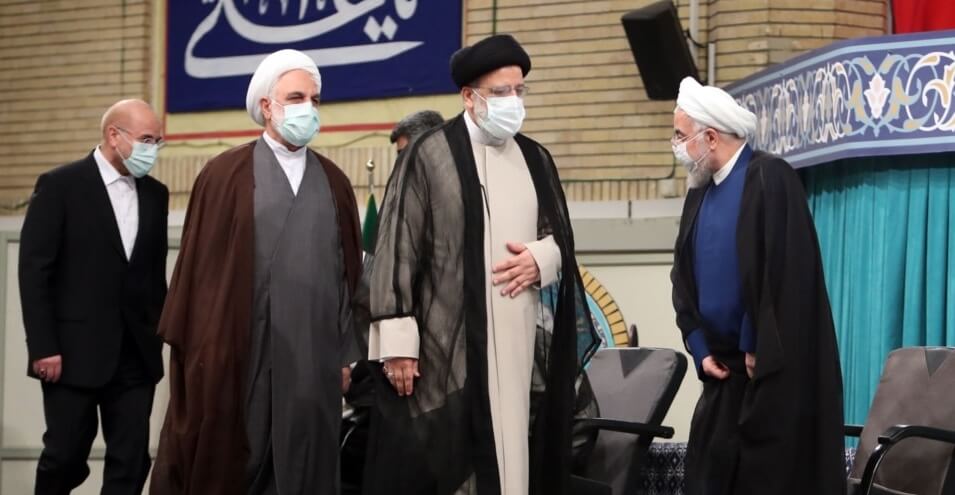
Following tedious ceremonies under the titles of “Ratification” and “Swearing-in,” the helm of managing the Islamic Republic’s executive apparatus was transferred from one clergyman to another. Hassan Rouhani left the presidential palace with a catastrophic economic record, and Ibrahim Raisi, with the slogan of transformation but without any plan or vision, became his successor.
This transition took place amid one of the most turbulent periods in contemporary Iranian history, in which economic decline is one of its main roots.
Given the nature of the political system in the Islamic Republic, a very large portion of Iranian public opinion considers clergymen and their followers to be the main cause of this decline.
Warning
The comprehensive dominance of clergymen over the levers of governance, including in the economic sphere, and the blow that this dominance has inflicted both on Iranian society and on the traditional influence of Shiite clergy, is more obvious than the sun. As economic difficulties intensify and disorder spreads in the provision of public services (including water and electricity), voices are being heard from within the clerical camp, even from those close to power circles, against the grip of this group on the most important reins of governance.
Recently, in connection with the approaching presidential election, Masih Mohajeri, editor-in-chief of the Jomhouri-ye Eslami newspaper, who is himself a clergyman, warned that he is “concerned about the position of the clergy” and does not deem it “appropriate to the nation’s interests” to have a religious figure “in the office of the presidency in the coming period, which requires accepting responsibility for securing people’s livelihoods.”
Why this warning? In his note dated the third of Khordad, titled “On a Well-Intentioned Proposal,” Masih Mohajeri responds to this question as follows: “Now the conditions in the country are such that from the perspective of public opinion, all problems—even those related to bread and water and people’s basic needs—are attributed to the clergy. Those who are comprehensively aware of the country’s situation know that remedying this dire state with the slogans that presidential candidates—both religious and non-religious figures—are raising is not possible. The belief in public opinion that the clergy has brought the country to this day, if a religious figure continues to hold the responsibility of the presidency, could reinforce this way of thinking and increase concerns about the institution of clergy.”
The note by the editor-in-chief of Jomhouri-ye Eslami newspaper, which in fact targets Ibrahim Raisi, without mentioning his name, frames his “well-intentioned proposal” as follows: “Clergymen should confine themselves to presence in legislative, judicial, and cultural positions and entrust executive responsibility, which deals with people’s livelihoods, to individuals who have expertise in related fields.”
Apparently, such warnings are no longer working. During the Islamic Revolution and the years that followed, a large portion of Shiite clergy, enjoying an exceptional position, sold their spiritual and enduring power to the glitter of a “hasty state,” gripped the main levers of political power, and using them seized the sources of wealth production and distribution, without giving thought to the inevitable outcome that sooner or later would arrive.
Economics is the most dangerous arena for entry by those who present themselves as “clergy.” In all religions, the clergy are guardians of eternal and unchanging dogmas, and their authority rests on beliefs that cannot tolerate doubt. The finality of prophethood of the Prophet of Islam, the Imamate of Ali ibn Abi Talib, and the expectation of the reappearance of the Imam of the Age are among the foundations of the beliefs of Twelver Shiite Islam, and the slightest doubt in any one of these foundations would collapse the entire system of belief.
From the Realm of Certainty to the Sea of Doubt
Sciences, unlike religious beliefs, are based on doubt, and change and evolution are inherent to them. Of course, sciences known as “exact” sciences have laboratories. In chemistry, the mixing of two elements and their consequences can be experienced in a laboratory. If this experience is repeated in the same space and no change occurs in the conditions of its performance, it will produce the same results.
Economics belongs to the group of “social sciences,” and conducting experiments in it is, except in rare cases, not possible. The laboratory of economists is the history of human societies, and even the results obtained from historical experiences are confronted with a thousand “buts” due to the complexity of individual and social human behaviors, including being influenced by their beliefs and living conditions. What benefit is there in a “clerical system,” with its absolute sacred beliefs, stepping into an arena where struggle over theories rages.
In all religions, the entry of clergy into the world of politics is problematic both for society and for themselves, especially in the very complex world of the twenty-first century. Statesmen are not necessarily economists, but the final decision-makers in various economic spheres are they themselves, from determining budget and foreign trade directions to fighting inflation and unemployment… Statesmen in all these spheres, even if they are economists, consult with experts and usually are presented with different and sometimes contradictory views. Using personal knowledge and experience, and the varied views of advisors, ultimately it is this statesman who must decide, implement it, and accept its consequences.
A statesman is subject to the judgment of citizens based on the achievement or non-achievement of his economic promises. Even in dictatorial systems, a politician cannot escape this judgment through resort to lies and propaganda. Lies and propaganda may work in the short term, but the burden of inflation and unemployment is too heavy not to be felt. This is why it is said that “economics doesn’t lie.”
Once again we turn to the role of Shiite clergy in the economic sphere. A clergyman with titles such as Ayatollah and Hujjat al-Islam, as long as he remains in his traditional role and speaks with people about religious beliefs, is safe from danger. However, if he enters worldly spheres and accepts responsibility and commitment in mundane matters, he necessarily accepts the risk of being questioned and failing.
In reality, when a person belonging to a hierarchy of religious clergy moves from the unchangeable world of religious beliefs to shifting sands such as economics and its management, it is as if he is thrown from the realm of certainty into the sea of doubt. Will a statesman dressed in the robes of Shiite clergymen, whose worldly promises prove false, be able to remain a guardian of religious dogmas and not endanger the authority of the entire institution of clergy?
From a Clergyman’s Record to Raisi’s Promises
Hassan Rouhani, in the 1392 presidential election campaign, with the title of Hujjat al-Islam and dressed in the “robe of the Prophet of Islam” (as clergymen claim), told his audience that “my discourse will be saving the economy, reviving ethics, and engagement with the world.” And when asked in a phone interview about the future of the cash subsidies of the Ahmadinejad period, his answer was: “The government of prudence and hope is seeking to create such economic prosperity and provide people with such abundant income that they no longer need this 45,000 tomans.”
Where did Hassan Rouhani’s promises lead after eight years? Zero percent average economic growth rate, the second highest inflation rate in Iran’s past 77 years (after the 1995 inflation), a one-third collapse in per capita national income (according to the assessment of the Parliamentary Research Center) or 20 percent in urban areas and 31 percent in rural areas (according to the assessment of Iran’s Statistics Center). In short, during Hassan Rouhani’s tenure, a significant portion of Iran’s middle class fell below the poverty line.
Debating which factions and individuals, through their obstructionism, led the “government of prudence and hope” to such a swamp is not particularly helpful in understanding what happened. Hassan Rouhani was from the beginning one of the architects of the Islamic Republic system and well knew that the Supreme Leader has never presented any president with a bouquet of flowers to this day.
Unlike his successor, Hassan Rouhani was familiar with Iran’s and the world’s economic issues. In fact, the statements and writings of the former president show that he was more experienced in dealing with economic events than any other Iranian executive heads after the revolution.
That despite this experience he left behind such a catastrophic record points back to the entire Islamic Republic system. In the 42-year history of this system, Hassan Rouhani was the third executive head, after Akbar Hashemi Rafsanjani and Mohammad Khatami, who thought he could reconcile Iran’s theocratic system with economic development. That his ship of presidency ran aground in such a miserable situation is very meaningful for all observers of Iranian affairs.
Ibrahim Raisi, unlike his predecessor, is estranged from Iran’s and the world’s economic life, and he displayed this estrangement painfully during the recent election debates. The “plan” of the newly inaugurated president is the product of the “Economic Committee of the Coordination Council of the People’s Support Headquarters of Seyyed Ibrahim Raisi,” in which his goals in the economic sphere are classified into seven categories: increasing production and exports, reducing household expenses, increasing household income, reforming the financial system, reforming the tax system, reforming the budget structure, and increasing transparency.
During this time, phases are determined for each of the goals and the timing of each phase from now until Mordad (August) of 1404, which marks the end of Ibrahim Raisi’s term, is set.
Listing these goals and undertaking to achieve them is not difficult. Rather, what is difficult and what is not mentioned in the table of goals is how to achieve them. For example, we refer to the first two goals:
1) The first goal is to increase production and exports, and based on the timeline, it is projected that from 1401 onwards the average rate of economic growth will reach above five percent, in 1402 the country’s total foreign exchange needs will be met through non-oil exports, and by 1404 non-oil exports will at least double (from 35 billion to 70 billion dollars).
With a quick glance at the various phases of achieving the first goal, the question immediately arises: how will the transition between these phases be possible? How is the zero percent average economic growth rate in the 1390s supposed to reach five percent per year through what miracle? It is said that this growth rate will be achieved by emphasizing improved productivity; the question is how catastrophic current productivity, which is negative, will become the engine driving Iran’s economic growth in just one more year?
Also, regarding the first goal, how does the thirteenth government intend to increase non-oil exports from 35 billion to 70 billion dollars? For both improving productivity and increasing non-oil exports, how much investment does the country need? How much of this investment will be financed from abroad? To achieve five percent growth and 70 billion dollars in non-oil exports, are sanctions to be lifted? And these questions can continue…
2) As for achieving the second goal (reducing household expenses), it relies on a series of populist promises, including issuing livelihood credit cards for the first five income deciles, building four million residential units in the next four years, reducing the share of housing in the household spending basket (from 50 to 30 percent), as well as generous initiatives in the field of health. Here too we face the question of how the costs of these measures will be financed.
Most importantly, to achieve the goal of “reducing household expenses,” the Raisi government commits to bringing the inflation rate in the first phase to half the 1399 inflation rate (from 36 to 18 percent) and then moving toward single-digit levels. Here too the question of how this goal will be achieved arises. Why did Hassan Rouhani’s government (based on official statistics on July inflation) end up with an official inflation rate above 44 percent? Why would Ibrahim Raisi’s government be more successful in dealing with this terrible scourge than Hassan Rouhani’s government?
The next five goals raise the same questions. The Iranian public, which does not quickly forget the bitter experience of the “government of prudence and hope,” why should it take Ibrahim Raisi’s promises seriously? What personalities, with what level of knowledge and experience, are to undertake such miracles in the economic sphere?
In the past four decades, the entry of clergymen into the very slippery arena of economic governance has borne crushing costs not only for Iran but also for Shiite clergy and its future. The Ibrahim Raisi government will raise this cost further.
Source: Radio Farda