International People’s Court of November; Testimony of Khatam al-Anbia Headquarters Employee
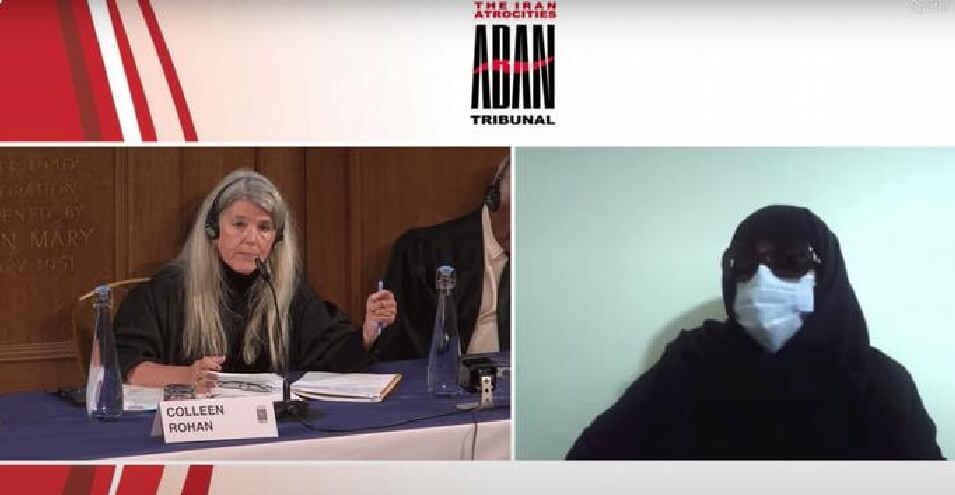
In the fifth and final session of the “International People’s Court of November” in London, several witnesses to the suppression of nationwide November 2019 protests testified. In various cities, ambulances transported the wounded to detention centers instead of hospitals.
“The International People’s Court of November” which began on November 10 (November 19, 2019) concluded on November 14. The court’s task was to symbolically investigate potential crimes of the Islamic Republic during the nationwide 2019 protests.
On the final day of the court proceedings, as on previous days, eyewitnesses and families of victims of the November 2019 nationwide protests described their observations and experiences.
Most of them appeared in video testimony with their faces covered, while some who live outside Iran testified without face covering.
Judges had asked witnesses to refrain from giving identifying details that could reveal their identity. For this reason, only some mentioned their city or region.
Among the witnesses who appeared without a mask, using his real name and hometown, was Jamshid Ariana, who testified on behalf of his family.
One of his close relatives named Burhan Mansurnia was killed in Kermanshah during the November protests.
According to Mr. Ariana, Burhan and two others came under fire. Those two were killed immediately, while Burhan was transferred to Farabi Hospital, but the hospital refused to admit him. He was then transferred to Taleghani Hospital. There too, they initially refused to treat him, but after two hours of his bleeding, he was taken to the operating room.
Ariana continued, saying that Burhan’s relatives witnessed at least eight bodies being removed from the operating room. Burhan ultimately did not survive.
The complaints that the victim’s family has submitted in Iran so far have been unsuccessful, and authorities asked them to stop pursuing the matter.
According to Jamshid Ariana’s testimony, they claimed that Burhan was not killed by “organized bullets” but was murdered by bullets from protesters. The witness emphasized that the bullet entered Burhan’s body from behind and exited from the front, and there was no bullet lodged in his body.
Ariana also said that authorities asked the victim’s family to say on camera that Burhan was a government supporter and was “martyred” at the hands of protesters.
Transporting Injured in Ambulances to Detention Centers
What some witnesses said in previous days was repeated on the final day: government officials were involved in violence and arson of public facilities.
Furthermore, several others who apparently witnessed protests in different cities reported that ambulances transported the wounded to detention centers or intelligence offices instead of hospitals.
One of these witnesses, whose face was completely covered, witnessed security forces shooting a teenager. He said: “It was on November 25. I had gone out for an important task. I saw the streets were crowded. All streets were closed. Cars were stopped and motorcycles were turned off. The protest was about why gasoline prices had risen. Where I was, special units were present with motorcycles and cars. I swear by God that when a bank caught fire, I told one of the special units to call the fire department to come and extinguish it. They said we’re not allowed to call. I realized then that their intention was to incite violence. People were filming too. They were chanting ‘death to the dictator.’ I chanted ‘death to Khamenei.’ Someone next to me said, don’t make it political. I said what do you mean don’t make it political? Khamenei is the cause of our misery. He is the basis of the system.”
He witnessed two people being hit by “plastic bullets containing pellets,” “one under his eye and another above his ear” on November 25.
According to him, in another confrontation with security forces, several people were wounded and ambulances transferred them to the intelligence office instead of a hospital.
“They were beating people with motorcycles”
Another witness said: “They fired at us from a distance of two meters. Both from the front and from a post behind… I myself saw them beating protesters with motorcycles.”
He is wounded and leaves the protest scene: “I was limping toward home. I had been wounded in the leg and was bleeding. They grabbed me and took me to a place where there were other protesters. From the very first moment, with beatings and insults and humiliation, they put us in a vehicle where maybe seven people were crowded on the back seat, and took us to a detention center… There they also beat us with batons and punches and kicks. They said you’re not even a thousand people, we’ll kill all of you. There were fourteen and fifteen-year-old children there too.”
Another witness testified that no one in his city had firearms: “It was peaceful. People were chanting against gasoline price hikes. There were some among the people who were inciting the protesters to violence. I identified two of them, they were active in the Basij in our area. For this reason, those who set fires to banks were from the government itself. I witnessed that the people did not initiate violence.”
Gunfire from Helicopter
What “shocked” this witness was an incident that occurred on November 25 in the city of Sadra, Shiraz. He said: “I wanted to go to Sadra, Shiraz to do some work. When I entered, I saw a scene that looked like war. I myself have experienced war. In Sadra, the scene was the scene of war. On one side there were unarmed people and on the other side there were military forces firing directly at the people. A helicopter was flying at a height of about 50 meters above the ground. I was about 100 meters away from the helicopter. I thought they had come to film the protesters so they could confront them later. But they opened fire on the people from the helicopter. In the stone alley of Sadra, Shiraz, there were many protesters and they fired at them to disperse the crowd.”
He continued, saying he moved closer to the crowd and witnessed this scene from a distance of about 50 meters: “I saw a teenager, 15 or 16 years old, I’m not sure if his name was Mohammad Dastaghkhaah, come under fire and fall to the ground. And to prevent anyone from helping him, they fired bursts of gunfire around that teenager too. Despite having experienced war, I have never seen such a scene. It was very disturbing.”
Request for Support from Law Enforcement
Aram Murdokhi was another witness who emphasized the peaceful nature of the initial protests. He described his observations in the city of Sanandaj.
According to him, from dawn on November 25, special units and anti-riot forces controlled the streets, and snipers were also positioned on top of tall buildings in some areas.
He said people initially chanted “peaceful” slogans and demanded support from law enforcement.
Murdokhi continued his testimony: “They put arrested protesters in Toyota vehicles that had something like a cage on them. They imprisoned people inside these cages. They used people as human shields so they couldn’t damage these vehicles.”
He also observed that ambulances transported the wounded to detention centers.
Testimony of Khatam al-Anbia Headquarters Employee
One of the witnesses who testified with a covered face said he was a contract employee of one of the projects of the Khatam al-Anbia Construction Headquarters and had a duty to participate with security forces in suppressing protesters.
For this purpose, he was taken to the protest site in Shahriyar, but he refused to participate in the suppression and was therefore fired.
He also emphasized that acts of sabotage such as setting fires to banks, cars, and shops were “the work of special units” and “plainclothes” individuals.
This witness said ambulances that entered the confrontation scene belonged to the Revolutionary Guards and only transported their own wounded and paid no attention to injured protesters.
Another witness said detained protesters were completely stripped of clothes and some, especially teenagers, were “sexually abused.”
Parliamentary Representative’s Confession to Participation in Massacre of Protesters
Hasan Norouzi, Vice-Chairman of the Parliamentary Judiciary Commission, said on Sunday, November 23, in response to the “International People’s Court of November”: “I was one of those who shot at the people. We killed. Now who wants to prosecute us? The other side came and set fire to banks, and we killed them too.”
Earlier, an official of the Islamic Republic also reacted to this court. Organizers of the court, citing European sources, said Ali Bagheri Kani, Deputy Foreign Minister of Iran, said the continuation of the people’s court in London could lead to a halt in part of nuclear negotiations.
In five sessions of the “International People’s Court of November,” 45 witnesses and experts testified in person. In addition, 120 written testimonies were provided to the court.
This court was formed at the initiative of three civil society organizations, “Justice for Iran,” “Iran Human Rights,” and “Together Against the Death Penalty,” in response to requests and follow-up by families of victims.
The ruling of the court’s six-member panel of judges is likely to be issued in the early months of next year.
Source: DW