Haft Tappeh: From Continued Worker Protests to Cancellation of Factory Privatization Contract
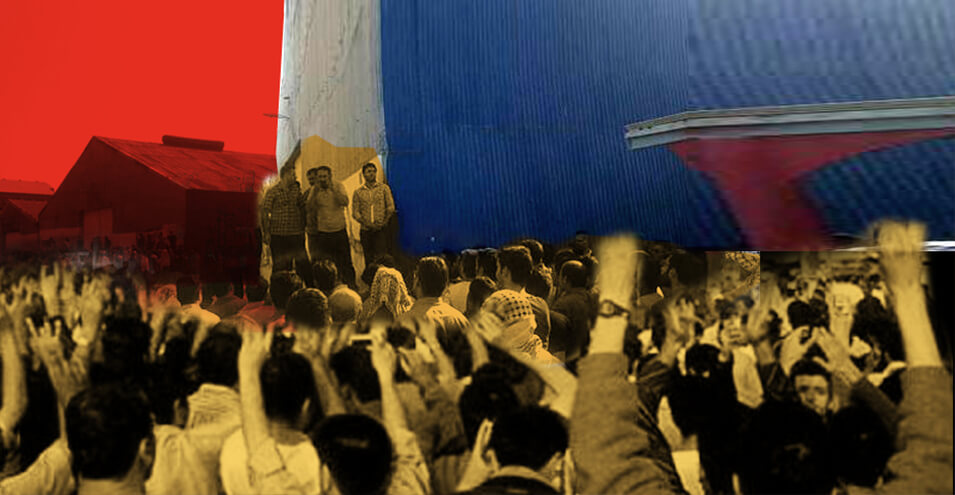
Nearly three months have passed since the start of a new round of protests by workers of the Haft Tappeh Agro-Industrial Company in Khuzestan Province. The protesting workers of this major Iranian industrial complex launched a new wave of continuous and uninterrupted peaceful protests from late June of this year, which is now approaching its 90th day. The foundation of problems and workers’ discontent and protests at this industrial complex was formed when Haft Tappeh’s management was handed over to the private sector. This occurred in 2015, and now after five years have passed, Iran’s “Court of Audit” has called for the cancellation of the privatization contract for Haft Tappeh Sugar Cane Company in Khuzestan after investigation and inspection into the manner of handover, performance, and status of the company.
One of the most important demands of workers during their protests has been determining the status of factory management and the removal of the current CEO, “Omid Asadbigi.” A demand that, given the Court of Audit’s announcement regarding contract cancellation, does not seem out of reach.
Factory Privatization and the Peak of Workers’ Hardships
Haft Tappeh Sugar Cane Factory is located 14 kilometers from the city of Shush in Khuzestan Province. A large factory situated on land covering 24,000 hectares that officially began operations in 1961 and despite numerous management changes over the years, remained under government management until 2015.
Currently, Haft Tappeh has nearly 5,900 workers, with some being permanent employees and others seasonal workers.
In February 2015, the country’s Privatization Organization transferred 100 percent of the company’s shares to two young men aged 28 and 31. These two managers of companies “Zeus” and “Aryak” became owners of this massive factory with a down payment of 60 billion rials.
According to the Privatization Organization’s announcement, Haft Tappeh Factory owed approximately 150 billion tomans to the Social Security Organization before privatization. In other words, factory managers had not paid workers’ insurance premiums for years.
Ali Ashraf Abdollahpouri Hosseini, then head of the Privatization Organization, stated that the accumulated losses of this company in 2015 and before privatization to the private sector were approximately 345 billion tomans, and the wages of the company’s personnel had not been paid for “seven months.”
Following the handover of Haft Tappeh Agro-Industrial Company, protests began regarding the manner of privatization.
Meysam Al-Mahdi, a labor rights activist, told Human Rights Campaign: “The claim that the factory owes heavy amounts to social security is despite the fact that throughout all these years, workers’ insurance premiums have been deducted from workers’ monthly salaries.”
This labor rights activist believes that the announcement of the factory’s debt to social security throughout all these years demonstrates that “dealings” between factory managers and the Social Security Organization during all this time have caused this debt, while the damage is borne by workers from all sides, not by managers who deducted workers’ insurance premiums from their salaries (even daily wages) but never paid to the Social Security Organization.
According to this labor rights activist, the announcement of debt to the Social Security Organization indicates a corrupt system intertwined between factory managers and government officials.
Critics of the privatization believed that the announcement of the company being “loss-making” at the time of handover was dubious, and this matter was raised so that buyers would purchase the company for a lower amount. Also, many workers of this complex believed that the 60 billion rial down payment for purchasing this factory for a complex that only has 24,000 hectares of land was insufficient and unjust.
Meysam Al-Mahdi states that this method, namely announcing the factory as loss-making, has had precedent before. According to him, years ago, during the privatization of Ahvaz Steel Factory to the Amir Mansour Aria Group, it was announced that this factory had a production of 800,000 tons before privatization, but one year after the factory’s privatization to the private sector, it was claimed that the factory’s production had reached 1,800 tons, while no noticeable changes occurred in the factory’s production process during one year and that complex’s workers’ problems persisted.
Nevertheless, the privatization of Haft Tappeh Factory to the private sector failed to resolve workers’ numerous problems, and shortly after private sector management took over the factory, the foundations of Haft Tappeh workers’ protests formed.
The most significant protests by Haft Tappeh workers date back to November and December 2018. The main Haft Tappeh workers’ protests at that time related to wage arrears and non-payment of health insurance premiums, as well as protests against private sector management methods. During several days of worker protests and strikes, Esmail Bakhshi, representative of Haft Tappeh workers, was arrested.
Following Esmail Bakhshi’s arrest, security forces subjected this labor activist to psychological and physical torture and forced him to make forced confessions.
During these protests, Sepideh Ghollian, a labor rights activist, was also arrested by security forces and was forced to confess. Confessions that were broadcast by Iran’s state television.
Following Esmail Bakhshi’s arrest, a wave of arrests and summons of Haft Tappeh workers began. A number of workers who protested and gathered in response to Esmail Bakhshi’s arrest were arrested by security agencies. Mohammad Khanifer was among the workers arrested by the Shush Information Agency and transferred to an unknown location.
At that time, Amir Amirgholi, Sanaz Alahyari, Asal Mohammadi, and Amir Hossein Mohammadi Fard were also summoned and arrested due to the Haft Tappeh workers’ protest case. These individuals were labor rights activists and journalists who covered news related to Haft Tappeh workers’ protests.
Following the continuation of Esmail Bakhshi’s detention and the summons and threats of another group of Haft Tappeh workers by security forces, a group of Haft Tappeh workers submitted a complaint letter to the International Labour Organization’s Committee on Freedom of Association against Iran’s government regarding the continuation of detention and suppression of labor activists.
In part of the letter from Haft Tappeh workers, referring to the continued detention of Esmail Bakhshi, representative of protesting Haft Tappeh workers, Sepideh Ghollian and Amir Amirgholi, social activists, and Sanaz Alahyari and Amir Hossein Mohammadi Fard, journalist couple, it stated: “The families of these detainees are all under pressure and harassment not to discuss their condition. Security and judicial officials have told some families that the more information about the prisoners leaks to media outlets, the heavier their sentences will become.”
Second Wave of Worker Protests and Trial of Young Haft Tappeh Managers
After Haft Tappeh workers’ protests regarding non-payment of several months of wages and non-payment of workers’ insurance premiums, as well as the manner of factory privatization to the CEO of this factory, Omid Asadbigi, made numerous promises about the factory’s revival and the return of laid-off workers to work. These promises were never implemented until the second wave of Haft Tappeh workers’ protests resumed from late June 2020 and amid the coronavirus pandemic in Iran.
The resumption of the second wave of labor protests coincided with the arrest of Omid Asadbigi, CEO of Haft Tappeh, on charges of disrupting the country’s foreign exchange system. Asadbigi, recognized as the primary defendant in this economic case, participated in the relevant courts but spent a long time on conditional release. One of the charges against Omid Asadbigi is the sale of “one and a half billion dollars” in government foreign exchange in the “free market.” Money that this young CEO received under the pretext of factory development and sold dollars in the free market instead of spending them in the factory.
Haft Tappeh workers, at the beginning of their protests, clearly stated their demands by writing a report; receiving outstanding wages, depositing insurance premiums, return to work of laid-off colleagues, and cancellation of the company’s privatization were announced as workers’ most important demands.
Also, in part of the workers’ report, it stated: “Workers are complaining to the case judge about Omid Asadbigi’s conditional release to pay personnel salaries and his failure to pay salaries. Workers say that someone who violates must be dealt with severely by the judiciary for the crime they committed. What reason is there for the primary defendant to be free while other criminals in the case are in prison?”
In this report, it was noted that workers developed the perception that he (Omid Asadbigi) is using the matter of company personnel salaries as “judicial immunity” and “human shield against arrest” and ultimately “not receiving a sentence and not going to prison.”
After a month of continuous and ongoing protests by Haft Tappeh workers, Farzaneh Zilabi, lawyer for Haft Tappeh Sugar Cane workers, announced the arrest of four workers of this industrial unit by the information police and security of Shush County.
Farzaneh Zilabi, on Tuesday, July 15, in an interview with the Emtedad website, said: “Four of my clients named Moslem Cheshmehkhavar, Youssef Bahmani, Ibrahim Abbasi, and Mohammad Khanifer were arrested by the information police and security of Shush County and transferred to Dezful Prison.”
According to Farzaneh Zilabi, Mohammad Khanifer and Youssef Bahmani were arrested while they were infected with coronavirus and were recovering from their illness.
At that time, Mohammad Reza Dabiryan, another Haft Tappeh Sugar Cane worker, was also summoned by the General and Revolutionary Prosecutor’s Office of Shush County on charges of “insulting officials and spreading lies and slander” and was sentenced to 222 lashes of discretionary punishment.
The sentence of 222 lashes was issued for this worker at a time when Mohammad Reza Dabiryan had also been infected with coronavirus and on this basis had requested a retrial from the court.
One of the court sessions was the scene of the presence of one of Haft Tappeh workers. Where Youssef Bahmani, representative of Haft Tappeh workers, who brought himself to court, addressed Judge Masudi and said: “Your Honor, every time their case [Omid Asadbigi and Mehrdad Rostami, Haft Tappeh owners and defendant in currency smuggling] comes up, they use workers as a human shield.”
This worker, referring to arrests and case-making against protesting Haft Tappeh workers, also said: “Your Honor, why when I, as a worker, claim my rights, they make a case for me and put prison clothes on me, but Omid Asadbigi with this huge amount of corruption is walking around freely in a suit and tie? Where is this justice?”
Youssef Bahmani, stating that he brought himself to this court by gathering support from other activists over a thousand kilometers and spending a lot of money so I could be the voice of workers, said: “Since the private sector came here, there has been nothing but misery and misfortune and calamity.”
Youssef Bahmani highlighted two of Haft Tappeh workers’ demands this way: “Announcing the removal of these gentlemen and payment of all claims from wages and insurance to other claims.”
The third court session on Omid Asadbigi’s case was held on August 20 with the presence of the Minister of Economic Affairs and Finance, the head of the Privatization Organization, a representative from the Ministry of Cooperatives, Labor and Social Welfare, a representative from the Court of Audit, a representative from Khuzestan Governor’s Office, and labor activists. In this session, Seyyed Nezamoldin Mousavi, member of the parliamentary commission on Article 90 of the Islamic Consultative Assembly, said that “if the issue of removing Haft Tappeh company’s employer from the Privatization Organization and Ministry of Economy is not resolved, we have no choice but to use our authority to impeach the Minister of Economy.”
Now the Court of Audit, after investigation and inspection of the manner of privatization, performance, and status of Haft Tappeh Sugar Cane Company in Khuzestsan, has called for the cancellation of the privatization contract, which in fact indicates that workers are approaching one of their demands.
However, Haft Tappeh Workers’ Union’s Telegram channel, on Monday, September 7, in response to this decision by the Court of Audit, announced a one-day suspension of strikes and protests with the publication of a statement that read: “Greater victories are ahead!”
In this statement, it was mentioned: “In these circumstances, it can be said that workers have achieved their first victory and taken a step forward, because with their strike, they forced parliamentary representatives to account. However, complete removal from the private sector was one of the original demands of workers that must be realized.”
The statement stated that “Haft Tappeh workers know well that until complete removal from the private sector, the struggle continues, and the problem is not solved only by Asdbigi and Rostami and their associates leaving, but rather the private sector arrangement must be dismantled, because it is not only the pieces of this game that need to be changed.”
The workers’ union statement emphasized that “Haft Tappeh ownership should not be in the hands of any other individual, organization, or institution. Haft Tappeh workers are the only ones who can best manage and administer the Haft Tappeh Sugar Cane Agro-Industrial Company.”
Meysam Al-Mahdi, a labor rights activist, says that the possibility of canceling the privatization contract to the private sector does not at all mean that in the coming months and quickly the problems and hardships of Haft Tappeh workers will be resolved.
Mr. Al-Mahdi says that if this privatization is canceled, there will be three possible futures for factory management; one is that, as some protesting workers say, factory management is returned to the government. That is, the situation that existed before privatization to the private sector. The second scenario is that factory management, as a large section of workers demands, is managed in council form with council management by workers. The third possible case for determining factory management would be the transfer of this factory to another individual or individuals in the private sector. A path that, according to Mr. Al-Mahdi’s view, is the government’s final choice for managing this factory.
Meysam Al-Mahdi told Iran’s Human Rights Campaign that “these government officials were the ones who no longer wanted the current management, and the change of Asdbigi’s management and cancellation of factory privatization did not happen because of workers’ demands and their protests.”
This labor rights activist says that all government organs, from the government and privatization organization and social security to the judiciary, have joined hands to increase pressure on the working class and workers’ protests and strikes.
This labor rights activist says that with the expansion of worker protests in Iran and the spread of these protests from southern factories to other factories throughout Iran, such as Isfahan and Arak, it will cause us to witness a very widespread wave of worker protests and strikes in the coming months.
Source: Iran Human Rights Campaign