IAEA Report: Iran Did Not Allow Inspections
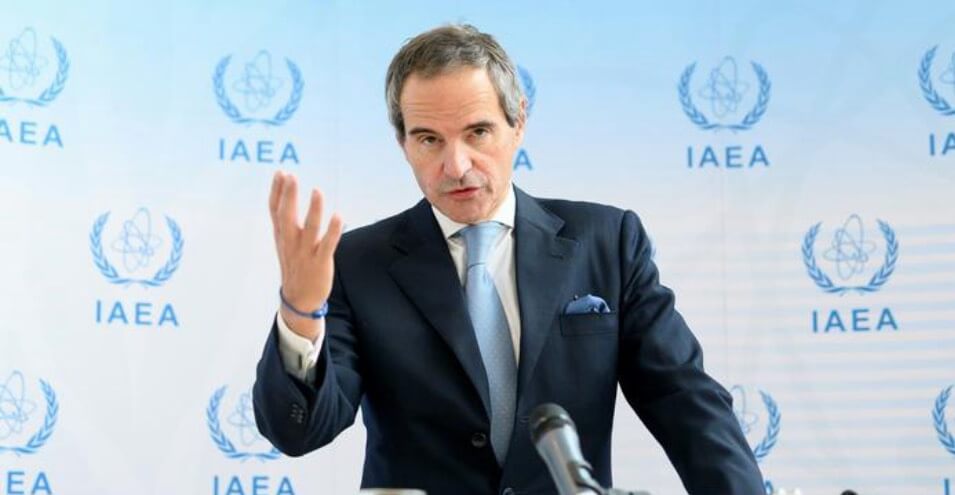
The International Atomic Energy Agency in its quarterly report on Iran’s nuclear activities wrote that this country did not allow inspectors access to two atomic centers and did not provide clear answers to the Agency’s questions.
According to Reuters news agency, the International Atomic Energy Agency in its quarterly report on Iran’s nuclear activities, released on Tuesday, March 3, stated that the Islamic Republic of Iran has refrained from issuing permits for this body’s inspectors to access two centers. The report also states that Iran did not provide necessary cooperation with Agency officials and did not give “clear answers” to their questions regarding nuclear materials.
This is the first quarterly report by the Agency following Rafael Grossi’s assumption of office as the new head of the organization. The report is also the first Agency report following the Islamic Republic’s withdrawal from its JCPOA commitments.
The head of the International Atomic Energy Agency has asked Iran to resume cooperation with the organization as quickly as possible and allow inspectors access to the mentioned centers. Reuters reported that Iran has accelerated its withdrawal from its JCPOA commitments. The International Atomic Energy Agency in a report provided to Reuters stated that Iran currently has 1,020 kilograms of enriched uranium, which has nearly tripled compared to this country’s reserves in November of last year.
The Agency has also warned Iran against any action that violates its commitments. The Director General of the Agency, in an interview with France’s news agency, even warned that he will “sound the alarm.” He has requested Iran to provide explanation about a center near Tehran where uranium particles were last found.
Agency inspectors visited the Turquzabad warehouse in February of last year. The existence of this center had also not been reported to the Agency. The Islamic Republic claims that a carpet washing facility existed at this location.
Grossi, before meeting with Emmanuel Macron, President of France, said that “Iran should have more transparent cooperation with the Agency.” The Agency will publish another report next week on Iran’s nuclear program that will reference these matters.
Iranian Version of the IAEA Report
Simultaneously, Tasnim news agency reported that Kazem Gharibabadi, Iran’s ambassador and permanent representative to the International Atomic Energy Agency based in Vienna, said: “The report once again confirms that the Agency’s verification activities regarding the JCPOA have continued from January 16, 2016 until now.”
He added: “The report also states that Iran’s activities regarding UF6 enrichment in Fordow have continued and Iran’s enrichment level is up to 4.5 percent.”
According to Kazem Gharibabadi, “the Agency’s report also acknowledges that Iran has installed new centrifuges as announced” and “Iran continues to voluntarily and temporarily implement the Additional Protocol and verification of the non-diversion of declared materials and activities in Iran continues.”
In 2015, Iran and the P5+1 countries (United States, Russia, China, France, Britain, and Germany) reached a historic agreement after years of negotiations to limit Iran’s nuclear activities. With Donald Trump’s arrival at the White House in 2017, the prospect of continuing the JCPOA became dim. The United States eventually withdrew from the JCPOA in 2018 and imposed extensive sanctions against Iran.
The Islamic Republic began the first phase of reducing its nuclear commitments on May 8 of last year on the first anniversary of the US withdrawal from the JCPOA. In this step, it was announced that the sale of enriched uranium and heavy water would be halted. Two months later, the second step was taken and the Iranian government announced it would exceed the 3.67 percent uranium enrichment limit set in the JCPOA.
The third phase of reducing JCPOA commitments also began on September 6. In this phase, the Islamic Republic abandoned the limitations provided for in the JCPOA and began research and development in various types of centrifuges and new centrifuges.
The Islamic Republic has repeatedly asked the remaining JCPOA parties, especially European countries, to fulfill their “banking and oil commitments” to Tehran and take “practical steps” to facilitate banking transactions and the sale of Iranian oil. Iranian officials had threatened that otherwise, the Islamic Republic would take its fourth step in reducing its nuclear commitments. This step was taken on November 5 of the current year. The Islamic Republic of Iran formally announced in January of this year that it would no longer be bound by the limitations and requirements provided for in the nuclear agreement regarding the level of uranium enrichment and the level of its reserves.
Source: DW