Netanyahu: Iran Possessed Another Secret Nuclear Facility
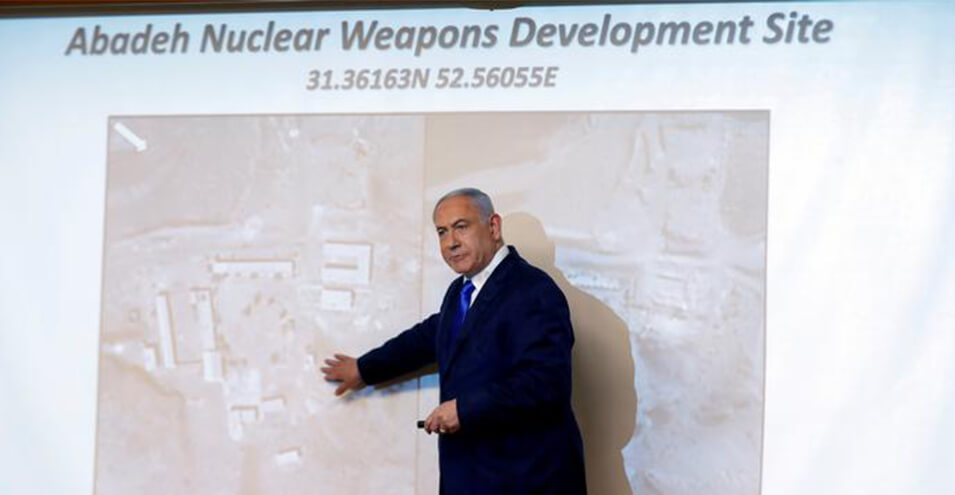
Benjamin Netanyahu, Prime Minister of Israel, said that Iran has been developing atomic weapons in “secret nuclear facilities in Abadeh.” The Israeli Prime Minister also stated that Iran conducted nuclear tests at these centers for military purposes.
According to Reuters news agency on Monday, September 18 (September 9), Benjamin Netanyahu, Prime Minister of Israel, spoke at a press conference about the existence of “hidden nuclear facilities in Abadeh” in Fars Province.
Netanyahu said he obtained this information from a collection of important intelligence about Iran that Israel had previously acquired.
Netanyahu, at the headquarters of Israel’s Ministry of Foreign Affairs, while showing aerial images of a location in Abadeh county in Fars Province, said that Iran “after discovering that Israel was aware of this secret nuclear facility, took steps to destroy it.”
The Israeli Prime Minister stated at this press conference that the Islamic Republic of Iran should know that we are tracking it and know what it is doing. He said: “Israel knows what you are doing, Israel knows when and where you do what.”
Netanyahu’s Previous Statements About “Iran’s Secret Nuclear Center”
The Israeli Prime Minister said a year ago that Iran possesses a “secret nuclear archive.”
Benjamin Netanyahu said in September 2018 that Iran removed 15 kilograms of radioactive material from a facility in August. According to this claim, Iran dispersed it in various locations in Tehran to hide this material. The Israeli Prime Minister had mentioned “Turquaz Abad” in the suburbs of Tehran.
The Israeli Prime Minister at Monday’s press conference, while showing aerial photographs of “Iran’s secret atomic centers,” emphasized that after Iran discovered that Israel was aware of the existence of these secret centers, it attempted to destroy evidence and documents about these facilities.
Coinciding with the visit of Colonel Cornel Feruta, the interim head of the International Atomic Energy Agency, on Sunday, September 17, Reuters news agency reported, citing unnamed diplomats, that international inspectors took samples from a location in Iran (Turquaz Abad). The report stated that inspectors found through this sampling that uranium existed at this location.
Deployment of New Centrifuges
The International Atomic Energy Agency on Monday, September 18 (September 9), announced in a statement that its inspectors in Iran, after observing atomic facilities, are confirming the installation of a newer generation of uranium enrichment centrifuges by this country.
The Agency’s statement stated: “These centrifuges have either been installed or are in the process of being installed.”
Installing these centrifuges allows the Islamic Republic to enrich uranium at a faster rate. By installing and operating these devices, Iran has reduced another part of its commitments in the atomic agreement with world powers.
Iran’s Atomic Energy Organization announced two days earlier, Saturday, September 16, that it had installed 20 IR-4 model centrifuges and 20 IR-6 model centrifuges in its facilities.
The International Atomic Energy Agency said Iran has installed or is in the process of installing 22 IR-4 devices, 30 IR-6 devices, and three IR-6s model devices at the Natanz facility.
According to the atomic agreement, Iran is only permitted to use the older IR-1 model centrifuges. The International Atomic Energy Agency announced that Iran intends to resume its research program.
Cornel Feruta, interim head of the International Atomic Energy Agency, emphasized on Sunday, September 17, during a meeting with Iranian officials, that this organization’s mission is verification and its approach is independent.
Behrouz Kamalvandi, spokesman for Iran’s Atomic Energy Organization, also said at a press conference on Saturday, September 16 (September 7), that Iran is no longer committed to the timeline schedule contained in the JCPOA and added that if other JCPOA parties fulfill their commitments, Tehran will return to its commitments.
Following the unilateral U.S. withdrawal from the atomic agreement, Germany, Britain, and France are striving to preserve this agreement.
Heiko Maas, Germany’s Foreign Minister, also said on Monday that Europe cannot be expected to find a solution to this dispute alone, while other countries are moving in the opposite direction.
Source: DW