Iran’s Ranking in Annual Corruption Index: 146 out of 180 Countries
Indices from Transparency International show that bribery, corruption, and governmental maneuvering are particularly severe in South Africa, and wealthy industrialized countries are also experiencing setbacks in combating corruption. Iran received a score of 26 out of 100 points.
Transparency International states that the fight against corruption worldwide has deteriorated. The organization’s latest report shows that a large number of the 180 countries reviewed do not have an acceptable record in combating governmental and financial corruption.
Transparency International annually evaluates the severity and weakness of corruption in countries on a scale from zero to 100 points in its assessment table. The notable point in this organization’s 2019 assessment is that more than half of the countries scored below 50 points. Denmark and New Zealand received the best ranking with 87 points. Finland with 86 points, and Singapore, Sweden, and Switzerland with 85 points are in the subsequent positions.
The average of the assessments is 43 percent, and no country has received a perfect score of 100. Two-thirds of countries scored below 50 points.
Iran ranked 146 in this review and received a score of 26 out of 100 points, which is the worst ranking for this country in recent years. In 2018, Iran with 28 points was ranked 138 in this table, and in 2017 it was in position 130.
Angola, Bangladesh, and Mozambique ranked alongside Iran in Transparency International’s 2019 assessment.
Transparency International reminds that corruption thrives in an environment where legal and democratic structures are in decline; where democratic institutions are weakened and the space for civil society and independent media has narrowed.
Industrialized Countries Have Experienced Setbacks
Statistics show that even among the seven major industrialized countries of the world, significant improvement in combating corruption is not evident. On the contrary, in four countries—Canada, France, Britain, and the United States—corruption has increased.
The situation in Germany and Japan has remained the same as before (9th position and 80 points), and only in Italy have conditions slightly improved compared to 2018.
Transparency International evaluates bribery, political and financial maneuvering, governmental and commercial corruption, and its criteria are based on the views of experts and country officials.
Clear Connection Between Corruption and Instability
The worst scores were given to Somalia, South Sudan, Syria, and Yemen. Marwa Fatfat, one of Transparency International’s advisors in the Middle East and North Africa, says that war, unrest, and violence exist in these countries, revealing the connection between corruption and instability.
After the four mentioned examples, sub-Saharan Africa has the worst situation in Transparency International’s charts. One reason for this is the region’s rich natural resources and the fact that foreign companies do not invest locally and for the benefit of the people of this region.
Mokgabudi Kope, one of Transparency International’s colleagues in South Africa, told Deutsche Welle: “What expectations can we have for combating corruption in an economy that doesn’t even have any infrastructure for healthcare and medical services?”
Patricia Moura, the director of Transparency International, says: “The lack of progress in this area is disheartening and has had destructive effects on the lives and fates of citizens of countries.” She reminds that improving people’s lives and ending corruption requires that the relationship between politics and financial circles be challenged.
Protest as Hope
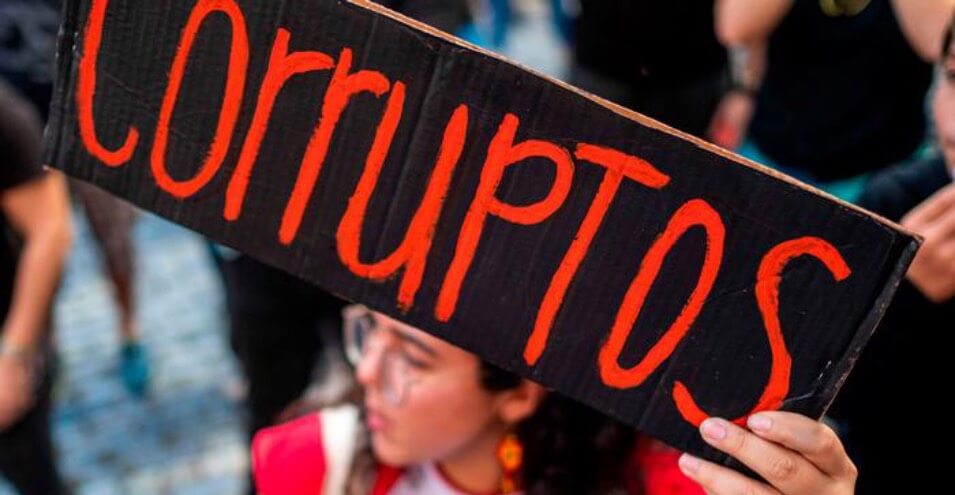
Nevertheless, throughout the world, from Iraq to Chile to Lebanon, people have taken to the streets to protest bribery, favoritism, and hidden financial and political flows.
Although progress is minimal and existing signs are disheartening, the fact that people continue to take to the streets against economic corruption and pressure governments is itself encouraging.
Marwa says: “I am almost certain that we will see changes in the future. Popular uprisings show that they have not surrendered and continue to resist to claim their rights.”
Source: DW