“Women’s Cycling If Not Accompanied by Crime Has No Restrictions”
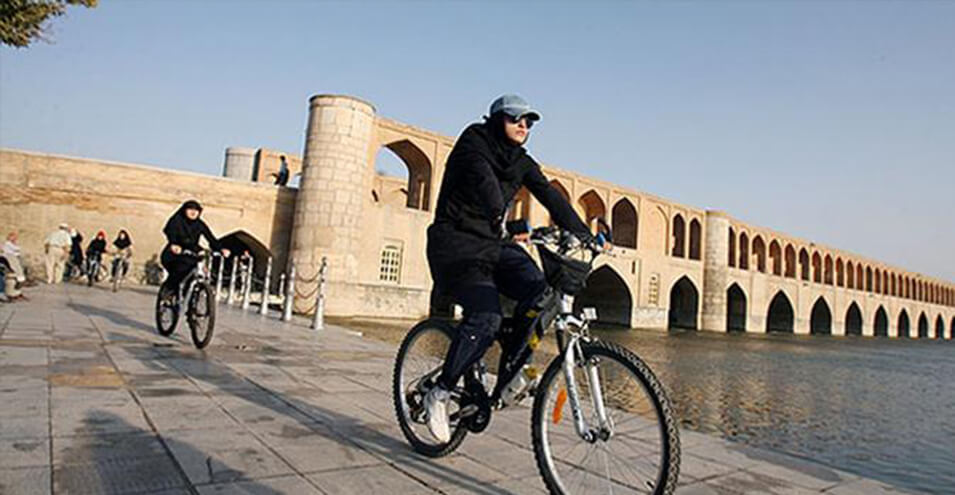
The spokesperson for the judiciary said that the letter from the Isfahan prosecutor regarding women’s cycling was misinterpreted and he did not say “women’s cycling is absolutely prohibited.” Khamenei had previously stated that if it is not in the presence of non-mahram men, there is no problem.
IRNA reported on Tuesday, May 21, that Gholam-Hossein Ismaili, spokesperson for the judiciary, said the interpretation of the Isfahan prosecutor’s remarks was “incomplete” and he did not say that women’s cycling is a crime, “but rather the appearance of women without a hijab in public is a crime.” Ismaili added that “women’s cycling if not accompanied by a crime is not problematic.”
Ali Esfahani, the general and revolutionary prosecutor of Isfahan, had told IRNA news agency last week: “According to the fatwa of scholars and also based on the law, women’s cycling in public space is a forbidden act.” He had also said “the police force was informed that if cases of women’s cycling are seen across the city, on the first occasion they should give a very polite warning, and if the person has identity documents, they should take them from them, and otherwise confiscate the person’s bicycle.”
The general and revolutionary prosecutor of Isfahan had added that those whose identity documents are taken “should go to the security police and the police will take a commitment from them for the first time and will return their documents or bicycle without punishment. If this measure continues for the second and third time, the forbidden act will be dealt with according to Islamic criminal law.”
Establishing Special Areas for Women’s Cycling
These remarks faced many objections both on social media and some officials considered it contrary to efforts to reduce air pollution. Some others also spoke of the declining tourist attraction of Isfahan city.
The judiciary spokesperson now says the subject of the Isfahan prosecutor’s circular is fundamentally “an order to prevent and deal with manifestations of acts contrary to chastity, bad hijab or no hijab, and encouraging others to corruption and obscenity and the like” and “if only those who expressed their views in cyberspace had seen the details of this order.”
According to him, based on the order issued, the municipality is supposed to “establish special areas for women’s cycling… On the other hand, in this letter it is recommended that it would be good, for the sake of protecting women’s dignity and honor, to make special bicycles for them, which is also not a ban on cycling.”
Ismaili has claimed that these recommendations are “protection and prevention of crimes and preservation of women’s dignity and honor.” It is unclear how “areas” or more simply, lanes for women’s cycling on streets should be built.
Public Transportation Culture and Supreme Leader’s Directives
The possibility of women’s cycling, which despite all intellectual, religious, and traditional barriers has expanded in some Iranian cities, was something that in the early years of the revolution and at the height of Islamic Republic restrictions was unimaginable to any woman. Before the revolution and despite the fact that the restrictive regulations of an Islamic government did not weigh heavily on people’s lives, few women in Iranian cities appeared on streets with bicycles. Basically, cycling did not have much place in the transportation culture of society.
Now the situation has changed. The use of bicycles for many, both men and women, is an activity for their health and improving the city’s air. The need to change transportation culture and the use of bicycles was first raised during Gholam-Hossein Karbaschi’s tenure as Tehran’s mayor. A seminar was held in this connection at Chitgar Park. In this seminar, the use of bicycles as a means of transportation was evaluated. One of the speakers at this seminar was Faezeh Hashemi, former parliament representative and former head of the Islamic Federation of Women’s Sports. She had said at this seminar “if bicycles are to be a means of transportation, we cannot expect only men to use them. Since the city is made up of men and women, there must also be cultural promotion for women’s cycling.” Remarks that later became the subject of harsh attacks against her.
Various cultural and sports activities in Iran, depending on the city and the city’s Friday prayer leader, judiciary and executive officials, and municipality managers, can be accompanied by fewer or more difficulties. Women’s cycling in Isfahan too, if it had not faced community resistance, could have perhaps met the same fate as music concerts in Mashhad.
In the Islamic Republic there is no law regarding the prohibition of women’s cycling. But the fatwa of the Supreme Leader of the Islamic Republic is the basis for work for many officials more than the law. The office of Ayatollah Khamenei in September 2016 in response to a question from FARS news agency said: “Women’s cycling in public gatherings and in the presence of non-mahram men, usually attracts men’s attention and exposes society to sedition and corruption and is contrary to women’s chastity and must be abandoned, and if it is not in the presence of non-mahram men, there is no problem.” In the view of critics, the Isfahan prosecutor in a way repeated these same words when talking about “establishing special places for women.”
Source: DW