Assyrian Evangelical Church in Tabriz Closed
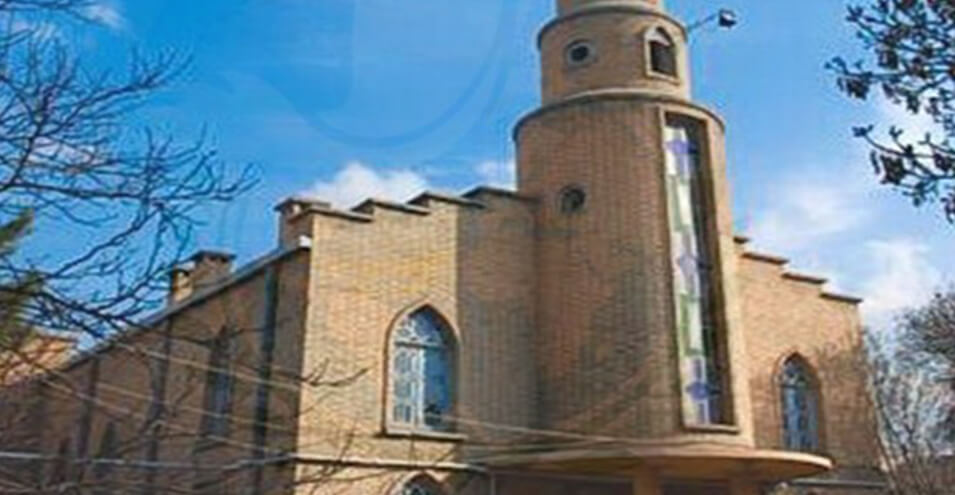
Following a raid by the Ministry of Intelligence officials along with several members of the Executive Headquarters of the Imam’s Order in Tabriz on the Assyrian Evangelical Church in the city, in addition to the closure of this Christian place of worship, the cross that had been installed on top of the dome of this religious site was also removed by the security forces of the city.
According to Human Rights in Iran citing Article 18, on Thursday, April 9, 2019, Ministry of Intelligence officials along with several members of the Executive Headquarters of the Imam’s Order in Tabriz raided the Assyrian Church in the city, replaced all locks on the entrance doors of this religious place belonging to Assyrian evangelical Christians, and removed the cross that was on top of the church. With this event, the community of Assyrian Christians in Tabriz is in shock. This church is considered one of the ancient monuments with a history of 100 years and is counted among the national heritage sites in Iran.
An informed source stated that after replacing all the locks on the entrance doors and removing the church cross, the security forces explicitly told the Assyrian Christians of Tabriz, who were seeking reasons for the closure of the religious place they visited for worship, that Assyrians no longer have permission to hold any religious ceremonies or church services in this church.
The informed source also said: Concerns among church members began a few days after Christmas. The reason was the prevention of priests from other churches to hold a joint church ceremony. This ceremony was supposed to be held at the Evangelical Church in Tabriz, but it was not permitted by the security authorities.
The informed source continued: On April 9, 2019, a large number of Ministry of Intelligence officials as well as members of the Executive Headquarters of the Imam’s Order, an organization that is directly supervised by the leadership administration, entered our church, replaced the locks on all doors, removed the cross that was installed on the church tower, installed a number of security equipment in the church, and forced the caretaker to leave his residence, which was inside the church courtyard, and move to another location outside the church.
It should be noted that the Evangelical Church of Tabriz, which once held church services in Assyrian, Armenian, Persian, and English, was confiscated in 2011 by order of the First Branch of the Revolutionary Court of Tabriz under the presidency of Hassan Babaei in favor of the Executive Headquarters of the Imam’s Order. However, until the day this building was seized, the Assyrians were able to continue using the church building to hold their religious ceremonies in the Assyrian language.
The provision of services in non-Assyrian languages had been discontinued for more than 30 years in this church, and this church was considered part of the “Assyrian-speaking Evangelical Church Society.”
Mansour Borji, director of Article 18 Organization, said in this regard: So far, many Protestant churches in Iran have been confiscated. In most cases, the government has not changed their usage but has left them as they were until their destruction. Some, like the church in Kerman, have turned into ruins and then been leveled with the ground.
The suppression of Iranian Christians, which includes Christian converts, Armenians, Assyrians, and Catholic Christians, is being carried out systematically and extensively with the aim of violating the civil rights of this group of religious followers in Iran.
Christian citizens and Christian converts in Iran face various types of security charges. Currently, no citizen in Iran is being convicted solely because of changing religion or inclination toward another religion. Although the charge of apostasy exists in Iran’s Islamic Penal Code, apostasy sentences are not issued. However, the various charges to which religious dissenters and Iranian Christians, including Christian converts, Assyrian Christians, and Armenians in Iran, are convicted have resulted in the issuance of heavy prison sentences and in some cases have resulted in exile sentences or asset confiscation for Christian converts.
Assyrian and Armenian Christians are considered historical communities and recognized religious minorities in Iran. Generally, they are allowed to freely conduct their religious ceremonies. This is, of course, on the condition that church services are not held in Persian and that they do not open their doors to Muslim-born Christian converts.
Since the triumph of the revolution in February 1979, at least 6 church leaders have been killed in Iran, and hundreds of Christians have been interrogated and imprisoned.
Beyond this, the printing of the Christian Bible in Persian has been prohibited, some churches have been closed, and Persian-language church services have been prevented.
It should be noted that although, according to law, Christians are recognized as a religious minority, the security apparatus pursues the issue of Muslims converting to Christianity with particular sensitivity and uses coercive measures against activists in this field.
The suppression of religious dissidents in Iran violates international human rights documents including Articles 18 and 19 of the Universal Declaration of Human Rights, as well as Article 18 of the International Covenant on Civil and Political Rights adopted on December 16, 1966, which recognizes the right of individuals to change religion and practice religious rites without fear and allows unlimited religious advocacy to individuals.
Source: Human Rights in Iran