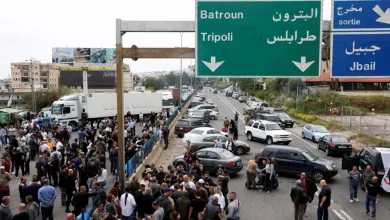
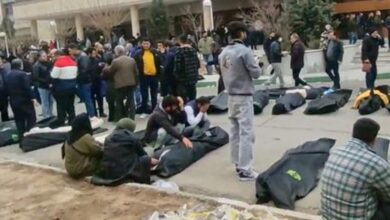
International Workers’ Day; Imposing the Right to Strike on Government and Employers
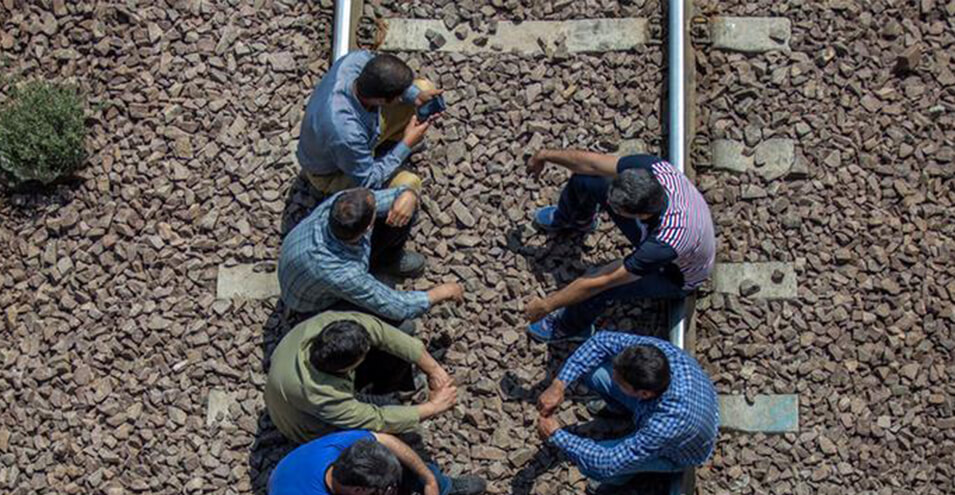
Fair wages, job security, elimination of temporary contracts, and the right to organize and assemble are the main demands of Iran’s working class. In recent years, workers have been able to secure the right to strike and protest from the government and employers. A right accompanied by punishment.
The minimum wage for Iranian workers in 2019 was set at 1 million and 517 thousand tomans; that is, 50,562 tomans per day. With this wage, one person can get through the day with one kilogram of onions, three cheese portions, and ten pieces of bread, provided they sleep on the street or in the desert.
The tables of working-class families become more modest every year and the working class becomes more impoverished, but the problems of workers are not limited to subsistence pressures. A weak economy and industrial units in their death throes threaten job security for this class. For every factory closure, dozens and hundreds of workers become unemployed, and at the same time, every protest and demand is labeled a security threat.
With intensified economic pressures in 2018, many production units have been either dismantled or operate at minimum capacity. Government sources say that of the 43,000 units in Iran’s industrial parks, 11 to 12 thousand units are in recession and semi-shutdown, and only 25 percent of units operate at above 70 percent capacity. In the latest examples, the deputy director of planning at the Ministry of Industry announced on May 21, 2019 the identification of two thousand semi-closed units, and the governor of Isfahan reported the closure of 300 production units in the industrial parks of that province.
Farbarz Raisdana, an economist, believes that 70 percent of Iran’s workers live below the absolute poverty line. He considers the minimum wage to be 3.5 million tomans when considering inflation of 30 to 40 percent.
In March 2019 and during the review of minimum wage, four independent worker organizations issued a joint statement calling for a minimum wage of 7 million tomans. The United Company Workers’ Syndicate, the Haft Tapeh Sugar Cane Syndicate, the Coordinating Committee for Assistance in Establishing Workers’ Organizations, and the Retired Workers’ Union Group called the Supreme Labor Council incompetent to set workers’ wages.
Such statements are issued in circumstances where independent worker organizations either experience divisions and fragmentation or witness “state-sponsored syndicates” and “parallel” ones such as the “Islamic Labor Council of Haft Tapeh” or the “General Assembly of the United Syndicate.”
In these conditions, temporary contracts, which have become customary and widespread, are gradually being replaced by verbal agreements. 2018 was a year of workers’ strikes and protests, and simultaneously a year of detention and suppression of activists in this arena.
Deutsche Welle Farsi, to review the demands and indicators of the labor movement in recent months, sat down with Alireza Navaei, a labor activist and member of the “International Union for Supporting Iranian Workers.” He points to the quantitative growth of protests as a positive sign and considers the “imposition of the right to assembly and strike on the government” a major achievement.
● Deutsche Welle: From last year to this year, Iranian society has witnessed turbulent times. What is the most significant development in the working class?
Alireza Navaei: The first indicator is the quantitative growth of worker protests. Continuing the upward trend of worker protests in the 1990s, we witnessed a 27 percent increase in these protests. According to incomplete statistics, we had at least 1,700 worker protests last year among employed, unemployed, and retired workers. Another issue is the threat to job security for workers in the context of the ongoing privatization process. Factory closures, layoffs, temporary contracts, and contracting companies.
● Have workers also protested over reduced purchasing power and halved income?
No. They did not directly struggle or assemble for wage increases, but they protested against the wage equalization plan, which reduced their purchasing power.
● Why don’t we see strikes and protests in very large factories and industrial centers?
Because from the beginning of the revolution, the activities of organizations in large factories were prohibited. The greatest opposition was to worker organizing, and workers were dispersed. Of course, for example, in the oil industry, we may not have seen strikes in HEPCO, steel, or Haft Tapeh, but contract workers through letters and protests of this kind opposed the wage equalization plan. We even see protests in Iran Khodro, although they don’t reach the level of assembly and strikes at the factory itself.
● The security approach to workers’ professional protests is very common, and with each protest we see arrests.
They have always wanted to stop or limit protests through the arrest and firing of organizers, but this method no longer works in the 1990s. That is, despite the fact that protests and assemblies are not free, workers have imposed them on the government. Protests are at a level where they have been forced to accept them, but at the same time they are completely opposed to independent worker organizations. For example, when the Haft Tapeh and Ahvaz Steel strike proceeds and the discourse of independent organizing is raised and even steps are taken, they resort to mass arrests. Last year’s indicator was that they arrested labor activists collectively. Not only did they arrest groups of twenty and some people in Haft Tapeh or Steel, but they even did this in protests by municipal employees.
● Is this method successful and does it cause fear and division?
It is possible that at the moment of arrests, a strike is suppressed or relations between workers are damaged, but experience has shown that after a period of decline in protests, the working masses see that problems are not only unsolved but have become more widespread, and for this reason they again resort to protest.
● Why are there divisions within the organizations themselves to the point that they issue statements against each other?
This division has both external and internal causes. Worker organizations suffered heavy blows in the early days of the revolution. Of course, it was not just suppression, but those of us who engaged in such activities in the 1950s were complicit in weakening these organizations for various reasons. In the 1960s and 1970s, worker activities were dispersed and somewhat underground. In the 1980s, we witnessed new labor activities such as the Coordinating Committee for Assistance in Establishing Workers’ Organizations, the United Syndicate, the Haft Tapeh Syndicate, or the Free Workers’ Union. These marked a new chapter in Iran’s labor movement, but divisions emerged between them in the 1990s.
● External division means what exactly?
Worker power has reached a point where it can impose protest, but the balance of power is not at a level where those in power will back down. The government uses various tools for division. Organizers and activists are fired from their jobs so their connection to the worker base is cut off. They use appeasement methods, for example offering a job with very high pay, or indirectly encouraging activists to leave Iran.
The way disagreements are handled in these organizations causes scattering and separation. In the 1990s, a new generation entered the arena, and the government tries to keep these three generations apart. Generational divisions have prevented experiences from being properly transmitted. Last year we saw what successful actions the teachers took in organizing nationwide protests, but we didn’t see such things among workers despite the quantitative growth of protests.
● Do you mean the organized protests at HEPCO or Ahvaz Steel?
Yes, those 15 HEPCO workers or 30 steel workers who launched a strike and were arrested are this new generation of the 1990s.
● But it seems that politics has cast a long shadow over worker actions.
No, at least not in the 1990s. From an epistemological perspective, there was a false expectation and incorrect assessment of the 2017 protests, such that in 2018 we would see resolution, and this was misleading. When steel and Haft Tapeh workers gathered simultaneously, some expected petrochemical and oil workers, drivers, and teachers to all enter the arena and we would witness major change and transformation.
The main issue is that from a labor activism perspective, both sides accuse each other of connection to yellow organizations, and yellow organizations spread this seed and take actions that intensify this suspicion. Regarding divisions, we are certain that the government’s think tanks are planning and working on this.
● Why don’t independent organizations unite with each other and each year, for Workers’ Day, hold several small gatherings?
What the House of Labor launches is not worker protests but the House of Labor’s protests. These gatherings were previously held in sports halls because they concluded not to march and hold controlled ceremonies and issued entry cards to specific individuals. Now that they come to the streets, all marches are surrounded and controlled so they can tell international bodies that we have May Day marches.
Let’s not forget one thing. One of the leaders of these yellow organizations was the mastermind of the takeover of the House of Labor in 1979. That is, we might better say a black organization. They present themselves as representatives of syndicates in international forums while inside they say there are no syndicates.
● Is that why scattered programs are organized?
From a tactical perspective, labor activists’ current assessment is that these gatherings no longer have the effectiveness they once did, but the fact that you say protests are over small professional issues goes back to divisions in independent organizations whose roots are earlier. We even witnessed some labor activists believing that at certain points they should cooperate with this or that yellow organization. During the apprenticeship plan period, they campaigned with the workers’ representatives assembly, which was ineffective and yielded no results. Now workers want to hold ceremonies in their own factories and express their demands on site. For example, some Ahvaz Steel workers have this view. Regarding the 50 percent increase in insurance contributions, construction workers said if this isn’t reversed, we will protest at our own unit.
● Where do blank check contracts stand given the deteriorating work, employment conditions, and rising prices?
The number of these contracts increases year after year. Now we are witnessing an increase in verbal contracts, while a verbal contract has no validity whatsoever. In today’s world, whatever work you do, they get your signature. In current conditions, we have workers who don’t even get the official minimum wage. That is, they work for a salary of 500,000 tomans per month. Don’t think they accept such wages in underground workshops; they receive such salaries in formal companies and production units.
● Do you have any statistics on this trend?
No, we don’t have separate statistics, but they formally say that in the past forty years, temporary contracts have gone from 10 percent to over 90 percent, meaning the previous trend where permanent contracts were 90 percent and temporary contracts were 10 percent has now reversed.
Source: DW