“Rounding up” Working Children; Whitewashing the Problem and Retouching Poverty
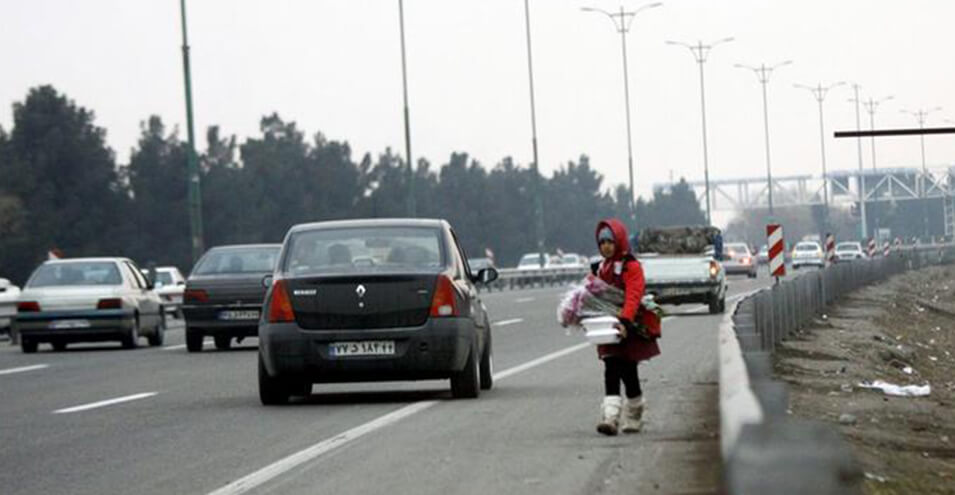
The “Organizing Working and Street Children” plan, which civil activists and social workers have called confrontational toward a “vulnerable and victimized” group, has resumed after a period of hiatus. The welfare deputy has not concealed that the plan’s objective is beautifying urban streets.
“Rounding up” is not an appropriate or respectful term for a group of human beings and is typically used for objects. This term in standard dictionaries means organizing scattered and chaotic things, and the joint plan of the Ministry of Labor and the Welfare Organization to address a social harm is also called “Rounding up Working and Street Children.” Another name for the plan is “Organizing Working and Street Children.”
This plan, which was halted in autumn 2017 due to protests, has been put into action again in the capital. This action, which initially took place in August 2016 under the framework of the “Rounding up Beggars Plan,” triggered reactions from several child welfare activists and members of Tehran City Council and was considered confrontational toward a “vulnerable and victimized” group.
After the plan was stopped, the director general of the Office of Social Harms at the Ministry of Welfare said: “Efforts will be made to make the process of social support for children more targeted through consultation with civil organizations and academic experts and better coordination between executive agencies.”
Now, after about two years, the plan has been resumed; this time by a decision of the Welfare Organization and participation of the “Supporting Society” and “Avaaye Baran” social work clinic. Welfare centers for working and street children create a file for “data monitoring” related to them, and they state the purpose of this monitoring as recording and examining the situation of families of working and street children.
These children are transferred to “Yaser,” “Afseriyeh,” and “Baath” centers to form and complete their files; centers that, despite limited capacity, are overflowing with covered individuals; including the “Yaser” center which, according to activists’ testimony, has a capacity of 35 people but has hosted 110 people. The plan is apparently aimed at screening non-Iranian children and verifying their identity, but for economic reasons, the presence of these children at intersections is ignored, and there is no response to the psychological harms resulting from keeping them in special centers.
The deputy for social affairs of the Welfare Organization explicitly stated that the purpose of this plan is to remove the presence of these children from urban streets: “The purpose of the joint plan for organizing Iranian and non-Iranian working and street children is that we no longer witness their presence in urban streets.”
Does retouching the city’s appearance and clearing streets of working children also erase the face of the problem and the reality of poverty?
Javid Sobhani, a civil activist and former member of the Children’s Rights Protection Society, emphasizes in a conversation with Deutsche Welle that the plan for organizing working children is based on the street’s appearance, not a child’s destiny.
He asks why, if monitoring is to be conducted, there is no action against contractors who force children into garbage collection. Sobhani also reminds that if the plan were to control child labor, it should address that vast multitude who, away from public view, work in agriculture, services, workshops, and homes.
● Deutsche Welle: What does organizing working children mean? Does the current plan provide order and livelihood to these children’s families?
Javid Sobhani: This terminology and expression are not appropriate and stem from a mentality concerned with surface manifestations of the problem. The basis of this discourse is not the reasons for the existence of working and street children, but controlling and removing what damages the city’s image.
Based on global statistics, most working children exist in agriculture and services. In Iran, they claim that working children are organized by gangs for begging. Part of this may be true, but in the current plan, streets have been made the focus and the concern that these children are out of sight. Calling it organizing when we make invisible the deprivation of children from education and decent living and remove them from society is not organizing.
● It is stated that children are taken to centers with insufficient capacity and interrogated.
Yes. The welfare organization itself says this. The problem of working children stems from poverty and economic shocks inflicted on families; from housing price shocks to widespread unemployment and environmental issues like drought and floods that force families to send children to work. This is a highly inappropriate method—to take children and create files for them, but ultimately have no vision or plan for them to return to education and decent living. Of course, welfare says child labor is not this organization’s issue, but that it has the responsibility for caring for neglected children, orphans, and street children in the true sense. Every year this plan is implemented seasonally, but it creates no change in the problem.
● So these kinds of plans only erase the appearance of the problem?
Yes. Essentially, real working children are outside major cities; they are in fields, workshops, and homes, and no one sees them at all. After all, an institution must at least have international standards for dealing with the worst forms of child labor. Why don’t they take action against these contractors who use children for garbage collection? Why don’t they care about those sectors that use children as cheap labor? The story is mostly theatrical and gathering support for welfare, and some of the budgets related to children are wasted on such plans.
There is no evaluation of these approaches to determine what the effects and consequences of such plans are. We don’t have such evaluation, and if work is to be done in this area, it’s these very evaluations that should show what the result of such methods is. Has it been able to prevent harms or does it itself cause harm to children.
● What is the role and responsibility of child support networks in all this?
The responsibility of non-governmental organizations is to encourage social participation and work for social change, but in recent years, most NGOs working in this field have gradually turned into charities, and their focus is on the victims rather than the roots. That part which could launch a social campaign and move toward large-scale poverty alleviation programs and address compensatory programs for vulnerable groups has weakened in recent years. In recent years, we have mostly encountered organizations that are aligned with government policies and have become competitors to non-governmental organizations and are unfortunately dominating.
● The governor of Tehran said that of 240,000 working children, 140,000 are foreign and their trafficking is a deliberate policy. Is this claim acceptable?
This statement has a serious contradiction. On one hand, the Afghan population is sharply declining due to economic pressures, and their return to their country has accelerated, and the same is true for children. We conclude that this is also part of activities that in some way create a political atmosphere and create mutual pressure at the global level.
● In the northern and western neighborhoods of Tehran, children selling fortunes, flowers, and window cleaners at intersections are very numerous. Has public opinion come to terms with the issue?
Look, the issue has become exhausting and sensitivity to it is being worn away. Now every social documentary produced with social criticism also touches on the problem of working and street children, and the subject is constantly repeated. This repetition normalizes it, and this is happening—people are losing their sensitivity.
● What do you think is the solution?
Everywhere you look in the world, child labor has been able to decrease through cooperation between families, NGOs, and the government. From 2002 to 2008, a large portion of child labor was reduced through intermediate-level interventions and controlling the economic shocks that threaten families with collapse. There must be a comprehensive social security program for these shocks so that families are not forced to use their children’s labor to make a living. We must confront these issues, not the final link in this problem—the presence of children on streets.
The roots of what happens lie in the family, economic structure, and the system of planning and poverty-creating policies. We are moving toward programs that create poverty and turn child-family relationships, instead of supportive, educational, and nurturing relationships, into economic relationships.
● Especially since there is no control or punishment for preventing children from receiving education…
Yes. Poor families in response to economic developments are forced to adapt and adjust, and between benefit and cost, they choose. There is also no program that creates prohibitions and restrictions for families or punishes workshops that use children’s labor.
But there is another aspect to the problem—incentive policies and providing educational subsidies and acquainting families with the consequences of child labor. Families should be encouraged to send children to school instead of work, and they should also see the effectiveness of quality education. But when our education system is moving toward privatization and a sharp decline in the quality of education, especially in poor areas, families conclude that education has no benefit in social mobility and breaking the cycle of poverty.
● So NGOs, even if effective within a certain circle, are crushed under prevailing conditions.
Yes, unfortunately government and non-governmental organizations accuse each other, and at the same time we have no comprehensive national program to address the harm. Of course, the initiative for this national program should definitely be with the government, and NGOs should have the motivation, despite all limitations, to be a powerful partner, but since we have no national agenda or legal framework in this area, all programs become ad hoc.
● Some economists say that with the existing class gap, Iran is moving toward becoming like São Paulo.
There is much speculation, but the reality is that many of these events were predictable beforehand. We are moving toward a depraved capitalism that does not observe the smallest standards of human development in discussions of investment in healthcare, public services, and education. These areas are the engine of movement and sustainable development, but now they have been liberalized under economic and structural adjustment programs. The effects of these policies will be seen in the long term in the expansion of poverty and social harms.
Look now at the price shock in the housing sector. Most people who lived in the lower city have been thrown into marginal and remote areas, and these factors increase the number of working children, otherwise removing them from streets is not a solution.
Source: DW