End of Third Teacher Sit-in Round in Iran; Minister Calls Protests ‘Limited’
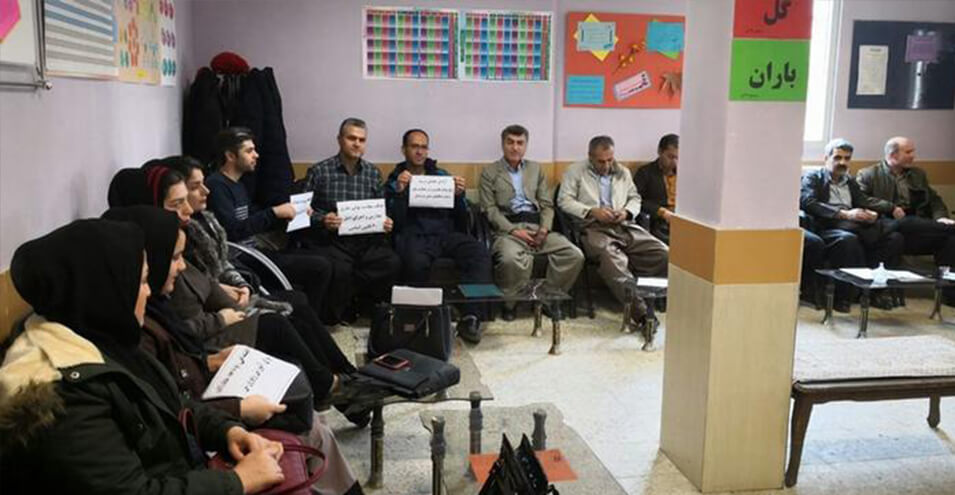
The third nationwide teacher sit-in in Iran has ended. Education officials have described these protests as “limited.” However, teacher representatives, citing their “documented statistics,” describe the recent sit-in as “more impressive” than previous rounds.
The third nationwide teacher sit-in in Iran, in protest of occupational and livelihood problems, ended yesterday, Tuesday, March 5 (14th of Esfand). The Coordinating Council of Iran’s Teachers’ Professional Associations, which had called teachers to this protest action, announced yesterday on its Telegram channel the end of the sit-in and the Education Minister’s “unbalanced remarks” in a “delayed reaction” to it.
Mohammad Bathaei, Iran’s Education Minister, reported yesterday that teacher protests occurred “in a limited number of schools” and said: “If this type of protest method takes place even in a single school in the country, it is an anti-educational action. I am not upset about my colleagues’ protest, but rather about the method of protest, because it teaches students a bad lesson when a teacher sits in the school office and does not appear in class, and with this action we have actually acted against justice.”
According to the Coordinating Council of Iran’s Teachers’ Professional Associations, the Education Minister described the protests as “limited” while “only in Kermanshah, teachers in over one hundred schools staged sit-ins, and in Khomeinishahr, over seventy schools participated in the sit-in.”
Other Cities Join Sit-in on Third Day
This professional association also emphasized: “The Council’s statistics are documented and based on received photos, while in many schools colleagues did not take photos or did not send and publish their photos. On the third day, alongside the cities that held sit-ins on previous days, we witnessed active participation of teachers from Zanjan, Jolfa, Shahriyar, Robat Karim, Boukan, and others.”
Earlier, numerous reports and images of teacher sit-ins in various Iranian provinces, including Kurdistan, Kermanshah, Alborz, Hamadan, Isfahan, Razavi Khorasan and South Khorasan, Tehran, East and West Azerbaijan, Mazandaran, Khuzestan, Fars, Gilan, Sistan and Baluchestan, Yazd, Qazvin, and Chaharmahal and Bakhtiari were shared on social media.
The Coordinating Council of Iran’s Teachers’ Professional Associations previously announced a call for sit-ins, stating that teachers would refrain from attending classes and present themselves at school offices on the 12th to 14th of Esfand to inform students and their parents of their objectives “by all possible means.”
In a statement by this professional association, the freedom of cultural activists and “removal of all legal obstacles to free activity of professional associations” was mentioned as one of the main demands of teachers. Teachers participating in the third round of protests in the 2018-2019 academic year, holding signs including “Freedom for imprisoned teachers,” “Quality education, fair budget,” “Stop file-making against professional activists,” “Independent unionization is teachers’ right,” “End discrimination,” “Effective and comprehensive insurance,” “Ensuring educational justice,” and “Equalization of retired educators’ salaries,” presented their demands.
The teachers’ demands, summarized in six points in the statement of the 6th of Esfand by the Coordinating Council of Iran’s Teachers’ Professional Associations, are as follows: “1- Freedom of cultural professional activists and closure of all files in this regard. 2- Removal of all legal obstacles to official and free activity of cultural teachers’ professional associations throughout the country. 3- Allocation of adequate budget share in the 2019 budget for education and training to resolve numerous school problems, fundamental repair of educators’ salaries and payment of all their arrears including claims of contract-hired teachers, teaching fees, and others. 4- Equalization of retired educators’ salaries with active employees and raising it above the poverty line. 5- Cancellation of contracts with the current ineffective supplementary insurance and replacement with effective and accountable insurance for active and retired educators. 6- Halt of school commodification policy and implementation of Article 30 of the Constitution.”
Minister: We Cannot Address Livelihood Issues in the Short Term
Officials have remained silent in response to teachers’ demands for the freedom of professional activists and removal of obstacles to formal professional activities. Regarding livelihood demands, Iran’s Education Minister has said: “In the short term, we cannot address livelihood concerns.” Bathaei added: “Unfortunately, we have faced enemy aggression, limitations, and sanctions, which have caused our operational capacity to decline compared to last year due to inflation. Of course, despite all these conditions, we have a duty to ensure that the education and training process is not compromised.”
Amir Ali Nematollahi, Acting Education Minister of Iran, also said yesterday, referring to the recent teacher sit-in: “We are ashamed before our colleagues’ services, efforts, and dignity, but our cultured colleagues should know that all our servants in the headquarters, provincial, and national levels of the Education Ministry have pursued everything that was possible.”
The Acting Education Minister simultaneously claimed that “this sit-in was not very widespread and is very limited.” According to the ILNA news agency, when asked “Aren’t the sit-ins actually nationwide and not limited? Why do you describe them as limited?”, Nematollahi said: “No, that’s not the case. The number is really limited, and sit-ins only occurred in some schools and educational centers in some provinces.”
Acting Minister: Sit-ins Are Not Concerning
The Acting Education Minister, claiming “We have statistics on these sit-ins and be assured that it is not concerning,” added: “If the situation were concerning, at the very least I, as the Acting Education Minister, should not be in my office. I speak transparently: in some provinces, we have not even had a single sit-in case, according to statistics I have since 10 a.m. Of course, it is not even clear whether the published photos are from that province or not, and it might be mischief by some individuals.”
However, the Coordinating Council of Iran’s Teachers’ Professional Associations stated in its report yesterday on the third round of teacher sit-ins: “Our investigations show that the Esfand sit-in received greater participation from colleagues compared to the October and November sit-ins, and the third day was more impressive than the first and second days. This was while security pressures reached their peak on the third day, but in turn, protesting teachers acted unitedly.”
Iranian cities have repeatedly witnessed widespread teacher protests in recent months against working conditions and livelihood situations. Teachers gathered on February 14 at least in the cities of Sanandaj, Urmia, Marivan, Ardabil, Mashhad, and Kermanshah in front of the Education Department buildings. On December 27 of last year, Isfahan teachers also gathered in protest in front of the province’s Education Department. However, security forces dispersed the gatherers by firing tear gas and arrested some of them. On December 10, the cities of Isfahan, Rasht, Yazd, and Abhar witnessed teacher and retired educator protests demanding improved livelihood conditions and freedom for imprisoned teachers.
During the second round of Iran’s teacher sit-in on the 22nd and 23rd of October, many teachers in numerous small and large Iranian cities participated in this strike. This two-day sit-in was accompanied by slogans against “oppression and injustice.” Although teacher demands in this sit-in were accompanied by promises of attention from government officials, it also involved confrontations with professional gatherings and arrests of their activists.
The arrest and subsequent release of Mohammad Reza Ramazanzadeh, head of the Coordinating Council of Iran’s Teachers’ Professional Associations in Bojnord, and Hashem Khavastar, a member of the board of directors of the Mashhad Teachers’ Professional Association, by agents of the Islamic Revolutionary Guards’ intelligence service, were among the consequences of the second round of teachers’ protest movement in the current academic year.
Teacher protests in Iran have significantly increased in recent months and years. In addition to demands for improved salary conditions and freedom for imprisoned teachers, demands such as effective and comprehensive insurance, school safety, eliminating discrimination in the educational structure, halting privatization and commodification processes, and ensuring access to free public education are among Iranian teachers’ requests.
Several cultural activists and prominent figures among teachers, such as Mohammad Habibi, Mahmoud Bahrami Langaroudi, Ismail Abdi, Abdolreza Ghanbari, Mohammad Sani, Ruhollah Mardani, and Bakhtiar Arefi, have faced imprisonment sentences due to their professional activities and are serving time in Iranian prisons.
Source: DW