Efforts by Iran’s Judicial and Intelligence Agencies to Direct Coverage of Cases and Defendants
An examination of several news reports in Iranian news agencies on one day regarding judicial defendants and regional issues demonstrates that the judicial system and security agencies continue their efforts to use news agencies as arms of information dissemination and news direction.
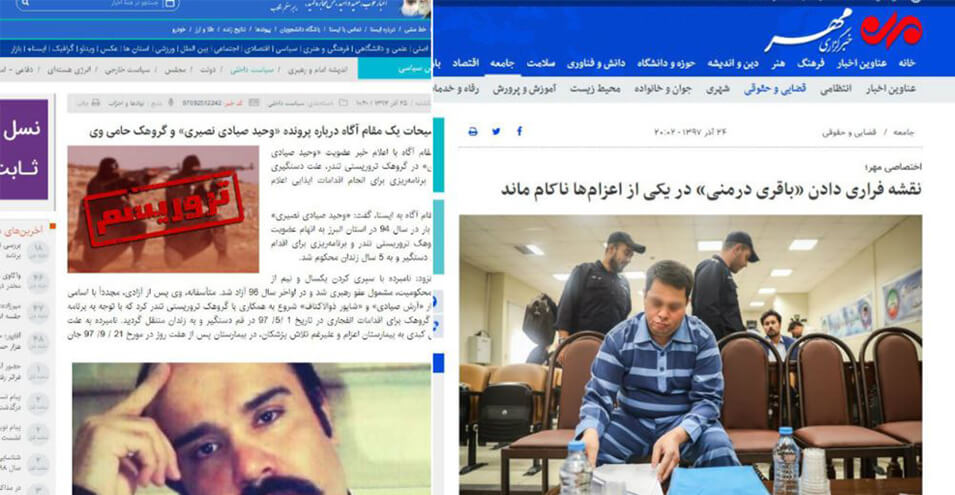
While a political prisoner died this week following a hunger strike, ISNA news agency reported on Sunday that he had a history of involvement with a militant group. Simultaneously, another report by Mehr news agency, citing “an informed source,” discussed attempts to help a financial defendant escape.
Reza Haqiqat Nejad, a journalist in Turkey, referring to ISNA’s report and Mehr news agency’s coverage, stated that the long-standing practice of the judiciary and security agencies toward media has not changed.
In an ISNA report published on Sunday, Azar 25, the news agency cited an informed source stating that Vahid Seyeedi Nasseri was arrested for planning “harmful operations.” The source explained that Mr. Seyeedi “began cooperating with the terrorist group Tondar, and was arrested given the group’s planning for explosive actions.”
Reza Haqiqat Nejad, referring to the history of judicial and security agencies’ attempts to direct media coverage, pointed to the issue of Zahra Kazemi’s death in custody and stated that in 1382 (2003), Tehran’s prosecutor attempted to convey through IRNA news agency that Zahra Kazemi was a spy and suffered a heart attack in hospital after arrest, an attempt that was unsuccessful.
According to this journalist and analyst of Iranian affairs, the effort currently being made by Mizzan and ISNA news agencies regarding Vahid Seyeedi Nasseri’s death in prison is similar to that story, and it appears that the “informed source” who provided information to ISNA has at least in the first stage succeeded in suggesting that Vahid Seyeedi Nasseri was a dangerous pawn who, despite favors shown by the system, continued to participate in activities of a notorious terrorist group.
Comparison of these two cases actually demonstrates that over the past 15 years, the judicial branch’s media approach and its relationship with media has not undergone any particular transformation.
Media Duties from the Security Agencies’ Perspective
Beyond the judiciary, the Ministry of Intelligence, the Islamic Revolutionary Guard Corps’ Intelligence Organization, and in some cases the secretariat of the National Security Supreme Council have followed the same practice over past decades. Reza Haqiqat Nejad believes: “From the perspective of these institutions, media as arms of the system’s information dissemination should perform two important tasks: promote the system’s intended macro components, report good news. A third and undeclared function of media is to erase the system’s stains of shame. What occurred in the death of Vahid Seyeedi Nasseri is the execution of such a mission.”
This journalist also referenced another example regarding the death of Kavous Seyedamami, an environmental activist, in prison, noting that media affiliated with the Revolutionary Guard Corps extensively and coordinately executed their intended news dissemination mission.
He said: “Elaborate storytelling about defendants’ missions, strange claims, rumor production, and maximum securitization of the matter is a specific agenda that these media outlets consistently carry out so that the killing of defendants is marginalized and the case remains out of reach. In the case of Vahid Seyeedi Nasseri as well, the matter was linked to terrorism and exactly like Kavous Seyedamami, the case became heavily securitized. The ultimate goal of all these actions is to create distortion in information dissemination through media.”
Concurrently with the publication of reports citing informed sources about judicial defendants, Farsi news agency, affiliated with the Islamic Revolutionary Guard Corps, also attempted in a report to link Saudi Arabia’s Crown Prince and the Crown Prince of the UAE to adherence to a tradition in Judaism.
In a Farsi news agency report, referring to the red bracelets worn by these two individuals, it was noted that the red bracelet in question “relates to a superstitious belief in Judaism.”
However, the mentioned bracelet relates to support for intellectual disability sports competitions.
Mr. Haqiqat Nejad believes that media outlets close to the Revolutionary Guard Corps typically have strong expertise and experience in executing such missions, but more reputable state media outlets also, depending on the nature of government relations with governmental institutions and parallel intelligence organizations, play their role.
Source: Voice of America