“Subsidence and Destruction Await 2,500-Year-Old Heritage”
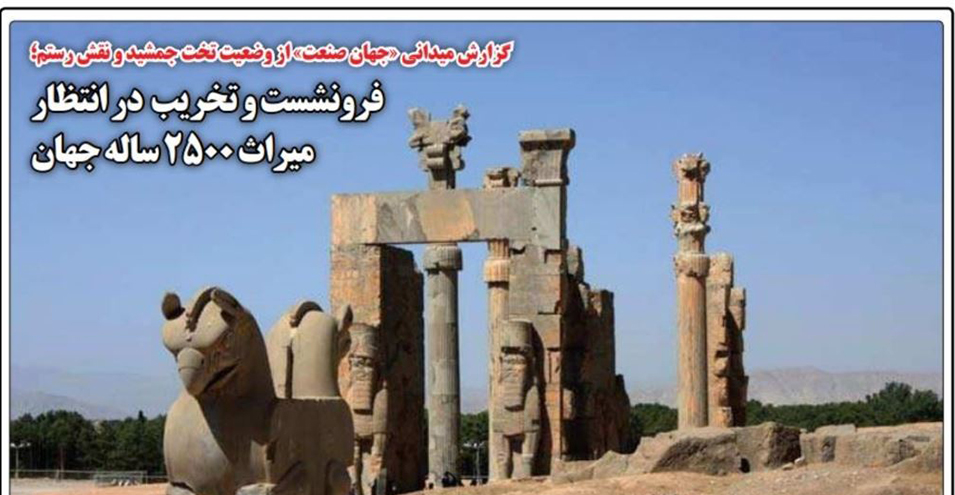
Jahan-e Sanat newspaper warned in its Monday edition about the “subsidence and destruction” threatening Persepolis and Naqsh-e Rostam, two “2,500-year-old heritage sites” of Iran and the world, writing: “Annual subsidence of 54 centimeters in Shiraz has not only endangered historical monuments but also threatens people’s lives. Ground fissures near Persepolis and Naqsh-e Rostam cannot be concealed. Historic Marvdasht is pregnant with catastrophe.”
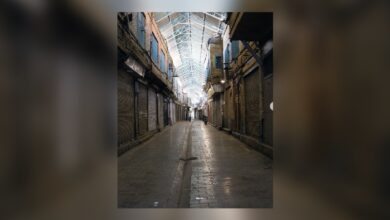
The newspaper reported on the condition of Persepolis: “On the road from Shiraz to Marvdasht, the first thing that catches your attention is the dryness of the land. It’s as if it hasn’t rained here for years. The ground is cracked and devoid of a single tree. Every few kilometers, some small houses and shops along the road have turned green and seem to have no vitality for living. Drought is the plague of Marvdasht and Shiraz, and “the long-term drought that has left its effects both in people’s lives and in the condition of Shiraz’s historical monuments.”
Masoud Razavi-Manafrad, director of the Persepolis complex, believes that “the Marvdasht crisis is no less than Lake Urmia, and the authorities’ negligence has been the main factor in accelerating subsidence in Fars.”
He told Jahan-e Sanat newspaper: “We cannot say everything is rosy and on track; a catastrophe is unfolding here,” while “we have repeatedly cried out that not only the thousands-year-old Persepolis but the lives of Marvdasht’s people are in danger, yet no one listens.”
The director of the Persepolis complex, pointing out that “groundwater levels and extraction from wells have increased from 3 meters to 300 meters,” said: “What they did was install meters on authorized wells, but is our problem authorized wells when we have more than 10,000 illegal wells in Marvdasht?”
According to Jahan-e Sanat, “Fars Province with 54 centimeters of annual ground subsidence has ranked first in the world. The depth of water wells in Marvdasht has increased from 10 to 300 meters. Hundreds of illegal wells daily swallow the underground waters of the region without realizing what damage they are causing to the province (Fars) and even themselves,” just as “the danger of ground fracture and settlement and the creation of enormous sinkholes awaits Fars Province, particularly Marvdasht. Vast agricultural lands in the vicinity of Persepolis are the bane of this historical monument.”
The newspaper emphasized that “today’s situation at Persepolis and other historical monuments of Fars Province is just a sample of what’s to come. It’s true that drought has deprived Shiraz of peace and climate change has overshadowed many people’s lives, but with a precise and timely plan, today’s situation could have been prevented.”
Kayhan newspaper in its Monday headline quoted Mohammad Ali Jafari: “If the Revolutionary Guards are designated as terrorist, we consider the US Army as ISIS.”
The newspaper wrote: “The publication of news about US President Donald Trump’s decision to implement the sanctions law known as CAATSA, one of the main components of which is declaring the Islamic Revolutionary Guards Corps terrorist, has been met with a sharp reaction from the commander-in-chief of the Revolutionary Guards.”
Kayhan, which is considered among newspapers opposed to nuclear talks and the “JCPOA,” simultaneously in its Monday editorial described Hassan Rouhani’s Saturday remarks about the JCPOA as “self-deception” and wrote: “Just as the mother of sanctions is on the way, unfortunately we are still talking about nostalgia and the benefits and memories of the mother of negotiations, but contrary to this self-deception approach, the fate of the agreement is tied to luck, as someone with Mr. Zarif’s characteristics says: the chance of the nuclear agreement’s survival is 50 percent.”
Simultaneously, Javan newspaper dedicated one of its front-page stories to Mohammad Ali Jafari with the headline “Retreat 2,000 Kilometers,” quoting the commander of the Revolutionary Guards: “If the new American sanctions law is implemented, this country must move its regional bases within a 2,000-kilometer radius of Iran’s missiles, and the American military will be equivalent to ISIS for us.”
According to the newspaper, Mohammad Ali Jafari said in a meeting of the Revolutionary Guards Command Council: “The Islamic Republic of Iran intends to resolve regional issues somewhere other than the negotiating table; there is no talk of negotiations nor is there a party for it.”
Iran newspaper, close to the government, dedicated its Monday front-page headline to the remarks of the spokesperson of the judiciary regarding Mohammad Khatami’s restrictions, quoting Gholamhossein Mohseni-Eje’i: “I don’t have the details of the report; the special prosecutor hasn’t denied it either and said the restrictions remain as before. The same previous restrictions that were issued through letters from the National Security Council secretariat and not the council itself—this time too a letter has been issued to the official and the previous orders have been extended.”
Simultaneously, Arman newspaper reported that “on Sunday, the parliament chamber and corridors were full of positions taken by some representatives in opposition to imposing restrictions on the head of the reform government.”
The newspaper, noting that “two lawyers of the former president as well as Mohammad Reza Tabesh, representative from Ardakan in parliament, had informed about these restrictions,” wrote that the Hope Faction of the Islamic Consultative Assembly issued a statement regarding recent issues, which stated: “Given recent actions, we declare that this order contradicts Articles 20, 23, 36, and 37 of the Constitution, and all judicial authorities are obligated under Article 156 of the Constitution to restore public rights and expand justice and legitimate freedoms, and any action contrary to these objectives will result in criminal and administrative prosecution.”
According to the newspaper, Masoud Pezeshkian, vice speaker of parliament, also “called for resolving this issue by the government and the National Security Council” and said: “It is unacceptable to tell someone they cannot attend sessions and assemblies while on the other hand saying we have democracy and freedom and can criticize other countries. He continued: I heard that Mr. President also said some things in an unclear manner and representatives made some reminders in this regard, and we will discuss it in the parliament’s presidium.”
Etemad newspaper, while publishing a report on “Hope faction members’ protest against restrictions on the head of the reform government,” wrote: On Sunday, “Hope faction representatives with a written reminder to the president, a factional statement, and a speech during orders of the day, as well as several comments, protested the new restrictions against Mohammad Khatami.”
According to the newspaper, “the three-month new restrictions on the head of the reform government, which after a process of confirmation and denial was finally confirmed, became the subject of a written reminder from Mohammad Reza Aref and 85 other representatives to the president as chairman of the National Security Council, and in addition to this, the central council of the Hope faction also issued a protest statement about this issue after its previous meeting,” and of course, “alongside all this, Parvane Salehshori, representative from Tehran and head of the women’s faction also used her opportunity to speak during orders of the day to protest this matter.”
Also, Masoud Pezeshkian in response to Etemad newspaper’s question about the activities of the Hope faction’s sanctions removal committee said: “Ask the committee’s spokesperson about this matter. They were supposed to have a meeting with Mr. Shamkhani. The meeting was held but I don’t know where it stands.”
The newspaper recalled that “the sanctions removal committee of the Hope faction started its work in the second year of the faction’s activities, and Elias Hazrati, Gholamreza Haidari, Kazemi, and Ghasem Mirzaei Neko are members of this committee who have had various meetings with senior officials in this regard.”
Elias Hazrati, parliament representative and owner of Etemad newspaper, while refraining from disclosing details of the sanctions removal committee’s meeting with Ali Shamkhani, secretary of the National Security Council, told the newspaper that he does not intend to publicize the Hope faction’s sanctions removal committee’s efforts.”
The Hope faction’s sanctions removal committee of the tenth parliament was formed with the aim of lifting the sanctions against Mehdi Karoubi, Zahra Rahnavard, and Mir-Hossein Mousavi, who have been under house arrest since February 15, 2011.
Shargh newspaper reported with the headline “Trump’s Shock in the Currency Market” that “the dollar, after months of stagnation, broke loose with Trump’s words and exceeded the 4,000 toman mark, and even in Sunday’s trading went beyond 4,010 toman for a while,” and this while “the bank’s dollar sales rate has also been accompanied by increases since previous months and in the latest price has reached 3,404 toman.”
The newspaper, pointing out that “the currency market had not been much affected by world political remarks for some time,” wrote: But with Donald Trump’s comments, an upward trend began, because the US president “called the JCPOA terrible” and said “it would have been better if it never happened.”
Shargh, however, simultaneously quoted Mohsen Qadri, currency and gold market analyst: “The market movement is not that great and the dollar hasn’t gone anywhere special. If the dollar’s movement was supposed to be more dramatic, it should have been 200 to 300 toman more; therefore, we cannot say a shock has been inflicted on the market,” but in this “two-day period the dollar’s upward trend has been much faster than previous days.” Also, “the dollar has had an increasing trend for a long time and in these two days combined had an increase of 50 toman, which compared to what happened during Ahmadinejad’s period and fluctuations of 200 to 500 toman, is not considered a shock.”
Shahrvand newspaper, while publishing a report with the headline “Birdmen,” wrote: “The men of Qaleh Rostam had no school; they became scaffolders,” and now “in the two villages of Qaleh Rostam and Bidastaneh many young people have been injured from falls and unemployed for months.”
This newspaper, referring to the deaths of several men from these two villages in Lorestan Province while working on scaffolding of high-rise buildings in Tehran and other cities, quoted the wife of one of the deceased workers from this village: “We always have to worry about our men. When the phone rings, our hearts drop. It’s not a joke. In the past 10, 20 years, 8, 9 people from our village (Qaleh Rostam) fell from scaffolding and died, and 8 people from Bidastaneh. How many young people were injured and left jobless.”
Source: Radio Farda