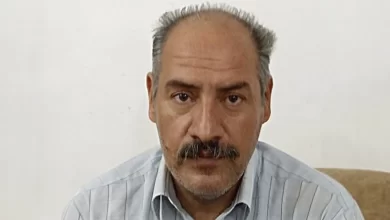
Detention of Two Christian Converts Continues in Evin Prison

Majidrreza Sozanchi Kashani and Fatemeh Mohammadi, two Christian converts residing in Tehran, remain in indefinite detention after more than 70 days.
According to Hrana news agency, the news organ of the Human Rights Activists group in Iran, Majidrreza Sozanchi and Fatemeh Mohammadi, two Christian converts living in Tehran who were arrested by Ministry of Intelligence officials on November 18 of last year, continue to be held in Evin Prison.
On November 18 of last year, Ministry of Intelligence officials, following a raid on the home of one of the Christians in the Tehran Pars area of Tehran, arrested two Christian converts named “Majidrreza (David) Sozanchi Kashani” and “Fatemeh Mohammadi” and transferred them to Ward 209 of Evin Prison.
These two Tehran citizens were charged at Branch 3 of Evin Court with membership in missionary groups and engagement in missionary activities.
These two Christian converts were transferred last week from solitary confinement in Ward 209 of Evin Prison to the general ward of the prison after enduring two months of solitary confinement; Mr. Sozanchi is currently held in Hall 2 of Reformatory 4, and Ms. Mohammadi is held in the women’s ward of Evin Prison.
Following the completion of the investigation phase and interrogation, a bail of 70 million tomans was issued for Mr. Sozanchi, although no information is available regarding the proceedings and status of Fatemeh Mohammadi’s case.
The last defense session of these two Christian converts was held yesterday at Branch 3 of Evin Court.
One of Mr. Sozanchi’s relatives told Hrana reporter: “There is no information available about the proceedings of the case of Majidrreza (David) Sozanchi and Fatemeh Mohammadi at the last defense session, and the judge in the case issued a bail of 70 million tomans for Mr. Sozanchi following the court session, but given that he does not have the financial means to pay the bail, he will necessarily be held in the general ward of the prison until the court hearing is convened.”
In recent years, the government of the Islamic Republic of Iran has increasingly intensified pressure on Christian converts and religious minorities; Hrana had previously reported in February of this year on the continued detention of a Christian convert named “Ali Amini” in Tabriz Central Prison and the transfer of another Christian convert named “Nasser Noor Dol Tappeh” to serve a 10-year prison sentence in Evin Prison.
It should be noted that although Christians are officially recognized as a religious minority under law, security agencies pursue the issue of Muslims converting to Christianity with particular sensitivity and take coercive action against activists in this field.
Article 26 of the Constitution explicitly emphasizes the freedom of activity of religious minorities, and states: “Political parties, associations, political and professional societies, and Islamic associations or recognized religious minorities are free, provided that they do not violate the principles of independence, freedom, national unity, Islamic standards, and the foundation of the Islamic Republic. No one can be prevented from participating in them or forced to participate in any of them.
This is while Hassan Rouhani, in his slogans, both before coming to power and after forming his government, repeatedly emphasized respect for citizens’ rights and in this regard also published a charter titled “Charter of Citizen Rights,” but despite this, these slogans have remained merely slogans so far!
Article 10 of the Charter of Citizen Rights states in this regard: “Insulting, degrading, or creating aversion toward nationalities and followers of religions and sects and various social and political groups is prohibited.”
Article 99 of this charter also states: “Citizens have the right to benefit from the necessary facilities to participate in their cultural life and to accompany other citizens, including in establishing organizations, associations, holding religious and ethnic ceremonies and cultural customs, in compliance with the law.
Source: Hrana