The Story of Underage Brides
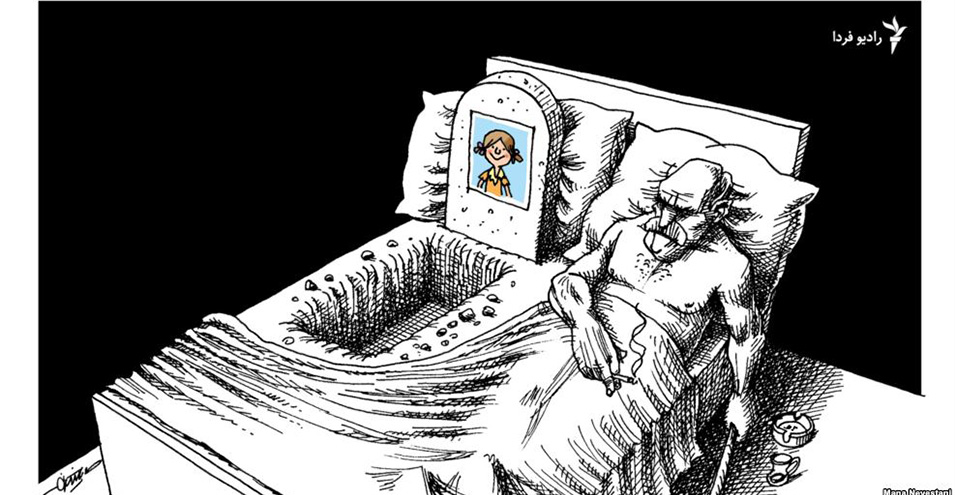
They are delicate and fragile, little girls in white dresses with rings circling their hands. The white light that envelops them is not a sign of good fortune but rather a childhood game that comes to an end. Underage girls who wish the game would end and they could return to their homes and spend the night beside their dolls. But the night does not pass. That night, not alongside fabric dolls but a man awaits them; a man in every legal, religious, and customary sense a husband. A man who from that night on not only takes away permission to go to school and attend parties but also controls their bodies.
The story of marriage for girls under the legal age is not a nightmare, but a reality that occurs in some countries around the world, including Iran. According to the United Nations, currently more than 700 million women worldwide have married before the age of 18, of which 250 million were under 15 at the time of marriage.
October 11, the twentieth of Mehr, is International Day of the Girl Child.
According to Iran’s registration statistics, in 1394 alone, more than 37,000 girls under 15 years old were married. Based on published research, more than 90 percent of these marriages were predetermined, and 75 percent of child brides dropped out of school after marriage. Before discussing the legal and social dimensions of child marriage with experts, we sit down with Leila. No statistics can express the fears and terrors that children face regarding child marriage like a woman who went to her husband’s house at age ten. Leila, who chose her name for this interview and lives in a city she does not wish to name, had the courage to share her story of 12 years of married life with us. Leila became a bride at age 10 to a boy of 15.
I was ten then. For me, marriage was not a choice, because I was half asleep when they knocked and woke me up. Our neighbor brought a ring and put it on my hand. That’s how my marriage was.
Had there been no discussion about this even with your family before that?
It’s like that here. Because they usually know each other, there’s no need to discuss it beforehand.
How old was the groom?
He is five years older than me. He was 15 then.
Was this marriage as sudden for your husband as it was for you?
It seems they had discussed it with Ali at their house. It was not as shocking for him as it was for me. But I didn’t know what marriage was. What is a family? What is my duty now? I really didn’t know these things. I hadn’t even reached puberty. That night when they brought the ring and showed it to me, I hadn’t started menstruating yet.
Did you go to school?
In our village, everyone goes to school up to fifth grade, and after that I didn’t go anymore. If I wanted to go to school, I would have had to… which wasn’t possible. I couldn’t. My father wouldn’t allow it.
Did your siblings also marry at this age?
In our village, everyone marries at this age. We don’t have any unmarried girls here over ten years old. Everyone marries at this age.
Is it still like that?
Yes. Yes. It’s better, but… it’s still like that.
What did you feel when they woke you from sleep and put that ring on your hand? Were you afraid? Did you become happy? Did you think you had grown up? What was your perspective at that moment on having a ring and a husband?
To be honest, the ring and the bracelet were interesting to me. But I had no information about why they were giving me this ring. One of my uncles was supposed to discuss with my father about letting me go to his house to… and study. Because I was a top student. He said it would be a pity. That night I was thinking that I didn’t think my uncle would be able to discuss it anymore. I knew this opportunity wouldn’t come again because I was now engaged and another family was making decisions for me. I knew that from then on my neighbor was deciding for me. Even if my father allowed it and my uncle allowed it, my neighbor, who is now my husband, wouldn’t allow it. I was upset about that. I was a bit frightened. I knew I would live again in that same alley; I wasn’t going far. But the fact that I was going to another house with people I didn’t know how to behave with; it upset me. Who exactly is this Ali and how should I be with him? I was afraid of these things. I was also upset about my school.
You didn’t know Ali, you hadn’t seen him until then?
Because Ali was somewhat older than me, when we were younger children in the alley, we used to play together. But usually in our village people go to the city or go to Tehran to work. This is the situation where we were no longer playmates and I didn’t know him after that.
How long after they brought the ring were you able to see Ali and understand up close who your future husband was?
The night they brought the ring, Ali wasn’t there. Only his parents and his sisters were there. I saw Ali himself two or three days later, on the day of the ceremony.
On the day of the ceremony, who dressed you? Who gave you the first congratulations? What was your mother’s and sisters’ reaction?
My mother sewed my dress because she was a tailor herself. She dressed me. She was happy because I was her youngest daughter. Because I was leaving and she felt relieved that I had also come of age. She was happy from that perspective.
What did your dress look like?
My dress was ugly. Because I’m small-framed. I’m thin and the dress was too big for me. Because my mother had sewed it hastily. She sewed it like a dress for a ten-year-old girl. But I was much smaller physically. The dress was too big.
When you saw yourself in the mirror, what did you think?
I was very young. I hadn’t even started menstruating when I married. My body hadn’t developed. I remember that because my dress was such that it had the form of a bride’s dress, but they put socks where the breasts should be in my dress.
When you first saw your future husband, what did you think? What did he look like and how was he dressed? Did he have a beard or a mustache?
He was also young, fifteen years old, and he didn’t have a beard or mustache. He was dressed neatly. The first time I saw him on the day of engagement, I was embarrassed and couldn’t look at him. I am not dissatisfied with my life, but it comes like a film before my eyes. How did it all happen that day? Everything before my eyes is black. I don’t remember what happened. I only remember being frightened and stressed, I wasn’t paying attention to what I was doing, and I clearly remember my hands trembling. But he was very confident. He seemed not to be afraid at all. But I was very afraid.
What was Ali doing back then? What was his job? How much education did he have?
Ali hadn’t completed elementary school either. But I had. He works in the fields with his father.
From the engagement until the wedding ceremony, how long did it take before you started living with Ali in a shared room or shared house?
The ceremony itself was for the marriage. That night when they brought the ring, it had the state of “introduction,” meaning someone’s name was upon you. After that it was the wedding ceremony.
So within three days or a week, you moved to Ali’s house permanently?
Yes. I went to their house. In their house they had a separate room for us.
From that very first day you moved to our neighbor’s house, did you sleep in a room with Ali?
Yes.
The first time you lay beside him, the first time you were alone with him in a room, as a ten-year-old girl, what were you thinking about? How much did you know about what was about to happen to you? How much did you know about marital relations?
The day before the ceremony, my sister told me some things. She said what I should do. Or what would happen. I wish she hadn’t told me that either. If I had gone there with zero information, it would have been much better. The things she told me, I didn’t understand at the time. Because I didn’t understand and went into that room and experienced it, it was much worse. It was very bad. Very. Even now… it’s better now. But even now that same thought exists, that same feeling exists. Because I was very frightened back then, I felt, well, we got married, I got the ring and put on the dress and smiled with you at the ceremony and ate and the ceremony ended and I came to your house. That’s enough, the game is over. But the game wasn’t over. The game was just beginning. The thing that was on my mind and I wanted to tell him was, well, that’s enough now. It’s over. Let’s sleep. Or it will end and tomorrow I’ll go to my mother’s house to help her with tailoring. I was distracting myself. But this wasn’t happening. He knew. I don’t know. Because Ali has an older brother. They must have told him or somehow he knew. He knew very well. But me… it was very difficult for me. I still say its effects are in me. I get trembling hands when I talk to you now; when I think about it; you don’t know how hard it was. I’m 22 now. I have severe anemia. I have weakness. I don’t know if you can tell from my voice. I’m sick all year. I’m sick even now. I know all this is due to the effects of this. I’m not dissatisfied. But Ali could have been different. Or at least they knew I was ten. They could have at least allowed me to grow a little.
Did you suffer only mentally or did you also suffer physical injury?
There was no tearing, but I had a lot of pain. I even went to the doctor. Because… we don’t have a health center. I went to… I was examined. There was a lady at the health center who said you’ll get used to it. Because I cried a lot with her. My mother wasn’t with me that day. I was with my mother-in-law, who was standing outside. I felt more comfortable with this lady. I cried with her. She comforted me. She said I had more cases like hers. Don’t be afraid, you’ll be fine. It’s like this at first. You might bleed again. If you sleep with your husband again in the future, you might bleed again. Don’t be afraid. It happens.
How long after your marriage did you start your period?
I was thirteen. That’s three years after it.
Did you experience this relationship throughout those three years?
Yes. But not always. Because sometimes Ali wasn’t there at all.
Can you say if you love Ali, do you look at him with a romantic gaze as a husband?
My sister always says: affection develops. It’s impossible for you to live with someone under one roof and not fall in love with him. Don’t say these things to me; it’s ugly for you to say and say that I don’t love him. How is it possible for you not to love him when you married him? Even now I can’t say I don’t love Ali. Why, sometimes I miss him. But it’s more of a sense of duty. I cook for him; I care for him; I take care of his house; I take care of his mother; I take care of his reputation. But it’s just that.
Leila, you said you don’t have children. Why don’t you have children?
I don’t want to get pregnant now myself. Because my body is very weak. From the beginning I grew up in a way that I couldn’t reach where I should have been for my age. You know what I mean? I was ten years old; suddenly because of this issue that came upon me, I became weak. My body was much ahead of my age in many ways. My body was expected to be much more developed than my age. Because of this, I absolutely don’t want to have children now. That is, I don’t allow myself to have children. Ali doesn’t use contraception at all. But I take pills myself. This is my decision. And it really should be my decision. Because if nothing has been my decision until now, at least I don’t want to bring a child into the world.
Do you still live in your mother-in-law’s house?
Yes. There’s a big courtyard here and in the courtyard there are four or five big rooms and each room belongs to one person. Here my house is on one side, one side is my mother-in-law and then there’s Ali’s older brother, he’s also in this house but he’s in another room. Usually they don’t separate.
What would you like to say to those who hear your voice, those who might be mothers and think that for their honor it’s better to marry their daughter at age ten and send her away?
I want them to think about the fact that I’m living in these conditions now. In conditions where my mother lived. The village hasn’t changed. People haven’t changed. If pressure came to her and people talked and she married me off at age ten because of pressure, I have the same pressure. Because nothing has changed. But why don’t I think like her? Because I don’t want to. I just want everyone to think. Ali to think. Why is he afraid? Why doesn’t he let me study? Why, for example, my own sister, who tells me I should love him, doesn’t she think? Why doesn’t anyone think? I think about my daughter now, a daughter whose face I already know in my mind, even now if I have extra fabric I sew clothes for her, even if she hasn’t been born yet, I already know what age she’ll marry at. I want my daughter to marry at 25, at 30. This is what I want. I want her to study. I don’t care what others say. What my sister says. I tell her: I’m behind you, you live in my house and I support you. I can’t divorce myself to feel relieved. Instead I think about what to do with my daughter.
Seven Provinces, Highest Rate of Child Marriage in Iran
Leila is not alone. She is one of 37,000 girls who donned the wedding dress before age 15 in 1394. Among these, perhaps Leila was fortunate that Ali was only 5 years older than her. Last year, 80 girls under 15 went to houses of men over 40. This is while according to the laws of the Islamic Republic, marriage before puberty is forbidden and the age of marriage for girls in the civil code is set at 13 years of age with the consent of the father.
Kamil Ahmadi, an Iranian anthropologist, conducted comprehensive research on early marriage of children in Iran. He says that child marriage in Iran has geographic dispersion in different regions: “I selected seven provinces of the country that have the highest percentage of marriages of girls and boys under the legal age of eighteen recognized in the UN charter: Razavi Khorasan, East Azerbaijan, Hormozgan, Khuzestan, Sistan and Baluchestan, West Azerbaijan, and Isfahan. In these cases, statistics on underage marriage are published by the registration office, but there are many hidden statistics. For example, we observed many girls and boys in these villages whose marriages were never registered, families don’t want to register them. This has different reasons. Either they’re not sure about the marriage; or lack of awareness or insufficient knowledge to register the marriage causes families not to register marriages. Another factor is fear of legal procedures and going to cities in rural areas where marriages are usually done in a very traditional way and they bring a local officiant with a handwritten document and the marriage takes place. Besides, one of the parties may have legal problems and complications that they don’t want to refer to legal authorities, or for other reasons. A large percentage of the marriages that are common in Iran usually have the man register the first wife in the identity document and the second, third, and other wives he only makes contracts with a simple handwritten document from the officiant and doesn’t register them.”
Traditions Cannot Be Easily Eradicated
Research on early marriage of children shows that more than half of such marriages take place in villages and small towns. Mostafa Eghlima, a Tehran-based sociologist, believes that the underdevelopment of society in Iran and the persistence of traditional village mentality even among city dwellers is the reason for families’ inclination toward child marriage: “In small cities, people are poor and no longer pay attention to whether their daughter is eight or nine years old. They say now a suitor has come and she has a husband. Usually those men are eighteen or younger. Because in Iran age doesn’t matter for them and marriage doesn’t require being eighteen years old. When a clergyman marries them, from a religious perspective these people can start living together and they think they have the capacity. We are a traditional and village society. Even in our cities, people, if they can, think the same way and say a ten-year-old daughter should marry. They still don’t have sufficient insight into marriage in the sense of having psychological and physical readiness. A little when the girl reaches puberty they say she is a complete woman.”
The statement of Mostafa Eghlima was confirmed by the warning of Soraya Azizpanah, head of the board of directors of the Association for the Protection of Children’s Rights, who in June of this year announced that 17 percent of girls in Iran marry before reaching the age of eighteen and considered the rising number of girls under eighteen marriage in Tehran a social alarm bell.
Simultaneously with the rise in marriages of girls under eighteen, the number of female students has been higher than male students for years. A contradiction that requires continued effort to create change according to Shahla Shafegh, a Paris-based sociologist: “I think this definition of modernity is wrong. That is, society can become urban and have a university and have all the tools of modernization without achieving that modernity of implementing citizenship rights and democratic rights. Implementation of citizenship rights is not just that you make a law and say women should marry at eighteen. Along with this there is a series of social works and a series of educational works. In societies that have reached this stage, the process has been very long and this long process can only happen if it is supported and if society is free and if there is social debate. You cannot easily eradicate premodern, tribal, clan, and patriarchal traditions.”
Law, A Problem Still Unsolved
The history of child marriage laws in Iran dates back to 1313. Article 1041 set the minimum marriage age for girls at 15 and boys at 18. This law was repealed in 1357 after the Islamic Revolution by order of Ayatollah Khomeini, and until 1979 marriage before puberty was allowed provided it was in the interest of the child as determined by the guardian. In that year the Assembly for Discerning the Expediency of the System approved the current law, according to which girls at age 13 and boys at age 15 can marry with permission of the guardian and determination of the court. Nasrin Sotoudeh, a Tehran-based lawyer, speaking about setting marriage age in Iranian law says: “Legal issues are primarily about the concept of puberty in individuals. You know that Iranian law in matters related to the age of criminal responsibility and determining punishment for those under eighteen is such that these people can even face execution. Even with the amendment made to the Islamic Penal Code in 1392, girls from age 9 and boys from age 15 are still subject to execution. This is because the Iranian legislator, following some jurisprudential theories that exist in Islamic thought and Islamic law, assumes the age of intellectual maturity for girls as 9 years old and for boys as 15 years old. This is while their rights and duties are not equal. Because the same civil law in Article 1043 itself says that the marriage of a girl, a girl who has not married before and even if she has reached the age of forty, is contingent on the permission of her father or paternal grandfather; while this same girl at age 9, if she commits a serious crime, without considering educational, social, and family factors, is subject to severe punishments of hudud and qisas. These are problems that exist in the totality of our laws. Because it is not compatible with the scientific standards that govern human life today.”
The fourth principle of the Constitution of the Islamic Republic of Iran stipulates that all civil, criminal, financial, economic, administrative, cultural, military, political and other laws and regulations must be based on Islamic standards. Islamic standards in which, from the time of the Prophet of Islam, the age of puberty for girls has been set at 9 years. This Islamic rule is the basis for determining the age of puberty for girls in Iran, while in many countries around the world marriage of people under the age of eighteen is illegal and sexual relations of someone over eighteen with a child under eighteen is considered a crime. The legalization of marriage under eighteen and the prevalence of marriage under the legal age is taking place in Iran while for years a bill called “Protection of Children and Adolescents” has been pending approval in the Islamic Consultative Assembly. A bill prepared by the Center for Reform and Training and submitted to the Mahmoud Ahmadinejad government but is still wandering the corridors of parliament. In Article 15 of this bill, anyone who marries children and adolescents under the legal age is sentenced to up to two years in prison, and also the suitor, officiant, parents, and legal guardians of the child who married are defined as accomplices to the crime.
Farnush Amirshahi, former parliamentary correspondent based in Prague, explains the reasons for the delay in passing this bill: “There are many legal and even jurisprudential complexities in this bill. Because some issues related to the field of children and adolescents are tied to religious and jurisprudential matters. Regarding the age of marriage of children, although this bill has tried to consider those under eighteen as children, it still has not ended the issue of marriage of girls at 13 and boys under 15 as mentioned in the civil law, even in the new bill. Nevertheless, lawyers and child rights activists consider the passage of this bill as a very effective and important step to clarify the fate of overlooked and vague laws that exist in this field.”
Child Marriage or Childhood Rape
Let us return to Leila’s house. A woman who went to her husband’s house at age ten and three days after the announcement of her engagement experienced her first sexual relationship. A sexual relationship that was the final stamp on the end of her childhood. Maryam Kahen, a psychologist based in Belgium, speaks of the consequences of deprivation of youth: “When you place a child or adolescent in a situation of premature marriage, you are actually depriving them of childhood and adolescence. In order for a person to reach the necessary psychological, physical, and mental development, they must go through this period. Marriage, especially if it is forced and the person is not even aware of it, causes the person, especially in the case of girls, to experience the first sexual experience as a terrifying experience in life. It’s exactly the conditions of rape that can stay with them throughout their life. Sexual instinct is something that you should usually be able to experience your body as a source from which you derive pleasure.
Unfortunately, instead of the child or adolescent experiencing their body as a source of pleasure, they experience it as something that evokes terror in their mind. Two reactions can be very significant. Either the person cuts off the relationship with all their feelings. In fact, it’s a psychological mechanism that can protect the person so they can continue their life. As a result, the person becomes indifferent to everything, not only to their sexual feelings but simultaneously to those around them and to events that happen. And this is a very serious harm and the person needs deep psychotherapy to eliminate this psychological shock. There’s another model where the person constantly lives in fear, which is also a kind of psychological shock.”
According to statistics from Iran’s registration office, last year 1,500 adolescents under fifteen became parents in the country. Among these, Sistan and Baluchestan province has the highest rate of child-mother deaths. This province has a 5.5 percent birth rate and a 12 percent maternal death rate in the country.
Despite all the cultural, social, and psychological consequences of early marriage for girls, Mohammad Esfanani, a judge at the Supreme Court, stated that the law preventing marriage of children under eighteen contradicts Islamic law and said that if early marriages are prevented, illegitimate relations will increase.
I ask Hossein Gaziyan, a sociologist based in Washington, why, despite all the negative consequences of early marriage for children, the Islamic Republic insists on enforcing it. Hossein Gaziyan answers: “Political officials in the Islamic Republic extract the concept of honor from the treasure of cultural traditions of our society, and take shelter behind it. Behind something called honor, you can define relations as legitimate and illegitimate, defend the legitimate and attack the illegitimate, and consider this an important issue and gather people behind this thought. Here people have a voice. Their voice connects with the voice of the state and they become complicit. But those children have no voice. They are children.
They have no power in society. They die in childbirth. They are subjected to violence in homes. Their bodies are harmed; because they are not ready for sexual relations. No one sees these things because they have no voice. They are children. Those who have a voice in this society are those who can take shelter behind concepts, behind the concept of honor. A concept that is so powerful that it gathers people who might even be politically opposed to the political system behind these thoughts and transforms themselves into elements of repression and accomplices of the political system that uses these concepts to gather people and fight against those people.”
In Esfand of last year, the UN Committee on the Rights of the Child requested that the Iranian government amend the criminal laws and child marriage law for girls. A request that has not yet been answered.